Help us get this right
Does this portrait look right for Lopnurs?
Nobody has judged this one yet. You would be the first.
Lopnurs Erotic
Lower Tarim River and the former Lop Nur lake basin, now mainly Yuli (Lopnur) and Ruoqiang counties, Bayingolin Prefecture, Xinjiang, China
Lop dialect of Uyghur (Turkic, Karluk branch), with notable Kipchak features
Sunni Islam
Regional ethnographic group of the Uyghurs; historically lakeside and riverine fishing communities such as Abdal on the lower Tarim
About Lopnurs People
The Lopnurs, who call themselves Loplik, are the people of the lower Tarim River and the lakes of Lop Nur, where the river runs out at the eastern edge of the Taklamakan Desert in Xinjiang, China. Their way of life is what set them apart. Elsewhere in the Tarim Basin, people farmed irrigated oases or kept herds. The Lopliks lived off the water. They fished from dugout canoes carved from desert poplar, built houses of reed, snared waterfowl, and spun the fiber of a wild marsh plant into nets and clothing. That plant is still called luobuma in Chinese, Lop hemp, after the lake.
They speak Uyghur and are counted as Uyghurs, but their speech is one of the main dialect groups of the language. It also carries features more typical of the Kipchak branch of Turkic, the branch that includes Kazakh and Kyrgyz, than of the oasis dialects around it. Scholars usually read that as a sign of mixed origins, with other groups absorbed into an older lakeside population over many generations. Like their neighbors, they are Sunni Muslims.
Outsiders came late. Nikolay Przhevalsky reached the lake country in the 1870s, and his reports started a long argument over where Lop Nur actually lay. Pyotr Kozlov and Sven Hedin later traveled through the fishing settlements, among them Abdal, and were drawn into the debate. The answer turned out to be that the lake moved: the Tarim shifted its channel over time, and villages followed the water. The twentieth century ended that cycle. Irrigation and dams upstream starved the lower river, the last lakes were dry by the early 1970s, and the Lopliks settled into farming villages. Meanwhile the name Lop Nur became known abroad for something else entirely: from 1964 it was the site of China's nuclear weapons tests.
Today most Lopliks live in Yuli County, whose Uyghur name is simply Lopnur, and around Ruoqiang, and most make their living from farming. Their fishing past lives on in family memory, in a dialect that still sounds different from the rest of the basin, and in a heritage village near Yuli where visitors eat fish roasted on sticks around an open fire, the way it was done on the old lakeshore.
Related ethnic groups
Groups that share Lopnurs's homeland, region, language, or religious tradition. These are likely candidates for comparative phenotype reference.
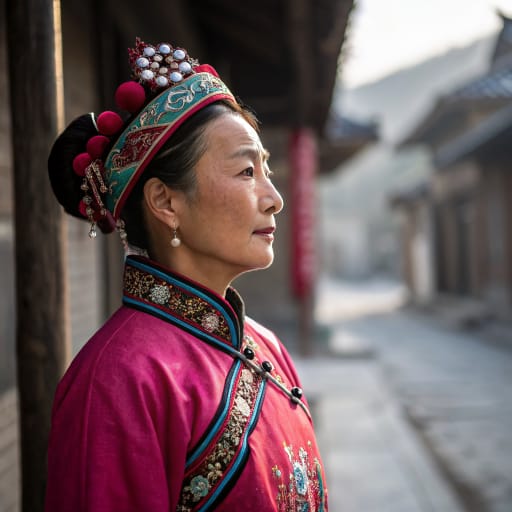
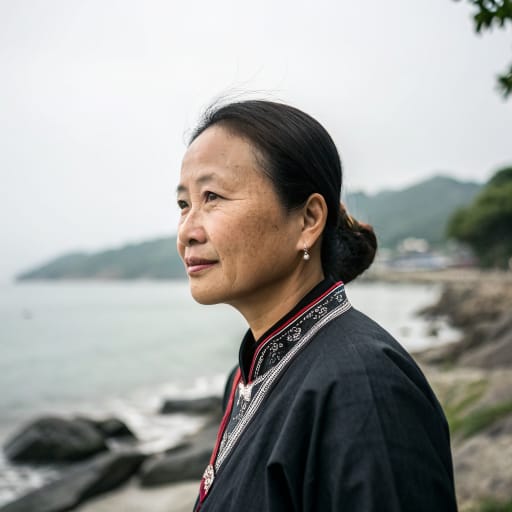
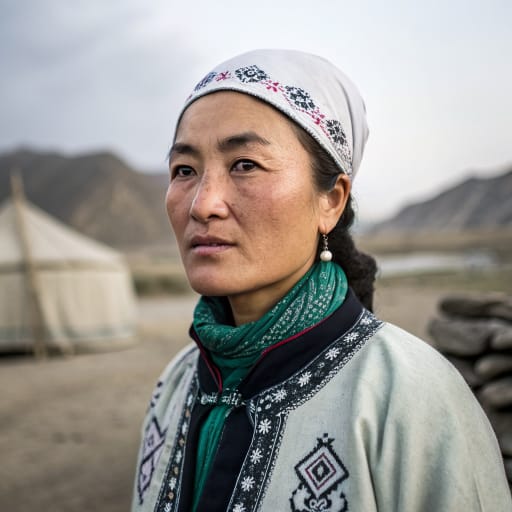

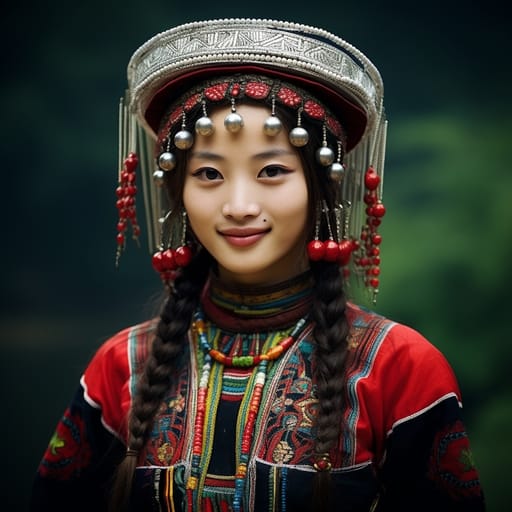
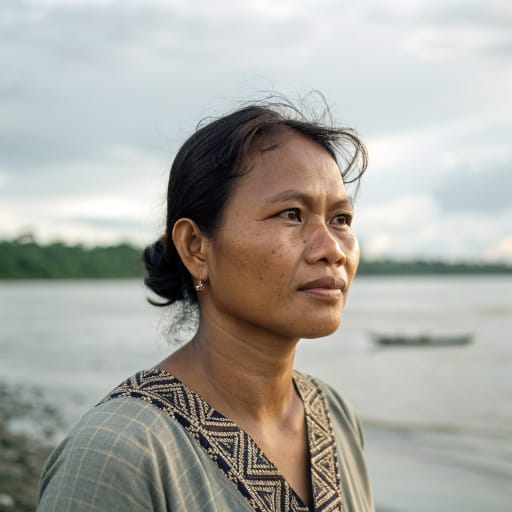
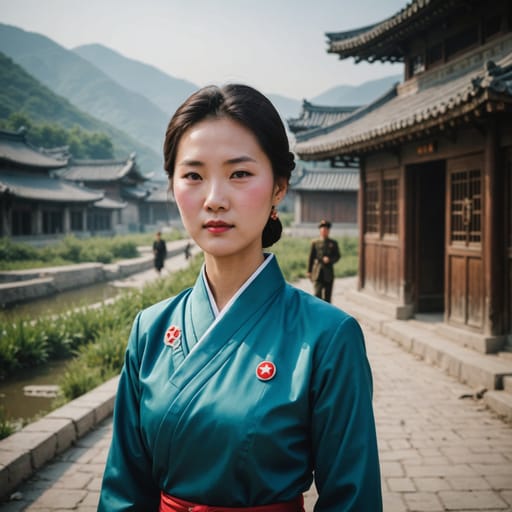
Typical Lopnurs Phenotypes
Reference for AI generation: hair, eyes, skin, facial structure, build
Lopnurs Body & Anatomy Reference
Per-feature anatomical profile for AI nude generation: East Asian Sinitic / Mongoloid phenotype
Lopnurs Boobs & Breasts
The typical Lopnurs bust is small-to-medium cup, modest projection, in line with the wider East Asian Sinitic / Mongoloid pattern. Areolas usually fall in the 26-36mm range, with light-pink to medium-brown areolar pigmentation against the light-to-medium skin tone. Compared with the fuller South Asian or Levantine bust profile, Lopnurs breasts sit forward and are generally firm and modestly projecting; smaller cup size than the South Asian or Western Asian average. A faithful AI render of Lopnurs tits keeps that shape and areola size.
Lopnurs Ass & Hips
Butt shape among Lopnurs women: small-to-medium, modest projection, narrower hip profile, over narrower iliac crests, less gluteal-femoral fat deposition. This follows East Asian Sinitic / Mongoloid ancestry and looks quite unlike the fuller projected glutes of the West African or Polynesian phenotype. An accurate Lopnurs ass in adult AI imagery keeps both the silhouette and the overall build (ectomorph-to-mesomorph, lean frame) instead of a generic average.
Lopnurs Vagina & Pussy
Vulvar anatomy among Lopnurs women: light-pink to medium-brown labial pigmentation, smaller labia minora. Pubic hair tends to be straight fine texture, sparser distribution than the South Asian norm, in the usual inverted-triangle pattern. Both follow East Asian Sinitic / Mongoloid pigmentation, which is why Lopnurs pussy renders should not fall back on a pale, sparse Western template.
Lopnurs Dicks & Penis
The Lopnurs cock profile, from East Asian Sinitic / Mongoloid anthropometric data: regional mean ~11-12cm erect; moderate girth; light-brown shaft pigmentation. Pubic hair has a straight fine texture and forms the usual inverted-V pattern. Whether Lopnurs men are circumcised follows religious and cultural practice rather than phenotype.
Lopnurs Body, Curves & Build
Build and curves among Lopnurs women follow the East Asian Sinitic / Mongoloid pattern: ectomorph-to-mesomorph, lean frame, mean adult female BMI 20-23. Proportions matter as much as skin tone, so Lopnurs figures should keep their regional height and limb ratios.
Lopnurs Skin Tone & Hair Texture
The Lopnurs skin range is light to medium (Fitzpatrick II-IV), and hair tends to be straight 1A, fine-to-medium, predominantly black. That combination marks the East Asian Sinitic / Mongoloid phenotype, and skin tone is the trait AI generators most often get wrong for Lopnurs women.
Explore phenotype categories
Structured taxonomy with peer-reviewed scales · 22 anatomical categories
Erotic Poses & Sex Positions
From the pose catalog: 219 named positions with reference skeletons
Frequently asked questions about Lopnurs people
Where is the Lopnurs homeland?
The Lopnurs homeland is Lower Tarim River and the former Lop Nur lake basin, now mainly Yuli (Lopnur) and Ruoqiang counties, Bayingolin Prefecture, Xinjiang, China in East Asia.
What language do Lopnurs people speak?
Lopnurs people primarily speak Lop dialect of Uyghur (Turkic, Karluk branch), with notable Kipchak features.
What religion do Lopnurs people practice?
The predominant religion among Lopnurs people is Sunni Islam.






Make your own Lopnurs images
Five a day, free, no credits to buy. The studio starts from this group's phenotype data, so you can set body type, pose and style and keep the traits accurate.
Start with Lopnurs