Help us get this right
Does this portrait look right for Ladins?
Nobody has judged this one yet. You would be the first.
Ladins Erotic
The Dolomite valleys around the Sella massif in northern Italy: Val Gardena and Val Badia (South Tyrol), Val di Fassa (Trentino), Livinallongo and Cortina d'Ampezzo (Belluno).
Ladin (Romance, Rhaeto-Romance branch); most also speak Italian, and German is widely spoken in South Tyrol.
Roman Catholic
Valley communities of Gherdëina (Gardena), Badia and Mareo, Fascia (Fassa), Fodom (Livinallongo) and Anpezo (Ampezzo); linguistically grouped with Romansh and Friulian speakers as Rhaeto-Romance.
About Ladins People
Ladins are the people who kept a Latin-born language alive in the high valleys of the Dolomites, with German to the north and Italian to the south. Their homeland, Ladinia, is a ring of valleys around the Sella massif. Gherdëina (Val Gardena) and Badia are in South Tyrol, Fascia (Val di Fassa) is in Trentino, and Fodom (Livinallongo) and Anpezo (Cortina d'Ampezzo) are in the province of Belluno. For centuries these valleys were part of Tyrol and the Habsburg world. In the First World War the front line ran across their own peaks, and Ladin men fought in Austrian uniform. Italy took the region after the war, and in the 1920s the Fascist state split Ladinia among three provinces. That split still decides how well the language is protected, and the answer can change from one side of a mountain pass to the other.
Ladin is a Rhaeto-Romance language, related to Romansh in Switzerland and to Friulian further east. Linguists have argued for more than a century about whether the three really form one family. Each valley has its own variety, and you can hear the differences within a short drive. The language is on its firmest legal footing in South Tyrol, where most Ladins grow up speaking three languages. Village schools in Gherdëina and Badia split lessons between German and Italian and teach Ladin as well. Protections are weaker in the other valleys and Italian dominates more, and the Ladin of Anpezo shows strong Venetian influence.
Nearly all Ladins are Roman Catholic, and the parish still shapes much of the year with feast days, processions and village bands in traditional dress. Hard mountain farming once pushed the valleys into crafts and trade. Gherdëina built a woodcarving industry making saints, altar figures and wooden toys, which peddlers carried across Europe. In Anpezo, groups of old local families called the Regole have owned and managed the forests and pastures together for centuries. In Badia, farmhouses sit in small clusters called viles, where neighbors shared ovens, fountains and work. The valleys also have their own cycle of legends about the Kingdom of Fanes, a lost mountain people said to have made a pact with the marmots.
Ski lifts and the Sella Ronda circuit have turned these old farming valleys into some of the busiest mountain resorts in Europe. That brings money, and also heavy pressure on a language with only a few tens of thousands of speakers. Ladins have pushed back with cultural institutes, a weekly newspaper, La Usc di Ladins, and families who still speak Ladin at home.
Related ethnic groups
Groups that share Ladins's homeland, region, language, or religious tradition. These are likely candidates for comparative phenotype reference.
Molise Croats
same region (Southern Europe)
Gottscheers
same region (Southern Europe)
Arbanasi
same region (Southern Europe)
Pasiegos
same region (Southern Europe)
Belli
same region (Southern Europe)
Picentes
same region (Southern Europe)
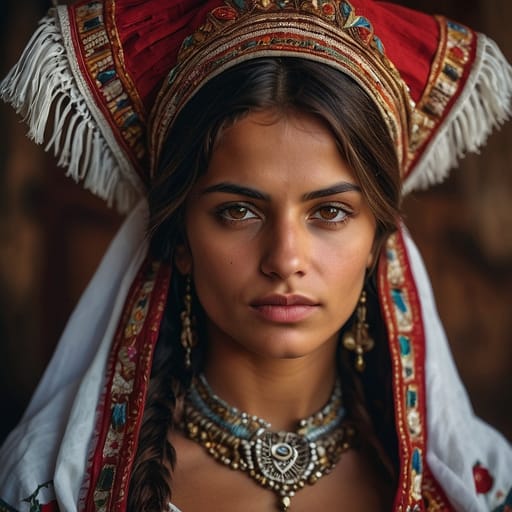
Romani European
same region (Southern Europe)
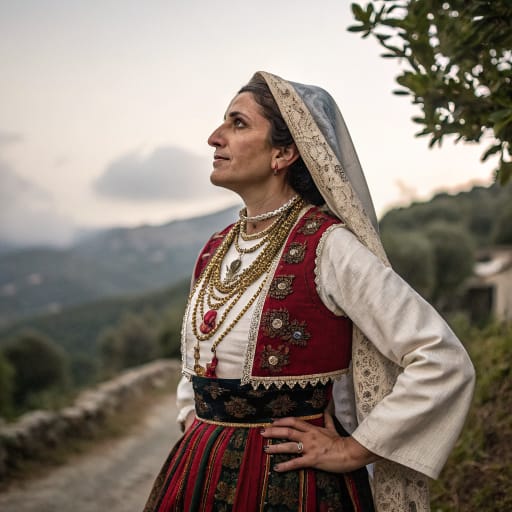
Arbëreshë
same region (Southern Europe)
Typical Ladins Phenotypes
Reference for AI generation: hair, eyes, skin, facial structure, build
Ladins Body & Anatomy Reference
Per-feature anatomical profile for AI nude generation: Southern European / Mediterranean phenotype
Ladins Boobs & Breasts
The typical Ladins bust is medium-to-large cup, full, moderate-to-high projection, in line with the wider Southern European / Mediterranean pattern. Areolas usually fall in the 32-46mm range, with medium-brown to dark-brown areolar pigmentation against the olive-to-light-brown skin tone. Compared with the lighter pigmentation of the Northern European bust, Ladins breasts sit forward and are generally full and projecting, generally the classic Mediterranean curvy bust profile. A faithful AI render of Ladins tits keeps that shape and areola size.
Ladins Ass & Hips
Butt shape among Ladins women: medium-to-full, moderate-to-high projection, broader hip profile, over medium-to-wide iliac crests, full gluteal-femoral fat distribution. This follows Southern European / Mediterranean ancestry and looks quite unlike the slim Northern European narrow-hip pattern. An accurate Ladins ass in adult AI imagery keeps both the silhouette and the overall build (mesomorph with full hip-and-bust deposition) instead of a generic average.
Ladins Vagina & Pussy
Vulvar anatomy among Ladins women: medium-brown to dark-brown labial pigmentation, fuller labia minora. Pubic hair tends to be wavy-to-curly medium-coarse dark texture, dense distribution, in the usual inverted-triangle pattern. Both follow Southern European / Mediterranean pigmentation, which is why Ladins pussy renders should not fall back on a pale, sparse Western template.
Ladins Dicks & Penis
The Ladins cock profile, from Southern European / Mediterranean anthropometric data: regional mean ~13-14cm erect; moderate girth; medium-brown shaft pigmentation. Pubic hair has a wavy-to-curly medium-coarse dark texture and forms the usual inverted-V pattern. Whether Ladins men are circumcised follows religious and cultural practice rather than phenotype.
Ladins Body, Curves & Build
Build and curves among Ladins women follow the Southern European / Mediterranean pattern: mesomorph with full hip-and-bust deposition, mean adult female BMI 24-28. Proportions matter as much as skin tone, so Ladins figures should keep their regional height and limb ratios.
Ladins Skin Tone & Hair Texture
The Ladins skin range is olive to medium (Fitzpatrick III-IV), and hair tends to be wavy-to-curly 2B-3B, dark-brown to black. That combination marks the Southern European / Mediterranean phenotype, and skin tone is the trait AI generators most often get wrong for Ladins women.
Explore phenotype categories
Structured taxonomy with peer-reviewed scales · 22 anatomical categories
Erotic Poses & Sex Positions
From the pose catalog: 219 named positions with reference skeletons
Frequently asked questions about Ladins people
Where is the Ladins homeland?
The Ladins homeland is The Dolomite valleys around the Sella massif in northern Italy: Val Gardena and Val Badia (South Tyrol), Val di Fassa (Trentino), Livinallongo and Cortina d'Ampezzo (Belluno). in Southern Europe.
What language do Ladins people speak?
Ladins people primarily speak Ladin (Romance, Rhaeto-Romance branch); most also speak Italian, and German is widely spoken in South Tyrol..
What religion do Ladins people practice?
The predominant religion among Ladins people is Roman Catholic.






Make your own Ladins images
Five a day, free, no credits to buy. The studio starts from this group's phenotype data, so you can set body type, pose and style and keep the traits accurate.
Start with Ladins