Help us get this right
Does this portrait look right for Kumo Xi?
Nobody has judged this one yet. You would be the first.
Kumo Xi Erotic
The Xar Moron and Laoha river basins of present-day eastern Inner Mongolia, western Liaoning, and northern Hebei, China
Kumo Xi, an unrecorded language close to Khitan (Para-Mongolic, Serbi-Mongolic)
Shamanism with sky and ancestor worship; Buddhism arriving late under Liao rule
Descended from the Wuhuan branch of the Donghu; organized in five tribes; sister people to the Khitan and later the Xi Six Divisions of the Liao
About Kumo Xi People
The Kumo Xi were a Mongolic-speaking people of the wooded uplands of what is now northeastern China, present in the record from 207 to 907 AD and then absorbed into the Khitan state that replaced them. Chinese chroniclers almost never write about them alone. It is nearly always the Xi and the Khitan, two halves of one frontier problem, and that pairing is the truest thing about them: the two came out of the same collapse, spoke closely related languages, and spent seven centuries as neighbors until the larger one swallowed the smaller. Their beginning is a defeat. The Wuhuan chief Tadun was killed by Cao Cao's cavalry in 207, and the survivors reassembled under Yuwen Xianbei overlordship. The group that emerged took the name Kumo Xi, and parted from the Khitan for good after the Northern Wei shattered the Yuwen in 388. Their country was the Xar Moron and Laoha river basins, hills and larch forest more than open grassland, and it made them mountain herders and hunters as much as steppe riders. Five tribes, chiefs raised by agreement, tribute paid south when the dynasty there looked strong and raids sent when it did not. The Tang enrolled them as the Raole Protectorate and handed their leaders the imperial surname Li. Turkic stonecutters on the Orkhon called them the Tatabi and listed them among enemies worth naming.
They kept the older northern religion of sky and ancestors and shamans, and took on Buddhism late and secondhand, through the Liao. Two things they made outlived them. The Xi cart was the best wagon on the northern frontier, sturdy enough that Liao officials specified it by name. And Song writers describe the xiqin, a two-stringed fiddle, as an instrument of the Xi. By that account it stands at the head of the huqin family that produced the erhu, so the name survives in the root of an instrument heard everywhere in China today. The end came from their sibling. Abaoji brought them under Khitan authority around 911, and the Liao governed them as a distinct population with their own king and their own six divisions, which is a dignified way of saying conquered. One last attempt at independence came in 1123, when a Xi commander named Xiao Gan declared a state of his own as the Liao collapsed. It lasted months. After that the Xi dissolve into the Jurchen, Mongol, and Chinese populations around them, leaving no living community that carries the name.
Related ethnic groups
Groups that share Kumo Xi's homeland, region, language, or religious tradition. These are likely candidates for comparative phenotype reference.

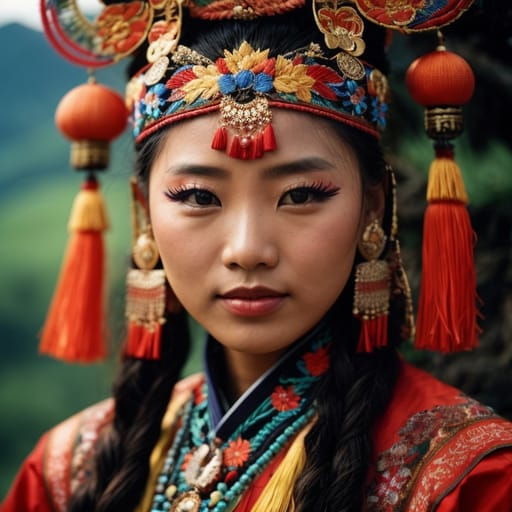
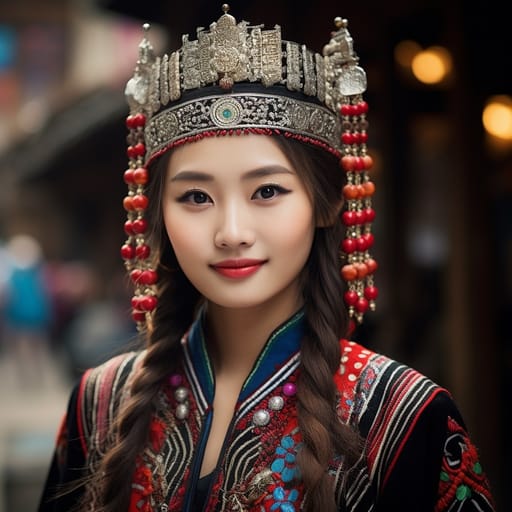


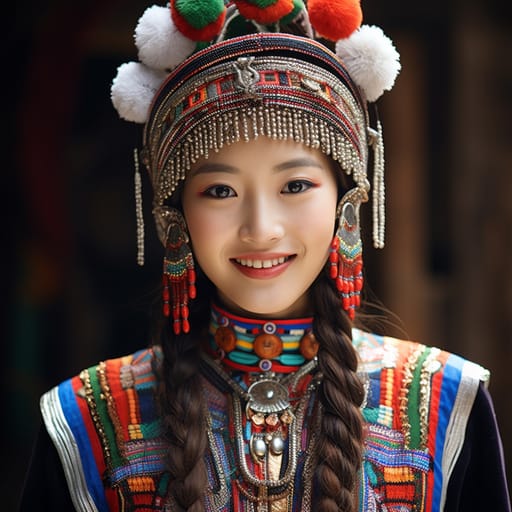
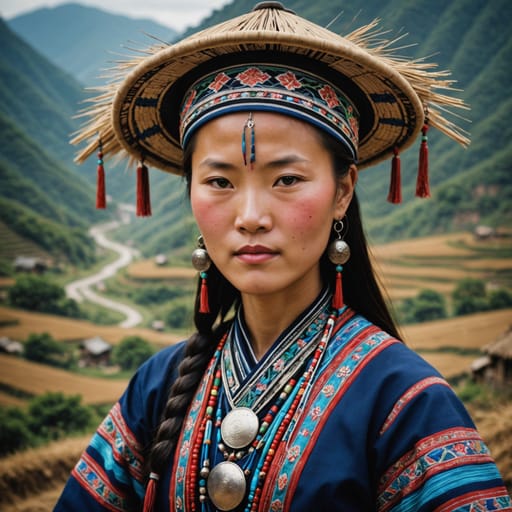
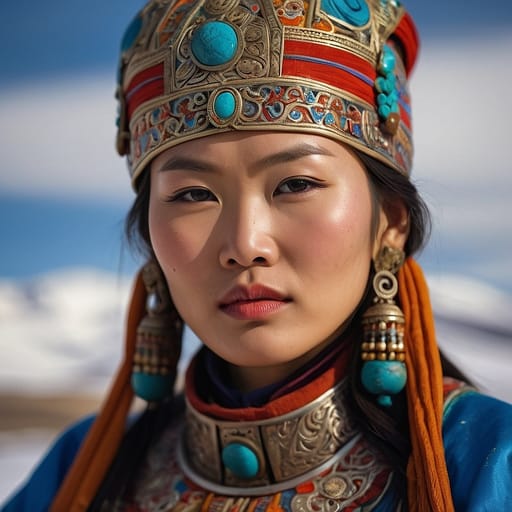
Typical Kumo Xi Phenotypes
Reference for AI generation: hair, eyes, skin, facial structure, build
Kumo Xi Body & Anatomy Reference
Per-feature anatomical profile for AI nude generation: East Asian Sinitic / Mongoloid phenotype
Kumo Xi Boobs & Breasts
Bust reference for Kumo Xi women: small-to-medium cup, modest projection, which is typical of East Asian Sinitic / Mongoloid ancestry. Areolas measure about 26-36mm across, with light-pink to medium-brown pigmentation. Body type (ectomorph-to-mesomorph, lean frame) shapes the bust as well, so Kumo Xi tits are usually firm and modestly projecting; smaller cup size than the South Asian or Western Asian average. In AI imagery, keep the forward-set shape rather than drifting toward the fuller South Asian or Levantine bust profile.
Kumo Xi Ass & Hips
The Kumo Xi ass is typically small-to-medium, modest projection, narrower hip profile, which sets it apart from the fuller projected glutes of the West African or Polynesian phenotype. Underneath, the pelvis shows narrower iliac crests, less gluteal-femoral fat deposition, part of the East Asian Sinitic / Mongoloid skeletal pattern. For Kumo Xi butt pics and AI renders, match that silhouette and the overall build (ectomorph-to-mesomorph, lean frame).
Kumo Xi Vagina & Pussy
Kumo Xi pussy and vulvar anatomy presents light-pink to medium-brown labial pigmentation, smaller labia minora, consistent with the East Asian Sinitic / Mongoloid phenotype's pigmentation pattern. Kumo Xi pubic hair is typically straight fine texture, sparser distribution than the South Asian norm, in the inverted-triangle pattern. For anatomically accurate Kumo Xi pussy renders the labial coloration should match the surrounding light to medium skin tone with a continuous gradient, and the hair should keep its straight fine texture.
Kumo Xi Dicks & Penis
Kumo Xi dicks follow the East Asian Sinitic / Mongoloid reference data: regional mean ~11-12cm erect; moderate girth; light-brown shaft pigmentation. Shaft color should track the light to medium skin tone with a smooth change toward the glans, and Kumo Xi pubic hair keeps its straight fine texture.
Kumo Xi Body, Curves & Build
Kumo Xi body type and overall build presents as ectomorph-to-mesomorph, lean frame, with mean adult female BMI 20-23: the characteristic East Asian Sinitic / Mongoloid habitus. Kumo Xi curves and proportions should keep the regional skeletal frame (height, shoulder-to-hip ratio, limb proportions) rather than a generic mesomorph default.
Kumo Xi Skin Tone & Hair Texture
Kumo Xi skin sits in the light to medium (Fitzpatrick II-IV) band. Hair is typically straight 1A, fine-to-medium, predominantly black, in keeping with the East Asian Sinitic / Mongoloid phenotype. In nude renders the skin should stay one even tone from face to body, and body, pubic and head hair should match.
Explore phenotype categories
Structured taxonomy with peer-reviewed scales · 22 anatomical categories
Erotic Poses & Sex Positions
From the pose catalog: 219 named positions with reference skeletons
Frequently asked questions about Kumo Xi people
Where is the Kumo Xi homeland?
The Kumo Xi homeland is The Xar Moron and Laoha river basins of present-day eastern Inner Mongolia, western Liaoning, and northern Hebei, China in East Asia.
What language do Kumo Xi people speak?
Kumo Xi people primarily speak Kumo Xi, an unrecorded language close to Khitan (Para-Mongolic, Serbi-Mongolic).
What religion do Kumo Xi people practice?
The predominant religion among Kumo Xi people is Shamanism with sky and ancestor worship; Buddhism arriving late under Liao rule.






Make your own Kumo Xi images
Five a day, free, no credits to buy. The studio starts from this group's phenotype data, so you can set body type, pose and style and keep the traits accurate.
Start with Kumo Xi