Help us get this right
Does this portrait look right for Keliko?
Nobody has judged this one yet. You would be the first.
Keliko Erotic
Southwestern Central Equatoria around Yei, South Sudan, and neighboring Aru Territory in Ituri, DR Congo; large refugee communities in northwestern Uganda
Keliko (Central Sudanic, Moru-Madi branch); many also speak Juba Arabic, English, Swahili, or Lingala
Predominantly Christian (Catholic and Protestant), with some ancestral and clan-based traditional practices
Moru-Madi branch of the Central Sudanic peoples, closely related to the Lugbara and Logo
About Keliko People
The Keliko are a border people in the most literal sense. Their homeland lies along the Congo-Nile watershed, the high ground that later became the frontier between Sudan and the Belgian Congo. So one community now has kin in South Sudan and in the Democratic Republic of the Congo, and after decades of war, in the refugee settlements of northwestern Uganda. What holds them together is not a flag. It is a language, a web of clans, and a shared sense of where home is.
Keliko belongs to the Moru-Madi branch of the Central Sudanic languages. Its closest relatives are Logo and Lugbara, spoken just across the borders. The Kakwa, who share the country around Yei with them, speak a Nilotic language from another family altogether. Like the other languages in its group, Keliko is tonal: pitch alone can tell one word from another. Most adults also speak a trade language. Juba Arabic and English do much of the public work on the South Sudanese side, and Swahili and Lingala do it on the Congolese side.
Most Keliko are Christian, either Catholic or Protestant, and Sunday services, choirs, and church weddings set the rhythm of the social calendar. Older beliefs have not so much disappeared as settled into specific moments. Respect for ancestors and the word of clan elders still count at burials, in settling disputes, and in marriage negotiations. In those talks, descent through the father decides who owes what to whom.
Daily life is built on farming. The country around Yei is some of the most fertile land in South Sudan. Keliko households grow cassava, sorghum, groundnuts, beans, and sesame, and they trade across borders that local people cross as a matter of routine. The same location has left them exposed again and again. Both Sudanese civil wars pushed Keliko families into Uganda and Congo, and the fighting that swept the Yei area from 2016 drove whole communities out once more. A generation has now grown up in the settlements, and much of Keliko life plays out in the space between those camps and the fields their parents left behind.
Related ethnic groups
Groups that share Keliko's homeland, region, language, or religious tradition. These are likely candidates for comparative phenotype reference.
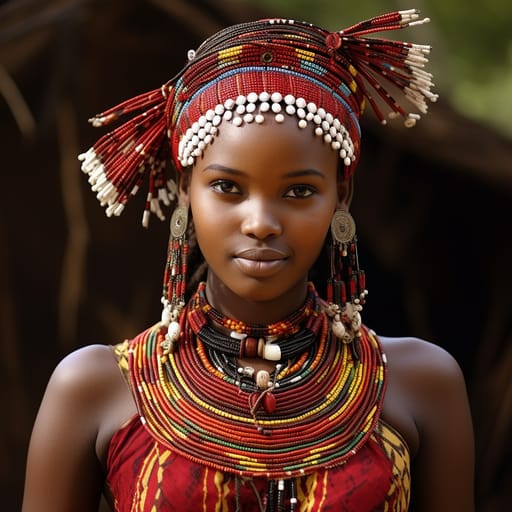
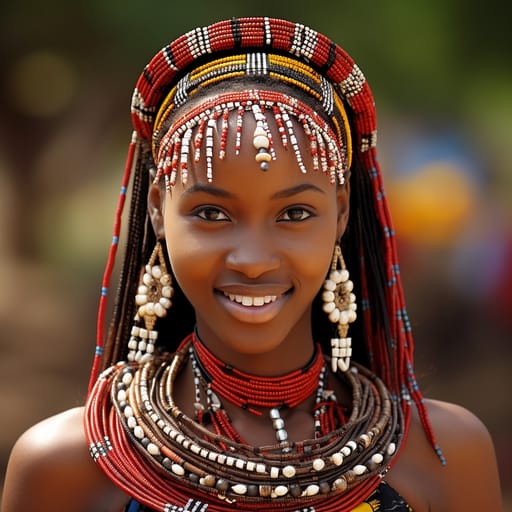
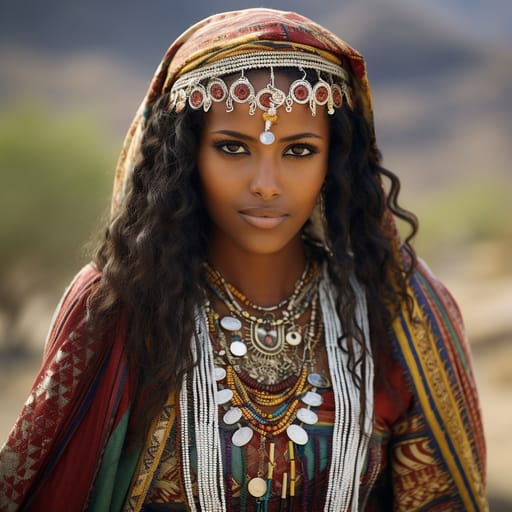
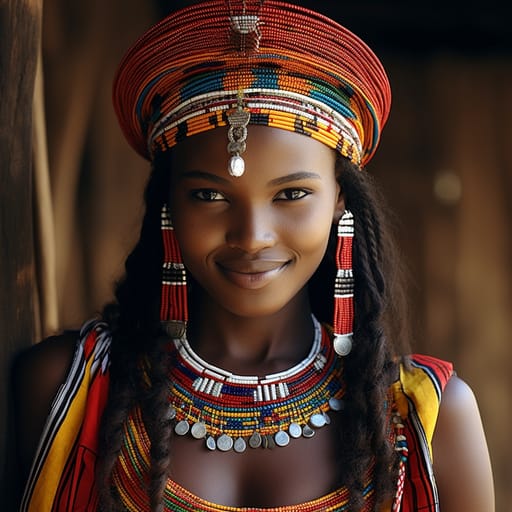
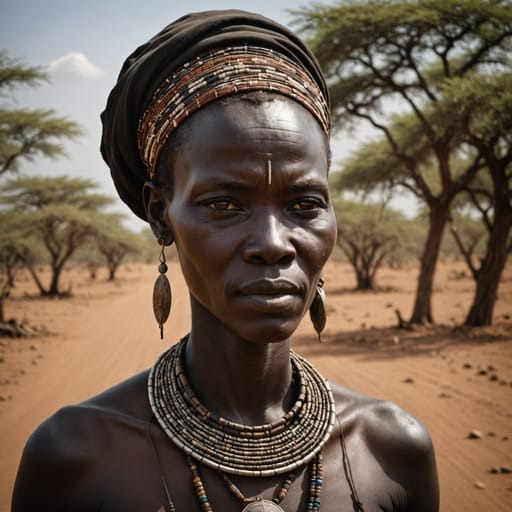
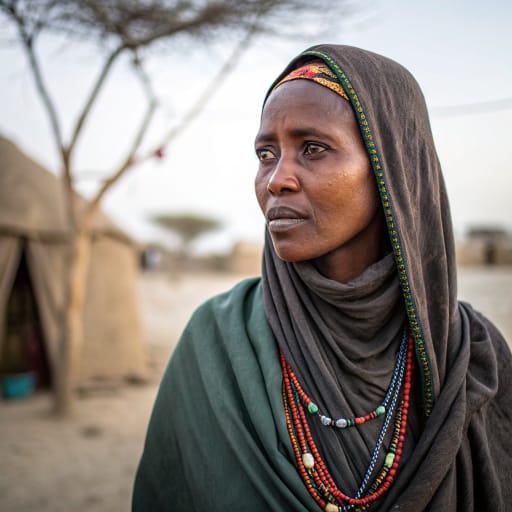
Typical Keliko Phenotypes
Reference for AI generation: hair, eyes, skin, facial structure, build
Keliko Body & Anatomy Reference
Cushitic / Nilo-Cushitic East African phenotype: anatomy reference for AI nude generation
Keliko Boobs & Breasts
Bust reference for Keliko women: small-to-medium-cup, high-set, conical, which is typical of Cushitic / Nilo-Cushitic East African ancestry. Areolas measure about 28-38mm across, with moderate-to-high pigmentation. Body type (lean ectomorph-to-mesomorph) shapes the bust as well, so Keliko tits are usually firmer and less projecting than the African-American or West African norm. In AI imagery, keep the forward-set shape rather than drifting toward the lateral spread of the West African phenotype.
Keliko Ass & Hips
The Keliko ass is typically small-to-medium, high-set, rounded, which sets it apart from the wide-set heavy-projection West African or African-American norm. Underneath, the pelvis shows narrow-to-medium iliac crests, longer torso-to-leg ratio, part of the Cushitic / Nilo-Cushitic East African skeletal pattern. For Keliko butt pics and AI renders, match that silhouette and the overall build (lean ectomorph-to-mesomorph).
Keliko Vagina & Pussy
Keliko pussy and vulvar anatomy presents brown-to-deep-brown labial pigmentation, narrow-to-medium labia minora projection, consistent with the Cushitic / Nilo-Cushitic East African phenotype's pigmentation pattern. Keliko pubic hair is typically tightly-coiled coarse texture, densely distributed, in the inverted-triangle pattern. For anatomically accurate Keliko pussy renders the labial coloration should match the surrounding brown to deep brown skin tone with a continuous gradient, and the hair should keep its tightly-coiled coarse texture.
Keliko Dicks & Penis
Keliko dicks follow the Cushitic / Nilo-Cushitic East African reference data: regional mean ~13.5cm erect; moderate girth, ~12cm circumference; deeper-pigmented than the West African norm. Shaft color should track the brown to deep brown skin tone with a smooth change toward the glans, and Keliko pubic hair keeps its tightly-coiled coarse texture.
Keliko Body, Curves & Build
Keliko body type and overall build presents as lean ectomorph-to-mesomorph, with mean adult female BMI 19-22: the characteristic Cushitic / Nilo-Cushitic East African habitus. Keliko curves and proportions should keep the regional skeletal frame (height, shoulder-to-hip ratio, limb proportions) rather than a generic mesomorph default.
Keliko Skin Tone & Hair Texture
Keliko skin sits in the brown to deep brown (Fitzpatrick V-VI) band. Hair is typically tight 4A-4C coil, often worn natural or in braided/twisted protective styles, in keeping with the Cushitic / Nilo-Cushitic East African phenotype. In nude renders the skin should stay one even tone from face to body, and body, pubic and head hair should match.
Explore phenotype categories
Structured taxonomy with peer-reviewed scales · 22 anatomical categories
Erotic Poses & Sex Positions
From the pose catalog: 219 named positions with reference skeletons
Frequently asked questions about Keliko people
Where is the Keliko homeland?
The Keliko homeland is Southwestern Central Equatoria around Yei, South Sudan, and neighboring Aru Territory in Ituri, DR Congo; large refugee communities in northwestern Uganda in Eastern Africa.
What language do Keliko people speak?
Keliko people primarily speak Keliko (Central Sudanic, Moru-Madi branch); many also speak Juba Arabic, English, Swahili, or Lingala.
What religion do Keliko people practice?
The predominant religion among Keliko people is Predominantly Christian (Catholic and Protestant), with some ancestral and clan-based traditional practices.






Make your own Keliko images
Five a day, free, no credits to buy. The studio starts from this group's phenotype data, so you can set body type, pose and style and keep the traits accurate.
Start with Keliko