- Home/
- World/
- Eastern Africa/
- Shambaa
Shambaa Erotic
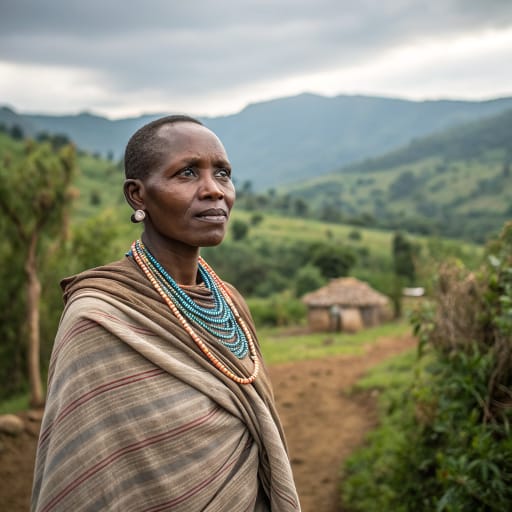
The Usambara Mountains of northeastern Tanzania, chiefly Lushoto and Korogwe districts in Tanga Region, with lowland settlement toward Mombo and the Mkomazi plains.
Shambala, also called Kishambaa or Sambaa (Bantu, Northeast Coast group, Niger-Congo); Swahili is near universal as a second language.
Predominantly Christian, Lutheran above all, with a Muslim minority and continuing ancestral and rainmaking practice.
Northeast Coast Bantu, closely related to the Bondei and Zigua; internally divided between the Kilindi royal lineage and commoner clans, with regional groupings around Vugha, Bumbuli and Mlalo.
About Shambaa People
The Shambaa gave their name to the mountains they farm. Usambara is their country, and for most of their recorded history the Shambaa have been the people who chose to live on a cold, wet, nearly vertical block of rock while the plains below stayed hot and thin. The Usambaras belong to the Eastern Arc, an ancient chain that has been catching rain off the Indian Ocean for millions of years, and the reward for the difficult ground is soil that grows almost anything: bananas, maize, beans, cardamom, tea, and the vegetables that now go down the escarpment by truck to Tanga and Dar es Salaam. Shambaa farming is terraced, intensive, and endlessly argued over, since a household's holding is measured in slope as much as in area. Their language, Kishambaa, sits in the Northeast Coast branch of Bantu, close enough to Bondei and Zigua that speakers manage across the boundary without much trouble, while the mountain itself has kept the speech of Vugha, Bumbuli and Mlalo distinct from one another.
Shambaa political history turns on a single idea: a ruler either heals the land or ruins it. The kingdom traces to Mbegha, a hunter and an outsider who in the traditions arrived from the west, killed the bush pigs wrecking the crops, gave the meat away, and was made king at Vugha. His descendants, the Kilindi, governed through sons installed as chiefs in outlying towns. Kimweri ye Nyumbai held the largest version of that kingdom in the first half of the 1800s, from the ridges down toward the coast, and received the missionary Johann Ludwig Krapf at his capital in 1848. After his death the succession split the Kilindi, and the wars that followed left the kingdom weak enough for German East Africa to absorb it in the 1890s. Running underneath all of it was the political vocabulary the historian Steven Feierman documented among Shambaa farmers: a good ruler heals the land, meaning rain falls, crops set and children are born, while a bad one harms it, and drought is evidence for the prosecution. Rainmaking was the central royal skill and the central royal liability. Something of that logic survives in the mshitu, patches of forest left uncut above villages for rain and for the ancestors, which is part of why these ridges still carry old growth the lowlands lost. Most Shambaa today are Christian, Lutheran above all, a legacy of the German Bethel mission at Lushoto and Mlalo, with a Muslim minority inherited from the caravan trade. Neither displaced the older rites entirely.
Related ethnic groups
Groups that share Shambaa's homeland, region, language, or religious tradition — likely candidates for comparative phenotype reference.
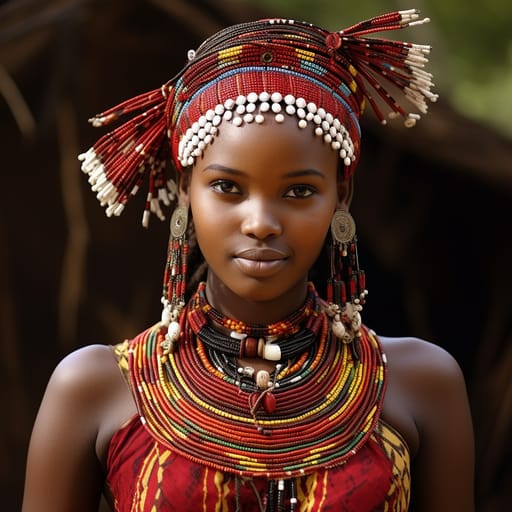
Typical Shambaa Phenotypes
Reference for AI generation — hair, eyes, skin, facial structure, build
Shambaa Body & Anatomy Reference
Per-feature anatomical profile for AI nude generation — Cushitic / Nilo-Cushitic East African phenotype
Shambaa Boobs & Breasts
Shambaa tits and boobs run small-to-medium-cup, high-set, conical — the classic Cushitic / Nilo-Cushitic East African bust profile. Shambaa nipples and areolas show moderate-to-high areolar pigmentation against the brown-to-deep-brown skin tone, with areolar diameter typically in the 28-38mm range and forward-set positioning rather than the lateral spread of the West African phenotype. Shambaa breasts trend firmer and less projecting than the African-American or West African norm, a function of the lean ectomorph-to-mesomorph body habitus and the mean adult female BMI 19-22. For anatomically-accurate AI-generated Shambaa nudes the render preserves: small-to-medium-cup, high-set, conical shape, 28-38mm areolas with moderate-to-high pigmentation, and the torso proportions of the Cushitic / Nilo-Cushitic East African phenotype.
Shambaa Ass & Hips
Shambaa ass and hip morphology presents as small-to-medium, high-set, rounded — distinctly different from the wide-set heavy-projection West African or African-American norm. The Shambaa pelvic profile shows narrow-to-medium iliac crests, longer torso-to-leg ratio, anchored in the Cushitic / Nilo-Cushitic East African skeletal pattern. Shambaa butt shots in adult AI imagery should render the small-to-medium, high-set, rounded silhouette with the lean ectomorph-to-mesomorph build and the gluteal-femoral fat distribution typical of the Cushitic / Nilo-Cushitic East African phenotype rather than defaulting to a globally-averaged "ethnic" butt that generic AI generators produce. The hip-to-waist ratio characteristic of Shambaa women is one of the identifying features of the Cushitic / Nilo-Cushitic East African regional phenotype.
Shambaa Vagina & Pussy
Shambaa pussy and vulvar anatomy presents brown-to-deep-brown labial pigmentation, narrow-to-medium labia minora projection — consistent with the Cushitic / Nilo-Cushitic East African phenotype's pigmentation pattern. Shambaa pubic hair is typically tightly-coiled coarse texture, densely distributed, distributed in the inverted-triangle pattern with regional-typical density. AI-generated Shambaa nude imagery should preserve the brown-to-deep-brown labial pigmentation and the tightly-coiled coarse texture hair texture rather than defaulting to a Western-European pink-and-sparse template. For anatomically-accurate Shambaa pussy renders the labial pigmentation and coloration should match the surrounding brown to deep brown skin tone of the Cushitic / Nilo-Cushitic East African phenotype, with continuous gradient rather than an abrupt color transition.
Shambaa Dicks & Penis
Shambaa dick and penile anatomy in adult AI generation should anchor on the regional reference data: regional mean ~13.5cm erect, moderate girth, ~12cm circumference, and deeper-pigmented than the West African norm. The Shambaa cock profile reflects the Cushitic / Nilo-Cushitic East African ancestral population's anthropometric measurements rather than a globally-averaged Western-pornography default. For anatomically-accurate Shambaa nude male imagery the shaft pigmentation should track the surrounding brown to deep brown skin tone, the glans-to-shaft pigmentation transition should be continuous, and the pubic hair pattern should match tightly-coiled coarse texture texture distributed in the typical inverted-V escutcheon. Circumcision status in Shambaa populations varies by religious-cultural tradition rather than ancestral phenotype.
Shambaa Body, Curves & Build
Shambaa body type and overall build presents as lean ectomorph-to-mesomorph, with mean adult female BMI 19-22 — the characteristic Cushitic / Nilo-Cushitic East African habitus. Shambaa curves and proportions in adult AI imagery should preserve the regional skeletal frame (height, shoulder-to-hip ratio, limb proportions) rather than scaling to a Western-European mesomorph default. The Shambaa nude female form, when rendered with anatomical fidelity, shows the height range, frame width, and adipose distribution pattern typical of the Cushitic / Nilo-Cushitic East African phenotype. Generic AI image generators tend to collapse regional body types into a few default shapes; the EthnicErotic phenotype-anchored approach preserves the Shambaa build as its own reference category.
Shambaa Skin Tone & Hair Texture
Shambaa skin tone falls in the brown to deep brown (Fitzpatrick V-VI) band — the surface signal most often miscalibrated by generic AI nude generators trained on Western-photographic datasets. Shambaa hair texture is typically tight 4A-4C coil, often worn natural or in braided/twisted protective styles, characteristic of the Cushitic / Nilo-Cushitic East African phenotype. For anatomically-accurate Shambaa nude renders the skin should hold the Fitzpatrick band consistently across body surface rather than showing the lighter-than-face body shading that AI generators default to. Shambaa hair pigmentation and texture on body, pubic, and head should match across the figure rather than mixing textures (a common AI artefact).
Explore phenotype categories
Structured taxonomy with peer-reviewed scales · 22 anatomical categories
Erotic Poses & Sex Positions
From the pose catalog — 219 named positions with reference skeletons
Frequently asked questions about Shambaa people
Where is the Shambaa homeland?
The Shambaa homeland is The Usambara Mountains of northeastern Tanzania, chiefly Lushoto and Korogwe districts in Tanga Region, with lowland settlement toward Mombo and the Mkomazi plains. in Eastern Africa.
What language do Shambaa people speak?
Shambaa people primarily speak Shambala, also called Kishambaa or Sambaa (Bantu, Northeast Coast group, Niger-Congo); Swahili is near universal as a second language..
What religion do Shambaa people practice?
The predominant religion among Shambaa people is Predominantly Christian, Lutheran above all, with a Muslim minority and continuing ancestral and rainmaking practice..

What does a typical Shambaa woman look like?
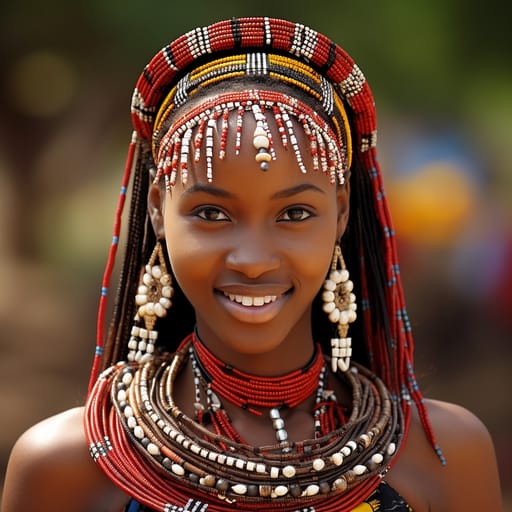
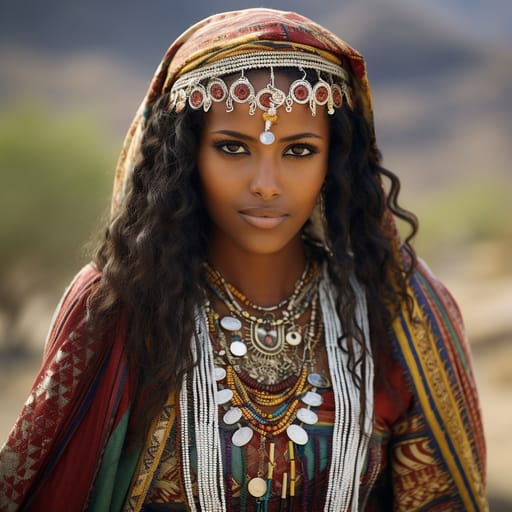
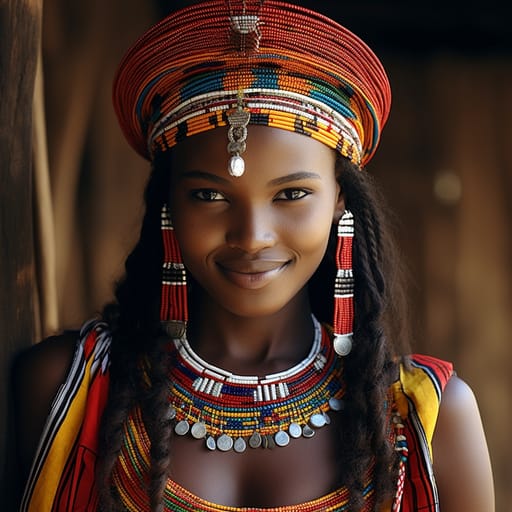
East African Bantu speakers, with brown to dark brown skin, tightly coiled hair, and medium to slender build. Everyday dress is ordinary Tanzanian clothing, with women in printed kanga and kitenge wraps, frequently two at once, and a headscarf or wrapped head cloth.
Make your own Shambaa images
Five a day, free, no credits to buy. The studio starts from this group's phenotype data, so you can set body type, pose and style and keep the traits accurate.
Start with Shambaa