Help us get this right
Does this portrait look right for Innu?
One tap. It takes a second and it is recorded.
2 say it looks right, 0 say it looks off.
Innu Erotic
Nitassinan: interior Quebec and Labrador, Canada
Innu-aimun / Montagnais-Naskapi (Algic, Algonquian)
Traditional beliefs (animism); Roman Catholicism
Montagnais and Naskapi
About Innu People
Innu are an Algonquian people of the eastern Subarctic whose homeland, Nitassinan, covers the interior and coast of the Quebec-Labrador peninsula in Canada. Historically called Montagnais in the south and Naskapi in the north, they speak Innu-aimun, part of the Cree-Montagnais-Naskapi continuum of the Algic family. They number around twenty thousand.
Society and subsistence
The Innu were mobile hunters of the boreal forest and the Labrador plateau, and above all hunters of caribou, supplemented by moose, beaver, waterfowl, fish, and berries. Small family groups ranged widely over the land through the long winter, traveling by canoe in summer and by snowshoe and toboggan in winter, and gathering in larger groups in warmer months. Life required deep knowledge of animals and weather, and hunting success carried spiritual weight: the drum, the shaking-tent rite, and respect for the master spirits of the animals framed the relationship between people and the land. Much Innu life was permanently reshaped in the twentieth century by settlement into fixed villages. Today most Innu live in about a dozen communities, the majority in Quebec along the north shore of the Gulf of St. Lawrence, with two communities, Sheshatshiu and Natuashish, in Labrador, where questions of land rights and self-government remain pressing.
Appearance and adornment
The Innu are renowned for their painted caribou-skin coats. Tailored from smoked hide, these coats were decorated by women with intricate red, yellow, and blue designs, double curves, geometric borders, and fine parallel lines, applied with bone tools and intended to please the caribou spirit and ensure the hunt. They were worn with leggings, moccasins, mittens, and pointed or peaked caps and hoods, often beaded. Snowshoes and tump-line packs were essential gear. Today the Innu wear modern clothing, and the painted coat survives as a treasured heritage art and a symbol of identity.
Related ethnic groups
Groups that share Innu's homeland, region, language, or religious tradition. These are likely candidates for comparative phenotype reference.
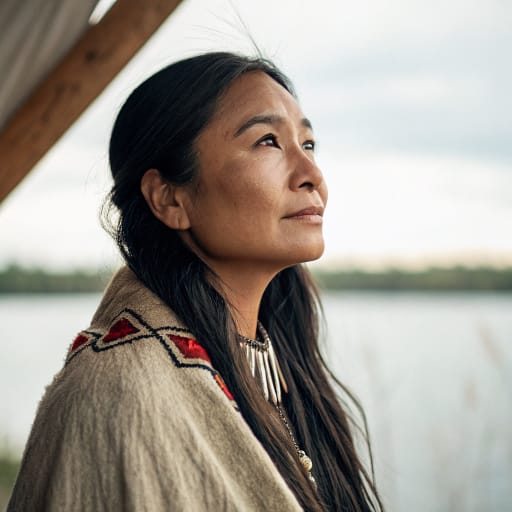
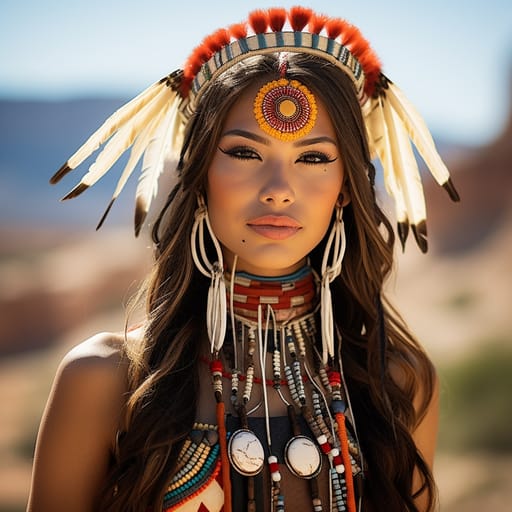
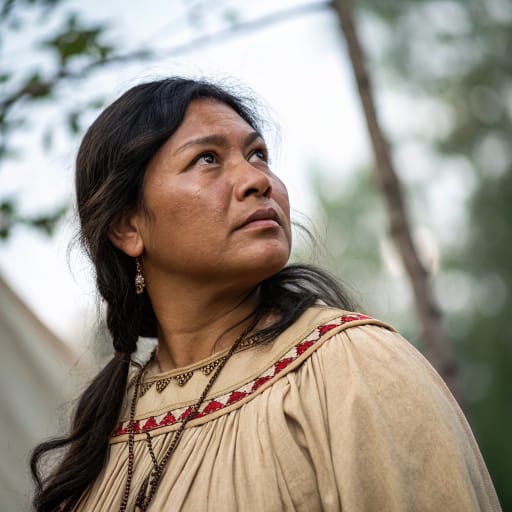
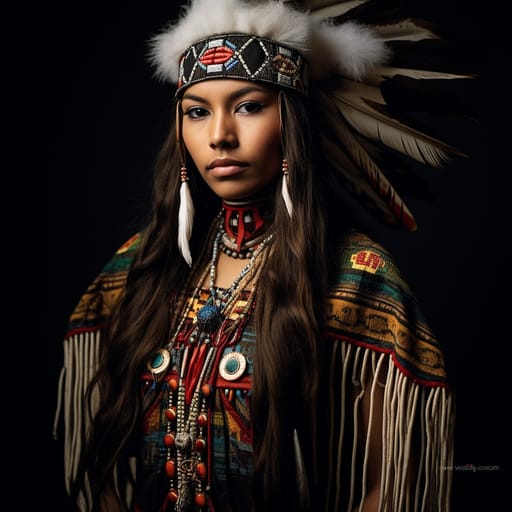
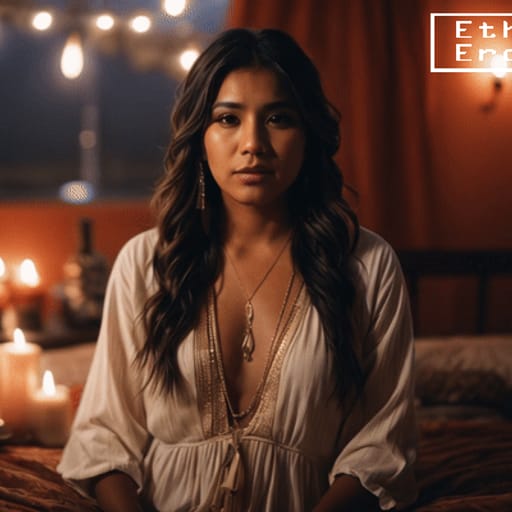
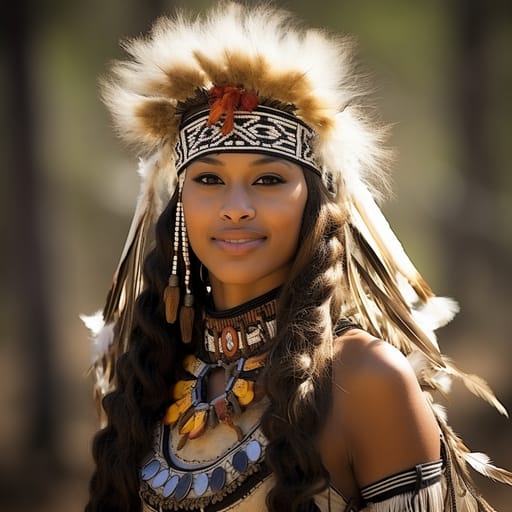
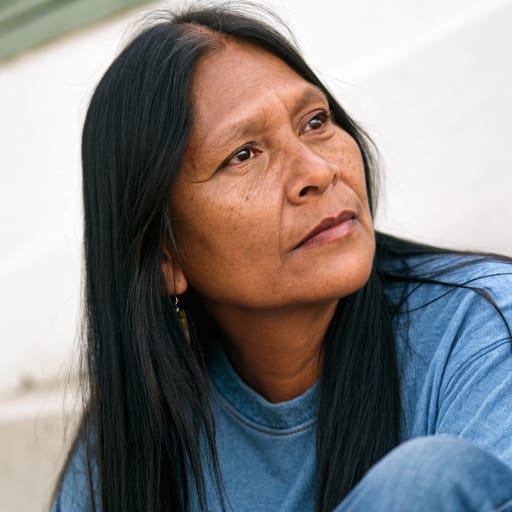
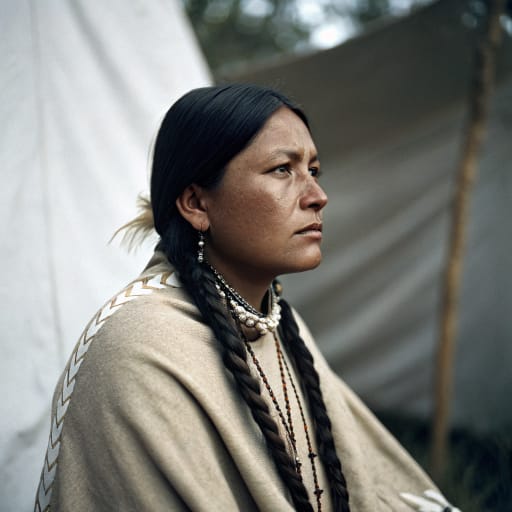
Typical Innu Phenotypes
Reference for AI generation: hair, eyes, skin, facial structure, build
Innu Body & Anatomy Reference
Indigenous Northern American / Algonquian-Iroquoian phenotype: anatomy reference for AI nude generation
Innu Boobs & Breasts
Innu tits and boobs run medium cup, moderate projection, the classic Indigenous Northern American / Algonquian-Iroquoian bust profile. Innu nipples and areolas show medium-brown areolar pigmentation against the copper-to-medium-brown skin tone, with areolar diameter typically in the 30-44mm range and forward-set positioning rather than the smaller East Asian bust. Innu breasts trend full and moderate projection, a function of the mesomorph, broader frame in northern Indigenous populations body habitus and the mean adult female BMI 25-28. For anatomically accurate AI-generated Innu nudes the render preserves the medium cup, moderate projection shape, 30-44mm areolas with medium-brown pigmentation, and the torso proportions of the Indigenous Northern American / Algonquian-Iroquoian phenotype.
Innu Ass & Hips
Innu hips and butt usually read as medium, moderate-to-full projection. The skeletal base is medium iliac crests, the Indigenous Northern American / Algonquian-Iroquoian pattern. Set against the slim East Asian narrow-hip profile, the difference is easy to see, and the hip-to-waist ratio is often what identifies Innu women in photos.
Innu Vagina & Pussy
Expect medium-brown labial pigmentation on Innu women, in keeping with Indigenous Northern American / Algonquian-Iroquoian ancestry. The pubic hair is straight medium-coarse texture. Coloring should run evenly from the copper to medium-brown skin of the thighs to the labia, and Innu nude imagery should keep the hair's straight medium-coarse texture.
Innu Dicks & Penis
Innu dick and penile anatomy in adult AI generation should anchor on the regional reference data: regional mean ~13cm erect, moderate girth, and medium-brown shaft pigmentation. The Innu cock profile reflects the Indigenous Northern American / Algonquian-Iroquoian population's anthropometric measurements. The shaft pigmentation should track the surrounding copper to medium-brown skin tone, and the pubic hair should keep its straight medium-coarse texture in the typical inverted-V escutcheon.
Innu Body, Curves & Build
Innu body type: mesomorph, broader frame in northern Indigenous populations, with mean adult female BMI 25-28. This is the typical Indigenous Northern American / Algonquian-Iroquoian build. Height range, shoulder-to-hip ratio and fat distribution all follow from it, which is what an accurate Innu nude body should show.
Innu Skin Tone & Hair Texture
Innu skin tone falls in the copper to medium-brown (Fitzpatrick III-V) band, the surface signal most often miscalibrated by generic AI nude generators. Innu hair texture is typically straight 1A, dark-brown to black, often thick and dense, characteristic of the Indigenous Northern American / Algonquian-Iroquoian phenotype. In Innu nude renders the skin should hold that band consistently across the body.
Explore phenotype categories
Structured taxonomy with peer-reviewed scales · 22 anatomical categories
Notable Innu People
14 reference figures, sourced from Wikipedia
- Jani Bellefleur-Kaltush, filmmaker
- Bernard Cleary, politician
- Jonathan Genest-Jourdain, politician
- Michel Jean, journalist and writer
- Jean-Luc Kanapé, conservationist and actor
- Kanen, musician
- Matiu, musician
- Claude McKenzie, musician (Kashtin)
- Geneviève McKenzie-Sioui, musician
- Peter Penashue, politician
- Scott-Pien Picard, musician
- Laurie Rousseau-Nepton, astrophysicist
- Shauit, musician
- Florent Vollant, musician (Kashtin)
Erotic Poses & Sex Positions
From the pose catalog: 219 named positions with reference skeletons
Frequently asked questions about Innu people
Where is the Innu homeland?
The Innu homeland is Nitassinan: interior Quebec and Labrador, Canada in North America.
What language do Innu people speak?
Innu people primarily speak Innu-aimun / Montagnais-Naskapi (Algic, Algonquian).
What religion do Innu people practice?
The predominant religion among Innu people is Traditional beliefs (animism); Roman Catholicism.






Make your own Innu images
Five a day, free, no credits to buy. The studio starts from this group's phenotype data, so you can set body type, pose and style and keep the traits accurate.
Start with Innu