Help us get this right
Does this portrait look right for Aleuts?
Nobody has judged this one yet. You would be the first.
Aleuts Erotic
Aleutian Islands, Pribilof Islands and the western Alaska Peninsula, Alaska, United States; Commander Islands, Kamchatka Krai, Russia
Unangam Tunuu, also called Aleut, in Eastern and Atkan dialects (Eskaleut, Aleut branch); English in Alaska, Russian on the Commander Islands
Russian Orthodox Christianity, layered over an earlier animist and shamanic tradition
Eastern Aleuts of Unalaska, the Alaska Peninsula and the Pribilofs; Atkans (Niiĝuĝis) of the Andreanof Islands; Attuans (Sasignan), dispersed since 1942; Commander Islands Aleuts in Russia. Part of the Eskaleut family alongside Inuit and Yupik peoples; di
About Aleuts People
The Aleuts are the people of the Aleutian chain, the arc of treeless volcanic islands that runs more than a thousand miles west from the Alaska Peninsula toward Kamchatka and divides the Bering Sea from the North Pacific. They call themselves Unangax̂. The name Aleut was pinned on them by Russian fur hunters in the 1740s, who also applied it loosely to the unrelated Sugpiaq of Kodiak. Their language, Unangam Tunuu, is the only branch of the Eskaleut family that is neither Inuit nor Yupik, and it split from those cousins so long ago that the kinship is visible mainly to linguists. Two dialects survive in Alaska, Eastern and Atkan. Attuan is gone, and on Russia's Commander Islands a handful of people once spoke a mixed tongue that bolted Russian verb endings onto Aleut roots. Fluent speakers today number in the low hundreds, most of them elderly.
Before contact the Unangax̂ engineered a maritime toolkit the Russians recognized as better than their own: the iqyax̂, a slim skin-on-frame kayak the newcomers promptly adopted for their fur trade; bentwood hunting visors trimmed with sea lion whiskers and walrus ivory; waterproof parkas sewn from seal gut; and Attu grass baskets woven so finely they pass for cloth. They lived in sod-roofed houses entered by ladder from above and preserved some of their dead as mummies in dry island caves. Contact was catastrophic. Russian promyshlenniki forced the men to hunt sea otter, reprisals for an uprising in the 1760s wiped out villages, and disease did the rest, reducing a population that may have exceeded fifteen thousand to under two thousand within a century. Out of the same era came a durable Orthodoxy that was not simply imposed: the priest Ioann Veniaminov worked with the Aleut chief Ivan Pan'kov in the 1820s and 1830s to write the language down and translate scripture into it, and the onion-domed churches at Unalaska, St. Paul and Atka remain the center of village life. Russian surnames are ordinary. In 1942 Japan occupied Attu and Kiska and shipped the Attu villagers to Hokkaido, while the United States evacuated nearly nine hundred other Aleuts to derelict canneries in Southeast Alaska, where roughly one in ten died. Congress apologized and paid restitution in 1988, but Attu was never resettled. On the Pribilof Islands, where Russians had planted Aleut families to work the fur seal harvest, the community stayed under direct federal control until 1983. Today the Alaskan Unangax̂ are organized in thirteen federally recognized tribes and the Aleut Corporation, Dutch Harbor lands more seafood than any other American port, and subsistence hunting of seal, sea lion, fish and seabirds carries on alongside the commercial crab and pollock fleets.
Related ethnic groups
Groups that share Aleuts's homeland, region, language, or religious tradition. These are likely candidates for comparative phenotype reference.
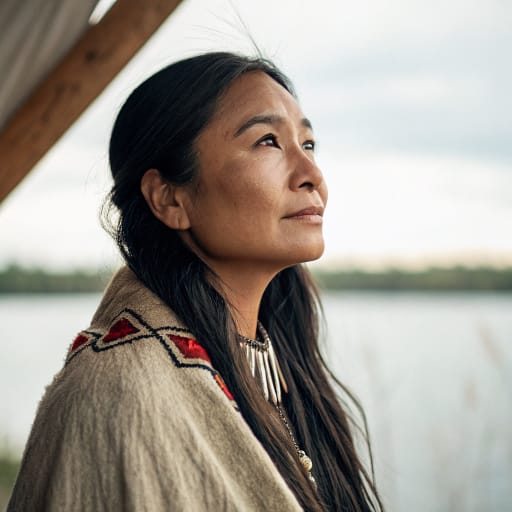
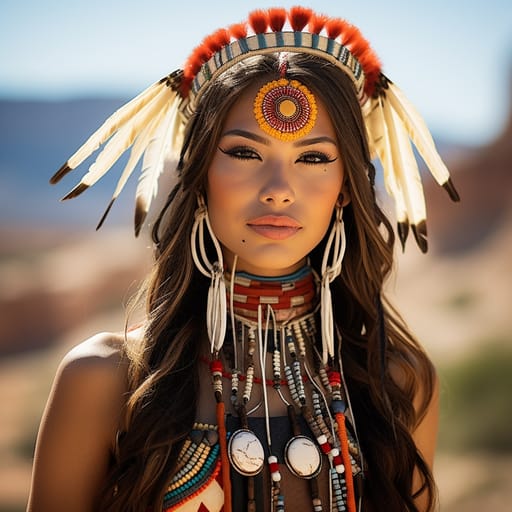
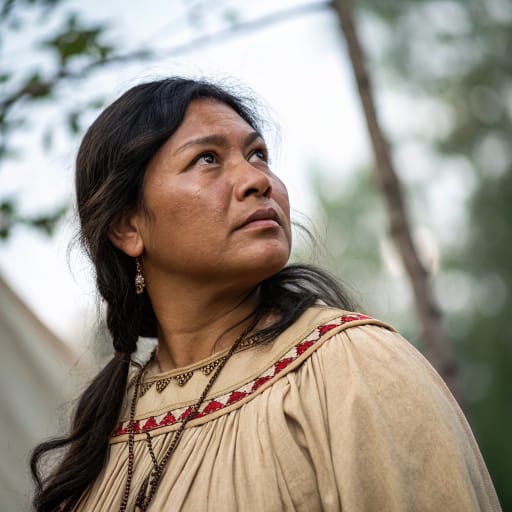
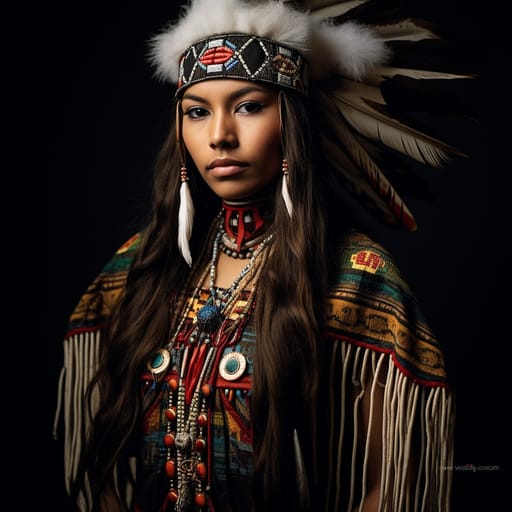

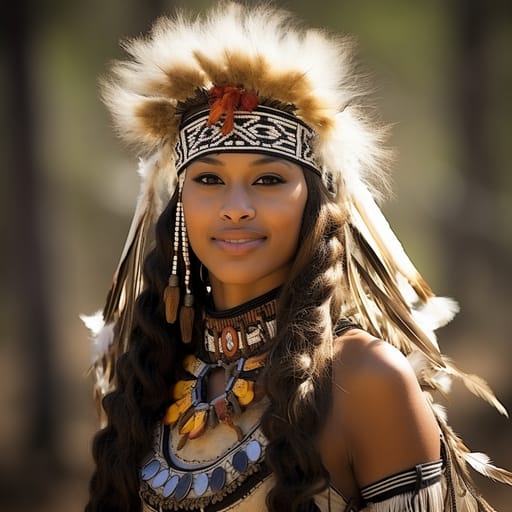
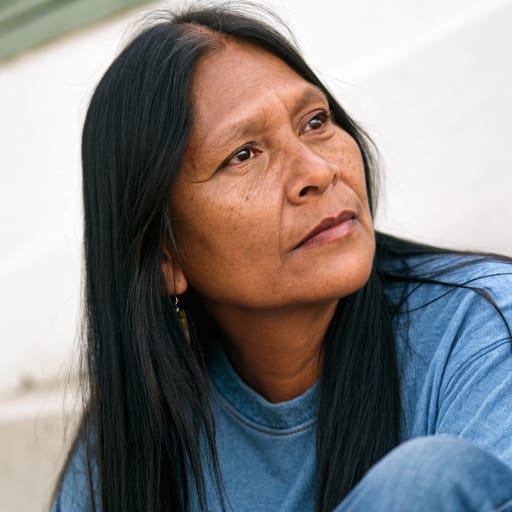
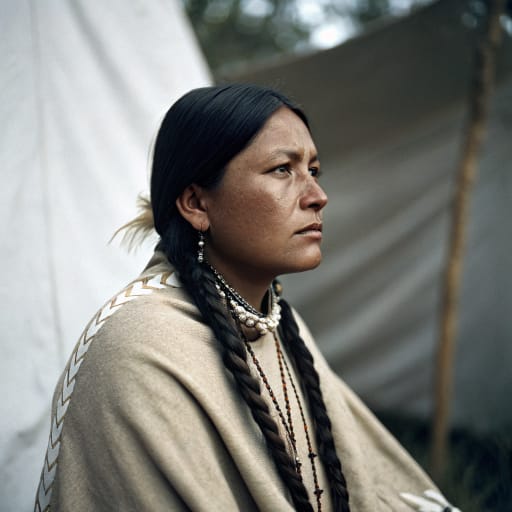
Typical Aleuts Phenotypes
Reference for AI generation: hair, eyes, skin, facial structure, build
Aleuts Body & Anatomy Reference
Anatomy by feature, Indigenous Northern American / Algonquian-Iroquoian phenotype
Aleuts Boobs & Breasts
Aleuts tits and boobs run medium cup, moderate projection, the classic Indigenous Northern American / Algonquian-Iroquoian bust profile. Aleuts nipples and areolas show medium-brown areolar pigmentation against the copper-to-medium-brown skin tone, with areolar diameter typically in the 30-44mm range and forward-set positioning rather than the smaller East Asian bust. Aleuts breasts trend full and moderate projection, a function of the mesomorph, broader frame in northern Indigenous populations body habitus and the mean adult female BMI 25-28. For anatomically accurate AI-generated Aleuts nudes the render preserves the medium cup, moderate projection shape, 30-44mm areolas with medium-brown pigmentation, and the torso proportions of the Indigenous Northern American / Algonquian-Iroquoian phenotype.
Aleuts Ass & Hips
Aleuts hips and butt usually read as medium, moderate-to-full projection. The skeletal base is medium iliac crests, the Indigenous Northern American / Algonquian-Iroquoian pattern. Set against the slim East Asian narrow-hip profile, the difference is easy to see, and the hip-to-waist ratio is often what identifies Aleuts women in photos.
Aleuts Vagina & Pussy
Expect medium-brown labial pigmentation on Aleuts women, in keeping with Indigenous Northern American / Algonquian-Iroquoian ancestry. The pubic hair is straight medium-coarse texture. Coloring should run evenly from the copper to medium-brown skin of the thighs to the labia, and Aleuts nude imagery should keep the hair's straight medium-coarse texture.
Aleuts Dicks & Penis
Aleuts dick and penile anatomy in adult AI generation should anchor on the regional reference data: regional mean ~13cm erect, moderate girth, and medium-brown shaft pigmentation. The Aleuts cock profile reflects the Indigenous Northern American / Algonquian-Iroquoian population's anthropometric measurements. The shaft pigmentation should track the surrounding copper to medium-brown skin tone, and the pubic hair should keep its straight medium-coarse texture in the typical inverted-V escutcheon.
Aleuts Body, Curves & Build
Aleuts body type: mesomorph, broader frame in northern Indigenous populations, with mean adult female BMI 25-28. This is the typical Indigenous Northern American / Algonquian-Iroquoian build. Height range, shoulder-to-hip ratio and fat distribution all follow from it, which is what an accurate Aleuts nude body should show.
Aleuts Skin Tone & Hair Texture
Aleuts skin tone falls in the copper to medium-brown (Fitzpatrick III-V) band, the surface signal most often miscalibrated by generic AI nude generators. Aleuts hair texture is typically straight 1A, dark-brown to black, often thick and dense, characteristic of the Indigenous Northern American / Algonquian-Iroquoian phenotype. In Aleuts nude renders the skin should hold that band consistently across the body.
Explore phenotype categories
Structured taxonomy with peer-reviewed scales · 22 anatomical categories
Erotic Poses & Sex Positions
From the pose catalog: 219 named positions with reference skeletons
Frequently asked questions about Aleuts people
Where is the Aleuts homeland?
The Aleuts homeland is Aleutian Islands, Pribilof Islands and the western Alaska Peninsula, Alaska, United States; Commander Islands, Kamchatka Krai, Russia in North America.
What language do Aleuts people speak?
Aleuts people primarily speak Unangam Tunuu, also called Aleut, in Eastern and Atkan dialects (Eskaleut, Aleut branch); English in Alaska, Russian on the Commander Islands.
What religion do Aleuts people practice?
The predominant religion among Aleuts people is Russian Orthodox Christianity, layered over an earlier animist and shamanic tradition.






Make your own Aleuts images
Five a day, free, no credits to buy. The studio starts from this group's phenotype data, so you can set body type, pose and style and keep the traits accurate.
Start with Aleuts