Help us get this right
Does this portrait look right for Igede?
One tap. It takes a second and it is recorded.
1 says it looks right, 0 say it looks off.
Igede Erotic
Benue State (Nigeria)
Christianity
About Igede People
The Igede live in the rolling country of Benue State in central Nigeria, concentrated mainly in Oju and Obi local government areas, with smaller populations spilling into Cross River State. Their land sits in the Middle Belt — that long transitional band between the predominantly Muslim north and the Christian and traditionalist south — and their identity has been shaped by being neither, while bordering both. They number somewhere around half a million speakers, and their language, also called Igede, belongs to the Idomoid branch of the Niger–Congo family. It is a close relative of Idoma, spoken by their larger northern neighbors, but distinct enough that the two are not mutually intelligible — a fact the Igede themselves are firm about, having long resisted being treated as a sub-group of the Idoma.
Igede society is organized around patrilineal clans, and historically governed not by a single chief but by councils of elders working through age-grade associations — institutions that still carry weight, even where formal local-government structures have been laid over them. The most visible expression of communal life is Igede Agba, the new-yam festival held every September, which functions less as a harvest celebration than as a kind of national homecoming: people travel back from Lagos, Abuja, and abroad to attend, and the festival doubles as the moment when collective decisions about land, marriage, and lineage disputes are aired in public. Christianity, mostly Catholic in the older generations and Pentecostal among the younger, is now the default religious frame, but it sits alongside rather than displaces older practices around ancestors and land — most Igede Christians would not describe themselves as having abandoned anything, only as having added.
The colonial encounter reached the Igede later than it reached the coastal peoples; the area was not formally administered until well into the early twentieth century, and missionary schooling followed rather than preceded the bureaucracy. One consequence is that Igede educated elites are a comparatively recent phenomenon, and the community has invested heavily in schooling as a route out of the agricultural economy that still defines the homeland — yam, cassava, rice, and sesame remain the staples, with sesame in particular grown for export. Music sung in Igede, especially the call-and-response forms used at funerals and festivals, has begun to circulate beyond the homeland through diaspora recordings, though it remains a minority taste even within Nigeria.
Related ethnic groups
Groups that share Igede's homeland, region, language, or religious tradition. These are likely candidates for comparative phenotype reference.
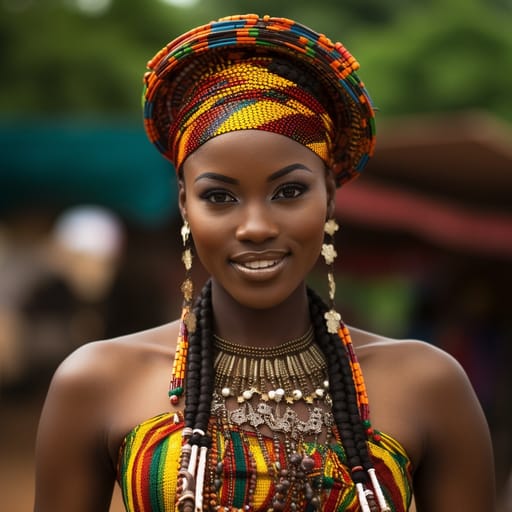
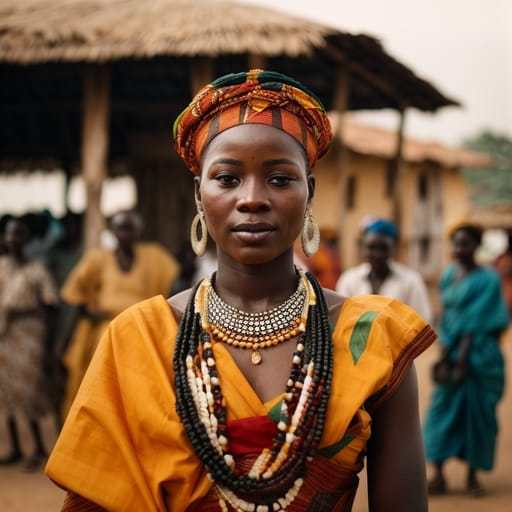
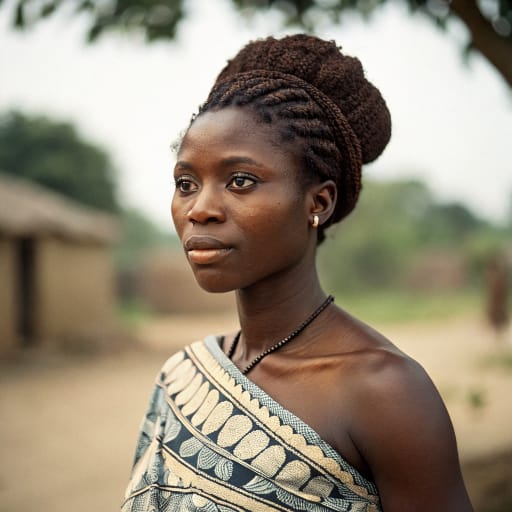
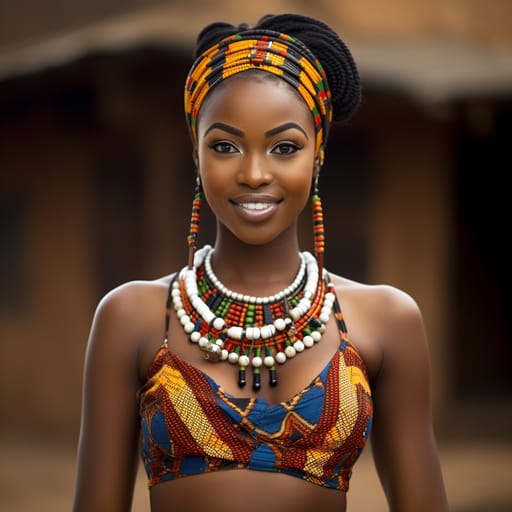
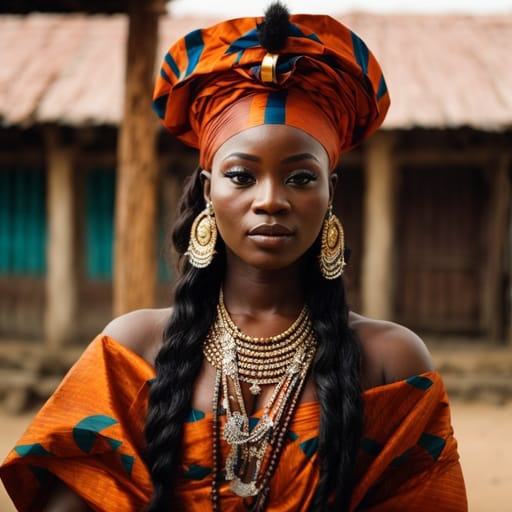

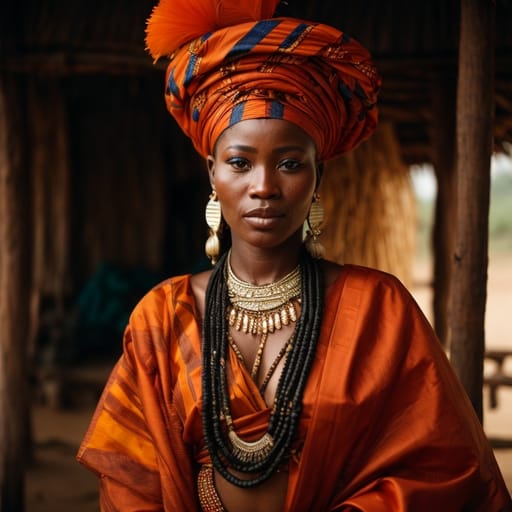
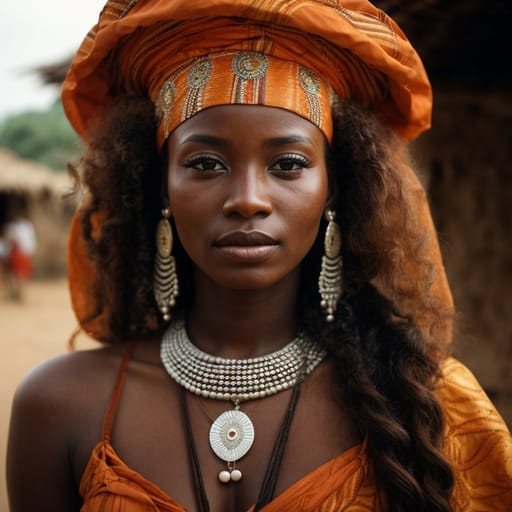
Typical Igede Phenotypes
Reference for AI generation: hair, eyes, skin, facial structure, build
The Igede are a relatively small Idomoid-speaking population concentrated in southern Benue State, and their phenotype sits firmly within the West African Sudanic pattern shared with neighboring Idoma, Tiv, and Igbo populations — but with the compact, slightly less elongated build typical of Middle Belt groups rather than the taller Sahelian morphology found further north.
Hair is almost uniformly Type 4, ranging from tightly coiled 4B through densely kinked 4C, with the coarse, high-density texture characteristic of the region. Natural color is uniformly black-brown with no meaningful incidence of lighter shades; gray onset tends to come late and concentrate at the temples. Eyes run from medium brown to very dark brown, occasionally near-black, with no epicanthic fold and a relatively wide, almond-to-round palpebral aperture. Sclera are typically clear white in youth, with the warm yellowish cast common in adulthood across the region.
Skin tone clusters in Fitzpatrick V to VI, most commonly a deep warm brown with red or olive undertones rather than the blue-black undertone seen in some Nilotic populations. The range is narrower than in larger neighboring groups — there's less of the lighter caramel variation seen among Yoruba or Igbo, and very little of the extreme darkness associated with parts of the Sahel. Peter Okwoche reads as a representative mid-range example.
Facial structure shows broad, moderately low nasal bridges with wide alae, full lips with a pronounced vermilion border on both upper and lower, and a square-to-rounded jawline. Cheekbones are present but not sharply prominent; the midface tends to be shorter and the lower face slightly heavier than in Tiv neighbors, giving a softer overall facial geometry.
Build is medium — adult male stature typically 168–175 cm, female 158–165 cm — with the stocky, muscular agricultural body composition common to Benue farming populations. Shoulders read broad relative to height, and lower-body musculature is well-developed. Subgroup variation across the Oju, Obi, and Igede-speaking clans is minor and not reliably distinguishable by phenotype alone.
Igede Body & Anatomy Reference
Per-feature anatomical profile for AI nude generation: West African Niger-Congo phenotype
Igede Boobs & Breasts
Igede tits and boobs run medium-to-large cup, full, projecting, the classic West African Niger-Congo bust profile. Igede nipples and areolas show deep-brown to near-black areolar pigmentation against the medium-to-deep-brown skin tone, with areolar diameter typically in the 35-50mm range and forward-set positioning rather than the smaller conical Cushitic East African profile. Igede breasts trend fuller and more projecting than the East African norm, a function of the mesomorph with strong gluteal-femoral fat distribution body habitus and the mean adult female BMI 24-27. For anatomically accurate AI-generated Igede nudes the render preserves the medium-to-large cup, full, projecting shape, 35-50mm areolas with deep-brown to near-black pigmentation, and the torso proportions of the West African Niger-Congo phenotype.
Igede Ass & Hips
Igede hips and butt usually read as wide-set, full, heavily projected glutes. The skeletal base is wide iliac crests, broad gynoid pelvic pattern, high glute-to-waist ratio, the West African Niger-Congo pattern. Set against the slim narrow-hip Cushitic East African profile, the difference is easy to see, and the hip-to-waist ratio is often what identifies Igede women in photos.
Igede Vagina & Pussy
Expect deep-brown to near-black labial pigmentation, fuller labia minora on Igede women, in keeping with West African Niger-Congo ancestry. The pubic hair is tightly-coiled coarse texture, densely distributed. Coloring should run evenly from the medium-brown to deep-brown skin of the thighs to the labia, and Igede nude imagery should keep the hair's tightly-coiled coarse texture.
Igede Dicks & Penis
Igede dick and penile anatomy in adult AI generation should anchor on the regional reference data: regional mean ~14-15cm erect, above-average girth, ~13cm circumference, and deep-brown-to-near-black shaft pigmentation. The Igede cock profile reflects the West African Niger-Congo population's anthropometric measurements. The shaft pigmentation should track the surrounding medium-brown to deep-brown skin tone, and the pubic hair should keep its tightly-coiled coarse texture in the typical inverted-V escutcheon.
Igede Body, Curves & Build
Igede body type: mesomorph with strong gluteal-femoral fat distribution, with mean adult female BMI 24-27. This is the typical West African Niger-Congo build. Height range, shoulder-to-hip ratio and fat distribution all follow from it, which is what an accurate Igede nude body should show.
Igede Skin Tone & Hair Texture
Igede skin tone falls in the medium-brown to deep-brown (Fitzpatrick V-VI) band, the surface signal most often miscalibrated by generic AI nude generators. Igede hair texture is typically tight 4A-4C coil, often worn natural, braided, or relaxed, characteristic of the West African Niger-Congo phenotype. In Igede nude renders the skin should hold that band consistently across the body.
Data depth
0/100Coverage of image-grounded phenotype observations · drives AI generation diversity
- Sample size
- 0/40· 0 images
- Image quality
- 0/30· 0% high
- Confidence
- 0/20
- Source diversity
- 0/10
- ·No image observations yet
Explore phenotype categories
Structured taxonomy with peer-reviewed scales · 22 anatomical categories
Notable Igede People
1 reference figure, sourced from Wikipedia
- BBC, Peter Okwoche, host of the BBC Focus on Africa TV news magazine programme
Erotic Poses & Sex Positions
From the pose catalog: 219 named positions with reference skeletons
Frequently asked questions about Igede people
Where is the Igede homeland?
The Igede homeland is Benue State (Nigeria) in Western Africa.
What language do Igede people speak?
Igede people primarily speak Niger-Congo / Idomoid / Igede.
What religion do Igede people practice?
The predominant religion among Igede people is Christianity.






Make your own Igede images
Five a day, free, no credits to buy. The studio starts from this group's phenotype data, so you can set body type, pose and style and keep the traits accurate.
Start with Igede