Help us get this right
Does this portrait look right for Idoma?
One tap. It takes a second and it is recorded.
0 say it looks right, 2 say it looks off.
Idoma Erotic
Benue State (Nigeria)
Christianity
Agatu, Alago, Yala
About Idoma People
The Idoma occupy the lower Benue valley in central Nigeria, a stretch of savanna and wooded country south of the great river that gives the state its name. They number somewhere around three to four million, depending on how the count handles the related groups along the language continuum, and they sit at one of those internal frontiers that Nigeria has many of: Yoruba country lies to their west, Igbo country to their south across the Benue, and the Tiv — their long-standing neighbors and historical sparring partners — share the same state. Idoma identity tends to define itself partly against this neighborhood, particularly against Tiv expansionism, which shaped much of the political memory of the nineteenth and early twentieth centuries.
The language belongs to the Idomoid branch of Volta–Niger, which makes it a cousin rather than a sibling of Yoruba and Igbo; it is tonal, and it fragments into a number of mutually intelligible varieties that map roughly onto the kingdoms and clan groupings the British later consolidated under a single ethnic label. The Agatu sit along the Benue floodplain and are known regionally as fishermen and farmers of the riverine plains; the Alago lie to the northeast in what is now Nasarawa State; the Yala have drifted south into Cross River, far enough that some classifications treat them as a separate people altogether. This scatter is part of the Idoma story — they are less a single kingdom than a confederation of communities that recognize a shared ancestor, the migration from Apa, and an apex traditional ruler, the Och'Idoma, a position created only in the colonial period to give the British a single counterpart to negotiate with.
Christianity is now the dominant affiliation, mostly Catholic in the older mission areas and increasingly Pentecostal in the towns, but the older religious vocabulary has not gone quiet. The masquerade traditions — particularly Oglinye, associated with warrior honor, and the white-faced Ichahoho masks that appear at funerals of elders — remain central to how communities mark death and seniority, and the ancestral cult around Alekwu, the collective dead, still shapes oath-taking and dispute resolution in ways that run parallel to the church rather than under it. The annual Aje Alekwu festival, with its libations and masked appearances, is the visible end of a quieter daily practice in which the ancestors are addressed before any consequential decision. Idoma social life is patrilineal, organized around the compound and the age-grade, and famous within Nigeria for a particular style of public oratory in which proverbs do most of the heavy argumentative work.
Related ethnic groups
Groups that share Idoma's homeland, region, language, or religious tradition. These are likely candidates for comparative phenotype reference.
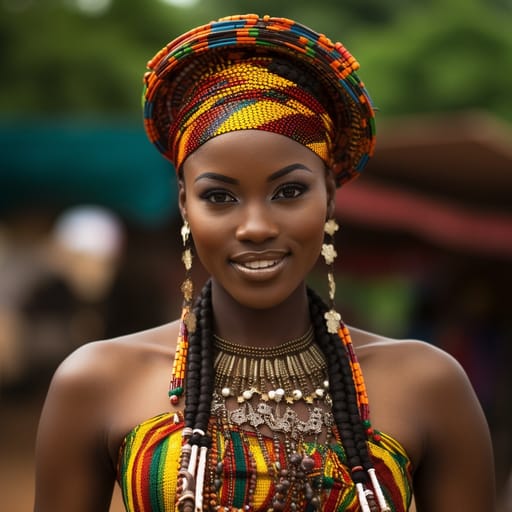
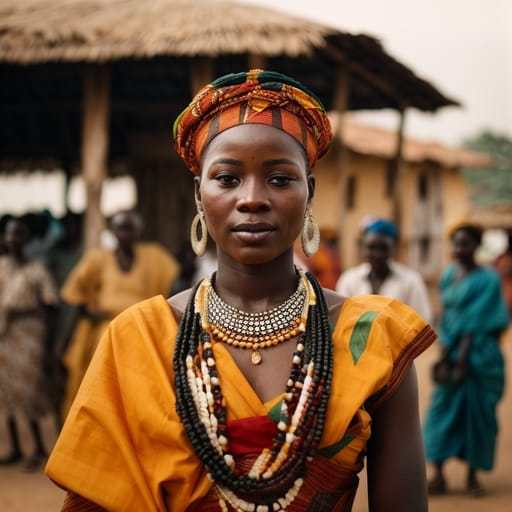
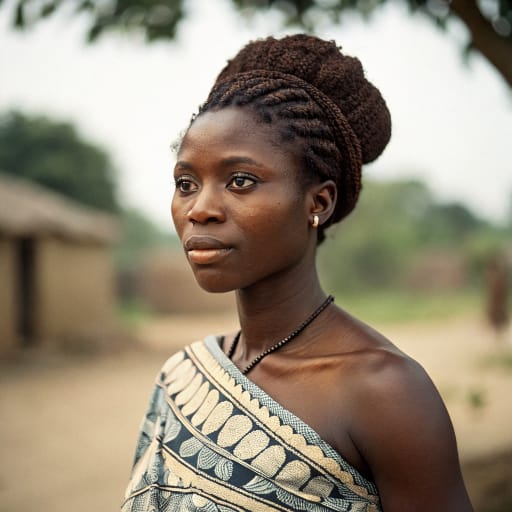
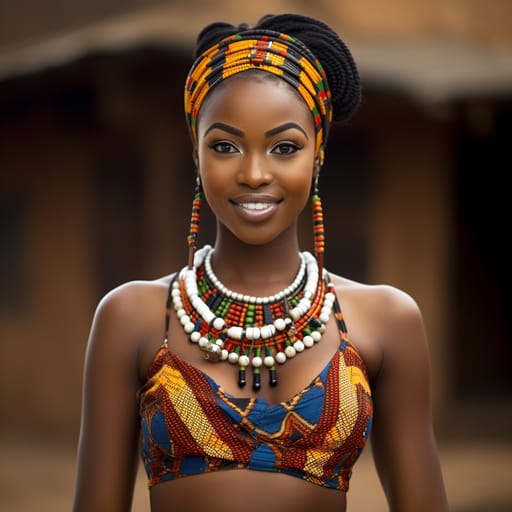
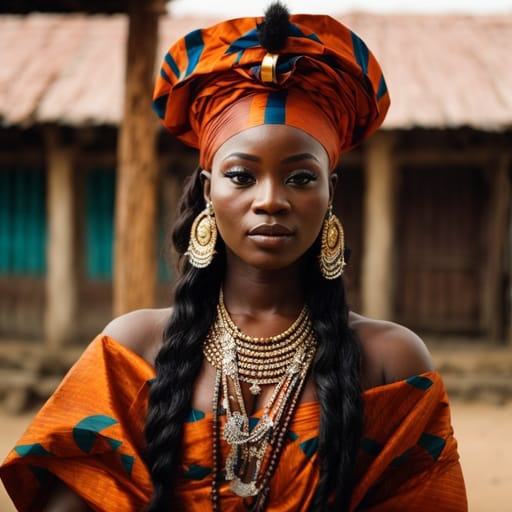

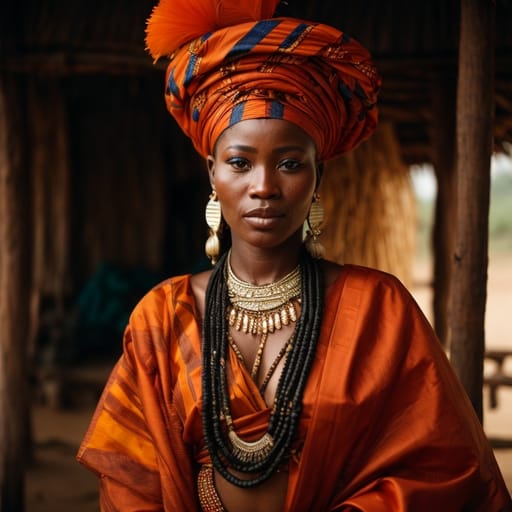
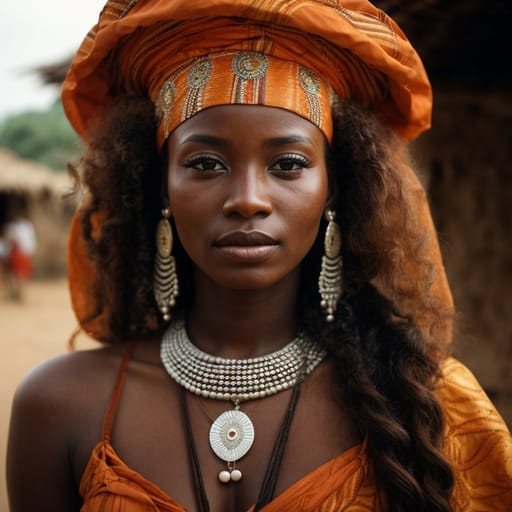
Typical Idoma Phenotypes
Reference for AI generation: hair, eyes, skin, facial structure, build
The Idoma sit in Nigeria's Middle Belt, and their phenotype reflects that intermediate position — generally darker than their northern Hausa neighbors, with slightly more gracile facial structure than many of the Niger Delta and southeastern groups. Hair is almost universally Type 4, tightly coiled with a fine, dense texture that holds shape well; natural color is true black with cooler undertones, and graying tends to come late. Eyes are dark brown to near-black, set under a moderate brow ridge with no epicanthic fold; the eye opening is typically almond-shaped rather than wide-rounded, and the lashes are thick.
Skin tone clusters in the Fitzpatrick V–VI range, leaning toward a deep cool brown rather than the reddish-mahogany seen further south, though warmer copper-brown tones do appear, particularly among Agatu communities along the Benue river. Undertones are predominantly neutral to cool. The facial structure is one of the more distinctive Idoma signatures — a relatively narrow nose by West African averages, with a defined bridge and moderate alar width rather than the broader nasal forms common in coastal Yoruba and Igbo populations. Lips are full but proportionate, cheekbones sit high and forward, and the jaw is typically square in men and softly tapered in women. Sharon Ooja and Ada Ameh both read as fairly typical of the women's facial template.
Build runs lean to athletically muscular, with average male stature around 170–175 cm and women around 160–165 cm. Shoulders tend to be square, limbs proportionally long, and body fat distribution gluteofemoral rather than abdominal. Among the sub-groups, Agatu populations skew taller and slightly leaner, Alago show a marginally broader facial form likely from historical contact with Jukun and Eggon neighbors, and Yala along the Cross River border show occasional softer features and a touch more rounded nasal tip. Variation is real but the underlying template — deep skin, narrow-bridged nose, high cheekbones, lean frame — holds across all three branches.
Idoma Body & Anatomy Reference
Per-feature anatomical profile for AI nude generation: West African Niger-Congo phenotype
Idoma Boobs & Breasts
Idoma tits and boobs run medium-to-large cup, full, projecting, the classic West African Niger-Congo bust profile. Idoma nipples and areolas show deep-brown to near-black areolar pigmentation against the medium-to-deep-brown skin tone, with areolar diameter typically in the 35-50mm range and forward-set positioning rather than the smaller conical Cushitic East African profile. Idoma breasts trend fuller and more projecting than the East African norm, a function of the mesomorph with strong gluteal-femoral fat distribution body habitus and the mean adult female BMI 24-27. For anatomically accurate AI-generated Idoma nudes the render preserves the medium-to-large cup, full, projecting shape, 35-50mm areolas with deep-brown to near-black pigmentation, and the torso proportions of the West African Niger-Congo phenotype.
Idoma Ass & Hips
Idoma hips and butt usually read as wide-set, full, heavily projected glutes. The skeletal base is wide iliac crests, broad gynoid pelvic pattern, high glute-to-waist ratio, the West African Niger-Congo pattern. Set against the slim narrow-hip Cushitic East African profile, the difference is easy to see, and the hip-to-waist ratio is often what identifies Idoma women in photos.
Idoma Vagina & Pussy
Expect deep-brown to near-black labial pigmentation, fuller labia minora on Idoma women, in keeping with West African Niger-Congo ancestry. The pubic hair is tightly-coiled coarse texture, densely distributed. Coloring should run evenly from the medium-brown to deep-brown skin of the thighs to the labia, and Idoma nude imagery should keep the hair's tightly-coiled coarse texture.
Idoma Dicks & Penis
Idoma dick and penile anatomy in adult AI generation should anchor on the regional reference data: regional mean ~14-15cm erect, above-average girth, ~13cm circumference, and deep-brown-to-near-black shaft pigmentation. The Idoma cock profile reflects the West African Niger-Congo population's anthropometric measurements. The shaft pigmentation should track the surrounding medium-brown to deep-brown skin tone, and the pubic hair should keep its tightly-coiled coarse texture in the typical inverted-V escutcheon.
Idoma Body, Curves & Build
Idoma body type: mesomorph with strong gluteal-femoral fat distribution, with mean adult female BMI 24-27. This is the typical West African Niger-Congo build. Height range, shoulder-to-hip ratio and fat distribution all follow from it, which is what an accurate Idoma nude body should show.
Idoma Skin Tone & Hair Texture
Idoma skin tone falls in the medium-brown to deep-brown (Fitzpatrick V-VI) band, the surface signal most often miscalibrated by generic AI nude generators. Idoma hair texture is typically tight 4A-4C coil, often worn natural, braided, or relaxed, characteristic of the West African Niger-Congo phenotype. In Idoma nude renders the skin should hold that band consistently across the body.
Data depth
39/100Coverage of image-grounded phenotype observations · drives AI generation diversity
- Sample size
- 11/40· 4 images
- Image quality
- 13/30· 25% high
- Confidence
- 15/20· mean 0.79
- Source diversity
- 0/10· wikipedia
- ·Small sample (n<10)
- ·Mostly low-quality source images
- ·Wikipedia-only source, not population-representative
Observed Distribution: Image Sample
Empirical observations from analyzed photographs · supplementary signal, not population truth
Sample: 4 images analyzed (4 wikipedia). Quality: 1 high, 3 medium, 0 low, 0 very_low. Avg analyzer confidence: 0.79.
Skin tone (Fitzpatrick): V (50%), VI (50%)
Hair color: black (75%), gray/white (25%)
Hair texture: straight (50%), coily (25%), shaved (25%)
Eye color: dark brown (75%), unclear (25%)
Epicanthic fold: 0% present, 75% absent, 25% unclear
Caveats: Sample size 4 is small, so the observed distribution should be treated as suggestive, not definitive. Quality skews toward older or low-resolution photos; phenotype detail may be lossy. Sample is 100% Wikipedia notable people, which skews toward male, public-life, and modern figures, not population-representative.
Last aggregated: May 7, 2026
Explore phenotype categories
Structured taxonomy with peer-reviewed scales · 22 anatomical categories
Notable Idoma People
11 reference figures, sourced from Wikipedia
- 2baba Innocent Idibia, musician
- Abba Moro, former Benue state Algon Chairman, former Minister of Interior, Senator, educ…
- Ada Ameh, Nigerian actress
- Audu Ogbeh, former Minister of Communications, former National Chairman of PDP, former Mi…
- Jerry Agada, former State Minister of Education, author and essayist
- Lawrence Onoja, former military governor of Plateau State and Katsina State, Nigeria and Prin…
- Monica Ogah, Nigerian Singer and winner, MTN Project Fame, Season 4
- Moses Ochonu, author, historian
- Sharon Ooja, Nollywood actress
- Susan Peters, Nollywood actress
- Terry G, Nigerian musician
Erotic Poses & Sex Positions
From the pose catalog: 219 named positions with reference skeletons
Frequently asked questions about Idoma people
Where is the Idoma homeland?
The Idoma homeland is Benue State (Nigeria) in Western Africa.
What language do Idoma people speak?
Idoma people primarily speak Niger-Congo / Idomoid / Idoma.
What religion do Idoma people practice?
The predominant religion among Idoma people is Christianity.






Make your own Idoma images
Five a day, free, no credits to buy. The studio starts from this group's phenotype data, so you can set body type, pose and style and keep the traits accurate.
Start with Idoma