Help us get this right
Does this portrait look right for Gonja?
Nobody has judged this one yet. You would be the first.
Gonja Erotic
The savanna between the Black Volta and White Volta rivers in northern Ghana, centered on the Savannah Region and the towns of Damongo, Bole, Salaga and Daboya.
Gonja, called Ngbanyito by its speakers (Guang branch of Kwa, Niger-Congo); English and Hausa widely used as second languages.
Predominantly Sunni Muslim, alongside continuing shrine and earth-priest practice and a Christian minority.
Divisional chiefdoms including Bole, Kpembe, Tuluwe, Kusawgu and Wasipe; three social estates of Ngbanya ruling lineages, Muslim clerical lineages and commoners; part of the wider Guang-speaking family.
About Gonja People
The Gonja are the ruling people of a savanna kingdom spread across the middle of northern Ghana, from the Black Volta in the west to the White Volta in the east, and their origin story is one of the stranger ones in West Africa: a band of Mande horsemen rode south out of the Mali orbit in the sixteenth century to take hold of the gold and kola routes running toward the forest, imposed themselves on the farming communities they found, and then lost their own language to them. Gonja today speak Ngbanyito, a Guang language of the Kwa family, which makes them a Kwa-speaking island in a region that is otherwise solidly Gur: their neighbors the Dagomba, Vagla, Sisala and Mo speak languages from a different branch entirely. The conquerors took wives locally, and the children spoke what their mothers spoke.
That history is still legible in how the society is organized. People belong to one of three estates: the Ngbanya, descendants of the founding cavalry, who supply chiefs; the Muslim estate, descended from the clerics and traders who arrived with them, who supply imams, scribes and ritual specialists; and the commoners, descended from the peoples who were there first. The estates intermarry but do not merge, and each has work the others do not do. The kingdom is divided among divisional chiefdoms, Bole, Kpembe, Tuluwe, Kusawgu, Wasipe and others, and the paramountcy rotates among them, so each Yagbonwura, seated at Damongo, comes from a different division than the last. Rotation is a deliberate brake on any one lineage's ambition, and it turns Gonja succession disputes into arguments about whose turn it is rather than about blood.
Islam arrived here as a court religion rather than a mass conversion, valued for its literacy, its diplomacy and its amulets, and Gonja Muslims produced one of West Africa's notable Arabic chronicles in the eighteenth century. It is now the majority faith, though shrines and earth priests keep their functions, and the big annual celebration, Damba, marks the Prophet's birth with drumming, horsemanship and chiefly display rather than with anything a preacher would recognize as liturgy. The nineteenth century brought Salaga, in the Kpembe division, which grew into the largest market of the interior and dealt in kola, cloth and people, until a succession war in 1892 and the arrival of European rule hollowed it out. Gonjaland is now the core of Ghana's Savannah Region, farmland, cattle and woodland, with Damongo as its capital.
Related ethnic groups
Groups that share Gonja's homeland, region, language, or religious tradition. These are likely candidates for comparative phenotype reference.
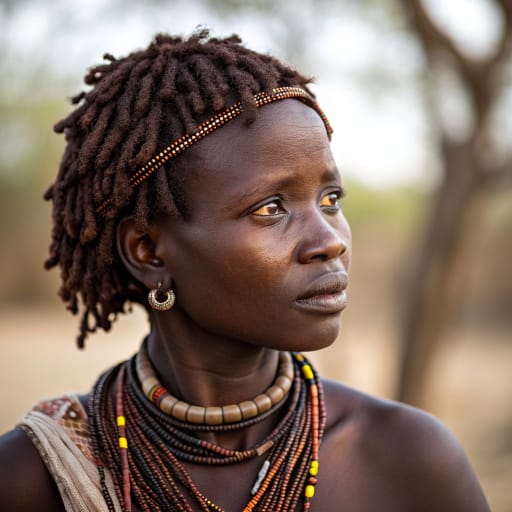
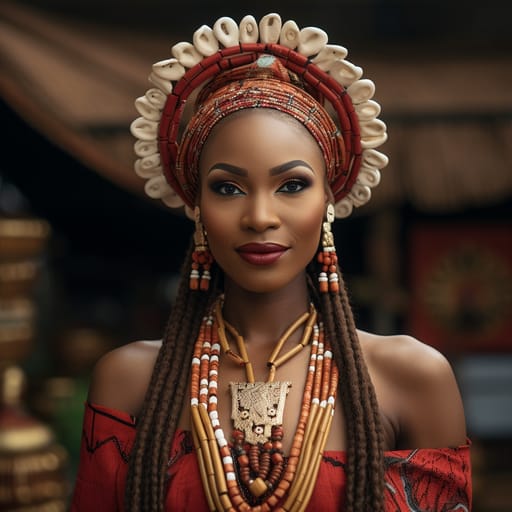
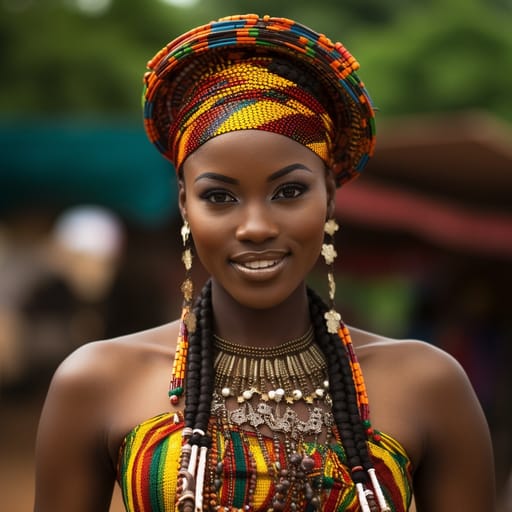
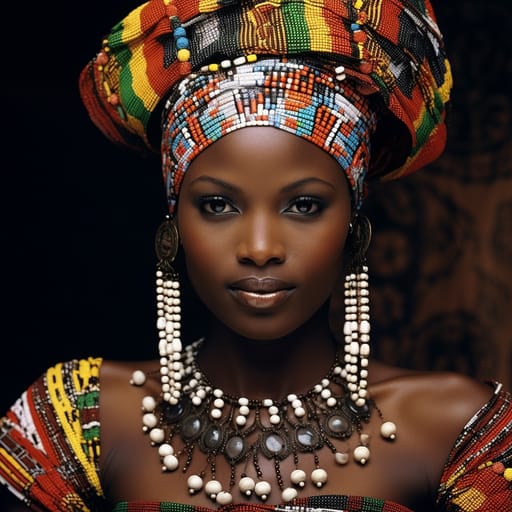
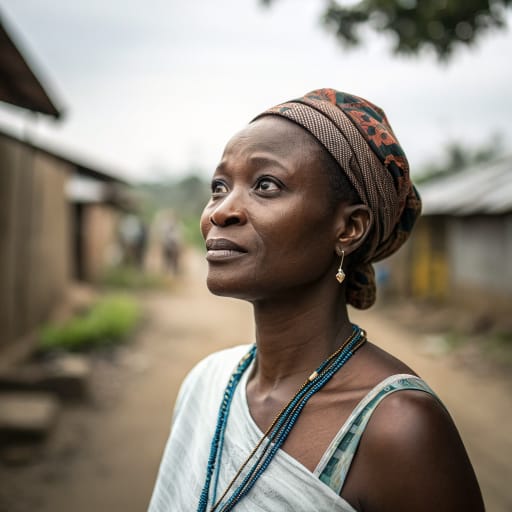
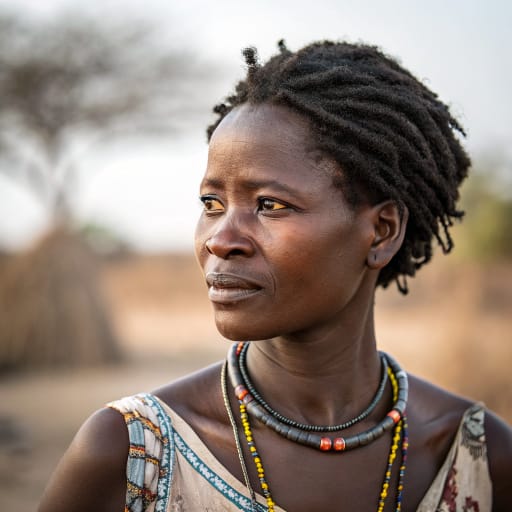
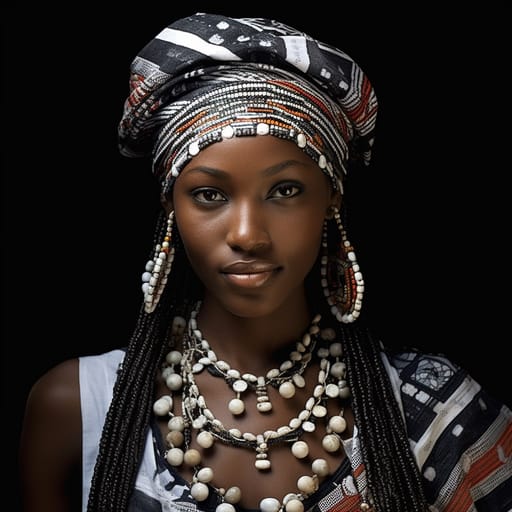
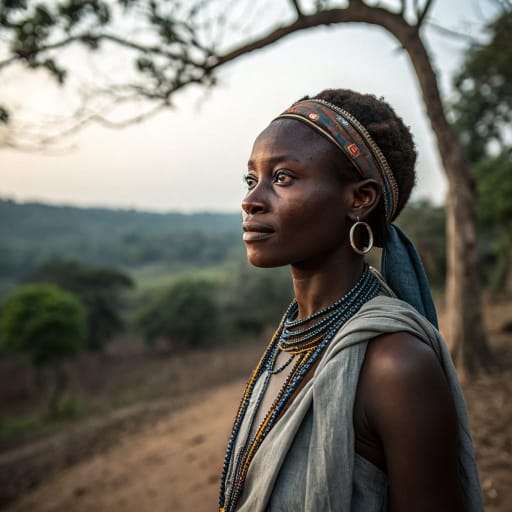
Typical Gonja Phenotypes
Reference for AI generation: hair, eyes, skin, facial structure, build
Gonja Body & Anatomy Reference
West African Niger-Congo phenotype: anatomy reference for AI nude generation
Gonja Boobs & Breasts
The typical Gonja bust is medium-to-large cup, full, projecting, in line with the wider West African Niger-Congo pattern. Areolas usually fall in the 35-50mm range, with deep-brown to near-black areolar pigmentation against the medium-to-deep-brown skin tone. Compared with the smaller conical Cushitic East African profile, Gonja breasts sit forward and are generally fuller and more projecting than the East African norm. A faithful AI render of Gonja tits keeps that shape and areola size.
Gonja Ass & Hips
Butt shape among Gonja women: wide-set, full, heavily projected glutes, over wide iliac crests, broad gynoid pelvic pattern, high glute-to-waist ratio. This follows West African Niger-Congo ancestry and looks quite unlike the slim narrow-hip Cushitic East African profile. An accurate Gonja ass in adult AI imagery keeps both the silhouette and the overall build (mesomorph with strong gluteal-femoral fat distribution) instead of a generic average.
Gonja Vagina & Pussy
Vulvar anatomy among Gonja women: deep-brown to near-black labial pigmentation, fuller labia minora. Pubic hair tends to be tightly-coiled coarse texture, densely distributed, in the usual inverted-triangle pattern. Both follow West African Niger-Congo pigmentation, which is why Gonja pussy renders should not fall back on a pale, sparse Western template.
Gonja Dicks & Penis
The Gonja cock profile, from West African Niger-Congo anthropometric data: regional mean ~14-15cm erect; above-average girth, ~13cm circumference; deep-brown-to-near-black shaft pigmentation. Pubic hair has a tightly-coiled coarse texture and forms the usual inverted-V pattern. Whether Gonja men are circumcised follows religious and cultural practice rather than phenotype.
Gonja Body, Curves & Build
Build and curves among Gonja women follow the West African Niger-Congo pattern: mesomorph with strong gluteal-femoral fat distribution, mean adult female BMI 24-27. Proportions matter as much as skin tone, so Gonja figures should keep their regional height and limb ratios.
Gonja Skin Tone & Hair Texture
The Gonja skin range is medium-brown to deep-brown (Fitzpatrick V-VI), and hair tends to be tight 4A-4C coil, often worn natural, braided, or relaxed. That combination marks the West African Niger-Congo phenotype, and skin tone is the trait AI generators most often get wrong for Gonja women.
Explore phenotype categories
Structured taxonomy with peer-reviewed scales · 22 anatomical categories
Erotic Poses & Sex Positions
From the pose catalog: 219 named positions with reference skeletons
Frequently asked questions about Gonja people
Where is the Gonja homeland?
The Gonja homeland is The savanna between the Black Volta and White Volta rivers in northern Ghana, centered on the Savannah Region and the towns of Damongo, Bole, Salaga and Daboya. in Western Africa.
What language do Gonja people speak?
Gonja people primarily speak Gonja, called Ngbanyito by its speakers (Guang branch of Kwa, Niger-Congo); English and Hausa widely used as second languages..
What religion do Gonja people practice?
The predominant religion among Gonja people is Predominantly Sunni Muslim, alongside continuing shrine and earth-priest practice and a Christian minority..






Make your own Gonja images
Five a day, free, no credits to buy. The studio starts from this group's phenotype data, so you can set body type, pose and style and keep the traits accurate.
Start with Gonja