Help us get this right
Does this portrait look right for Giriama?
Nobody has judged this one yet. You would be the first.
Giriama Erotic
Coastal hinterland of Kenya, chiefly Kilifi County between Mombasa and Malindi, with many also living in Mombasa and other coastal towns
Giriama, or Kigiryama (Niger-Congo, Bantu, Sabaki branch, Mijikenda cluster); Swahili and English widely used as second languages
Christianity and Islam, alongside enduring traditional belief in Mulungu and ancestral spirits
One of the nine Mijikenda peoples, alongside the Digo, Duruma, Rabai, Chonyi, Jibana, Kambe, Kauma and Ribe
About Giriama People
The Giriama are the largest of the nine Mijikenda peoples of the Kenyan coast. The name Mijikenda means nine towns, and it points to what holds them together: the kaya. Each Mijikenda people traces itself to a fortified clearing on a forested ridge, and for the Giriama that place is Kaya Fungo, in the hinterland of Kilifi County. Almost nobody lives inside it now. Families farm scattered homesteads across the dry country between Mombasa and Malindi, but the kaya is still the ritual center. It is kept by the Kambi, a council of elders, and protected by rules against cutting its trees. That discipline is much of why the forests survive, and why UNESCO listed the Mijikenda kaya forests as a World Heritage Site in 2008.
Giriama is a Bantu language of the Sabaki branch. It sits close to the other Mijikenda varieties and is a near relative of Swahili, the language of the port towns the Giriama have traded with for centuries. In the nineteenth century Giriama farmers grew grain for those ports and pushed their settlements north across the Sabaki River. Oral tradition places an older homeland farther north still, at Shungwaya, which they left under pressure from pastoralist neighbors.
That northward push led to the defining clash of the colonial era. By 1913 the British were demanding hut taxes and laborers, and they wanted the Giriama off the land north of the Sabaki. Much of the resistance was organized by Mekatilili wa Menza, a widow who drew crowds by performing the kifudu dance and bound her followers by oath to refuse cooperation. She was arrested in 1913 and exiled to Kisii in western Kenya. She escaped and walked home, and open fighting and British punitive expeditions followed in 1914. Her statue now stands in Malindi, and her name carries weight well beyond the coast.
Religion here is layered rather than either/or. Christianity is now widespread and Islam has deep roots near the coast. Belief in Mulungu, a remote creator, sits alongside close attention to the dead. Funerals run long, with drumming and dance. Men of the Gohu society were once honored with vigango, carved wooden memorial posts set up at the homestead. Collectors carried many of them off to foreign museums, and some have since come home. Palm wine, mnazi, tapped from coconut trees, still flows at rituals and in ordinary village life.
Related ethnic groups
Groups that share Giriama's homeland, region, language, or religious tradition. These are likely candidates for comparative phenotype reference.
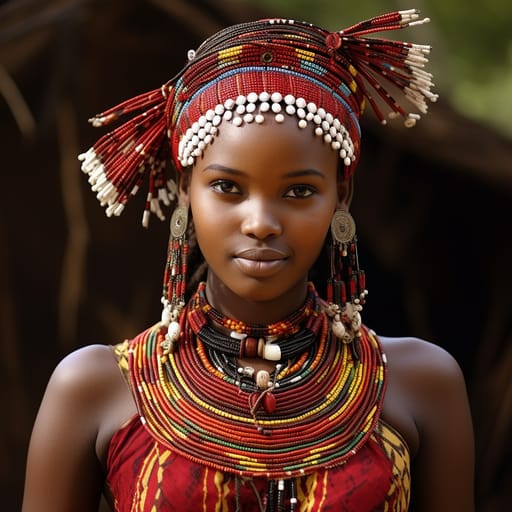
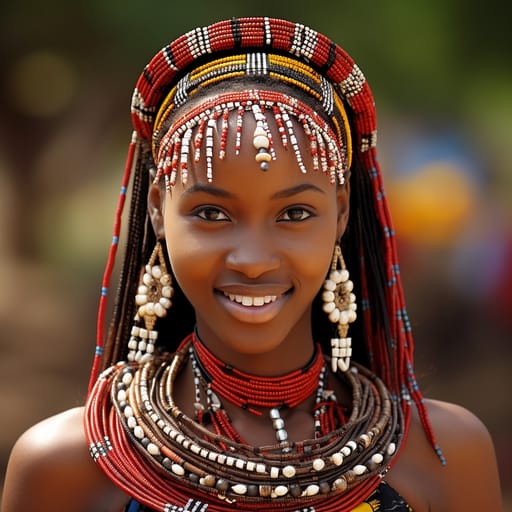
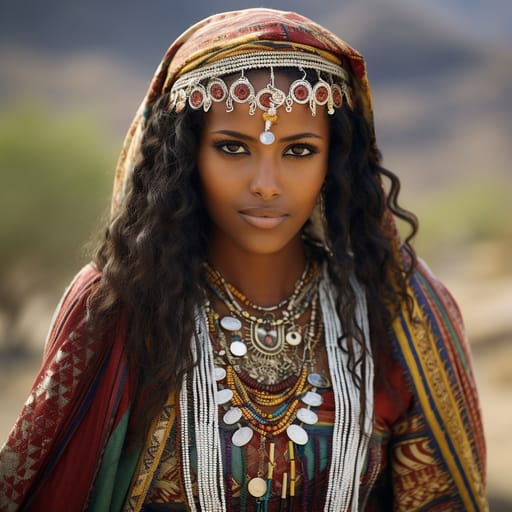
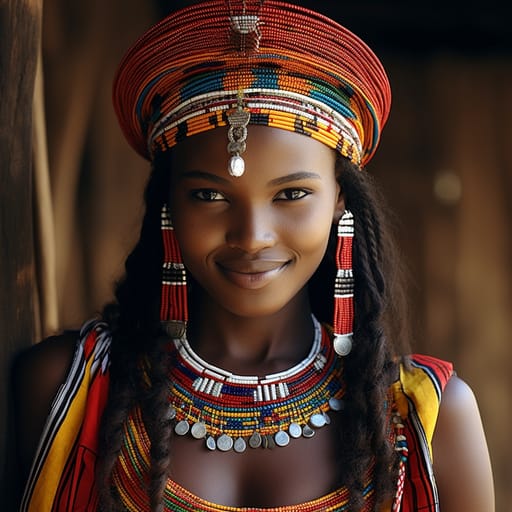
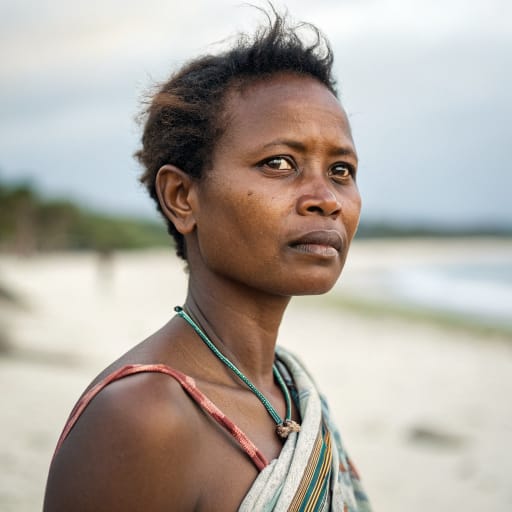
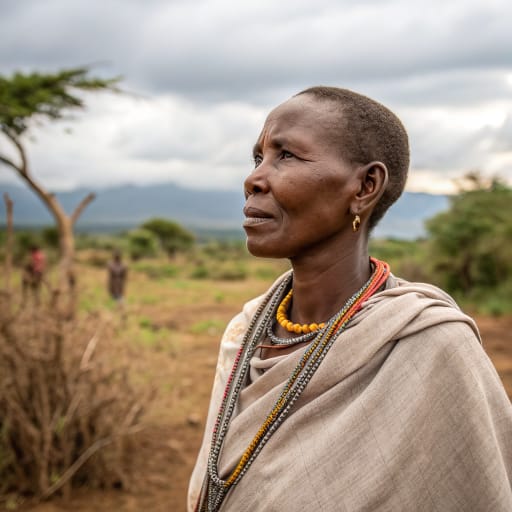
Typical Giriama Phenotypes
Reference for AI generation: hair, eyes, skin, facial structure, build
Giriama Body & Anatomy Reference
Anatomy by feature, Cushitic / Nilo-Cushitic East African phenotype
Giriama Boobs & Breasts
Giriama boobs follow the Cushitic / Nilo-Cushitic East African profile: small-to-medium-cup, high-set, conical. Areolar diameter is usually 28-38mm, and the coloring is moderate-to-high areolar pigmentation against the brown-to-deep-brown skin tone. Breast shape tracks body composition (lean ectomorph-to-mesomorph, mean adult female BMI 19-22), so Giriama breasts tend to be firmer and less projecting than the African-American or West African norm. Expect a forward-set shape, not the lateral spread of the West African phenotype.
Giriama Ass & Hips
Giriama ass and hip morphology presents as small-to-medium, high-set, rounded, distinctly different from the wide-set heavy-projection West African or African-American norm. The Giriama pelvic profile shows narrow-to-medium iliac crests, longer torso-to-leg ratio, anchored in the Cushitic / Nilo-Cushitic East African skeletal pattern. Giriama butt shots in adult AI imagery should render the small-to-medium, high-set, rounded silhouette with the overall build (lean ectomorph-to-mesomorph) and the fat distribution typical of the Cushitic / Nilo-Cushitic East African phenotype.
Giriama Vagina & Pussy
Giriama pussy anatomy typically shows brown-to-deep-brown labial pigmentation, narrow-to-medium labia minora projection. Pubic hair is usually tightly-coiled coarse texture, densely distributed. In AI-generated Giriama nudes, labial color should blend into the brown to deep brown skin with a gradual transition, and the hair should keep its tightly-coiled coarse texture.
Giriama Dicks & Penis
Penis reference for Giriama men: regional mean ~13.5cm erect, moderate girth, ~12cm circumference. Coloring: deeper-pigmented than the West African norm. An accurate Giriama cock in AI imagery matches the surrounding brown to deep brown skin rather than a generic porn default. Circumcision depends on religion and custom, not ancestry.
Giriama Body, Curves & Build
The Giriama figure is generally lean ectomorph-to-mesomorph, with mean adult female BMI 19-22, characteristic of Cushitic / Nilo-Cushitic East African ancestry. AI image tools tend to flatten regional body types into a few stock shapes; here the Giriama build is kept as its own reference.
Giriama Skin Tone & Hair Texture
Skin: brown to deep brown (Fitzpatrick V-VI). Hair: tight 4A-4C coil, often worn natural or in braided/twisted protective styles. Both are typical of Cushitic / Nilo-Cushitic East African ancestry. The most common mistake in AI nudes of Giriama women is a body rendered lighter than the face.
Explore phenotype categories
Structured taxonomy with peer-reviewed scales · 22 anatomical categories
Erotic Poses & Sex Positions
From the pose catalog: 219 named positions with reference skeletons
Frequently asked questions about Giriama people
Where is the Giriama homeland?
The Giriama homeland is Coastal hinterland of Kenya, chiefly Kilifi County between Mombasa and Malindi, with many also living in Mombasa and other coastal towns in Eastern Africa.
What language do Giriama people speak?
Giriama people primarily speak Giriama, or Kigiryama (Niger-Congo, Bantu, Sabaki branch, Mijikenda cluster); Swahili and English widely used as second languages.
What religion do Giriama people practice?
The predominant religion among Giriama people is Christianity and Islam, alongside enduring traditional belief in Mulungu and ancestral spirits.






Make your own Giriama images
Five a day, free, no credits to buy. The studio starts from this group's phenotype data, so you can set body type, pose and style and keep the traits accurate.
Start with Giriama