Help us get this right
Does this portrait look right for Dhimba?
One tap. It takes a second and it is recorded.
1 says it looks right, 0 say it looks off.
Dhimba Erotic
Lower Kunene River valley, Namibe Province, Angola (and Kunene Region, Namibia)
Otjidhimba (Zemba), a Herero-cluster Bantu language (Niger-Congo)
Traditional animism (ancestor veneration)
About Dhimba People
The Dhimba (self-designation Ovadhimba) are a small semi-nomadic cattle-herding people of the lower Kunene River, whose homesteads straddle the arid frontier between southwestern Angola and northwestern Namibia. They belong to the wider family of Herero-speaking pastoralists of the Kunene basin, a cluster that also includes the neighbouring Himba, Zemba, Hakaona and Tjimba, and they are frequently confused with the Himba by outsiders because of a shared material culture and language.
Society and subsistence
Dhimba life is organised around herds of cattle, goats and sheep, which supply milk, meat, hides and the bridewealth that underwrites marriage. Because rainfall on the Kunene is sparse and unreliable, households practise transhumance, moving stock between a permanent homestead and seasonal cattle posts as pasture and water allow. Like other Herero peoples, the Dhimba reckon descent through a double system: a person belongs both to a patrilineal line (oruzo), which governs the sacred ancestral fire and ritual cattle, and to a matrilineal line (eanda), which channels the inheritance of wealth. Each homestead keeps a holy fire (okuruwo) tended between the main hut and the cattle enclosure, understood as the living link between the household and its ancestors. Authority rests with senior men and lineage elders, and disputes are settled through councils rather than any centralised chieftaincy.
Appearance and adornment
Dhimba women are the most visible bearers of the group's traditional aesthetic. Many dress the skin and hair with otjize, a paste of butterfat and powdered red ochre that lends a coppery sheen, protects against the sun and marks a distinctly Kunene ideal of beauty. Hair is worked into long ochred plaits, and married women may add a leather or fabric headpiece; girls and women wear pleated skirts of softened goat or calf hide, with iron and shell ornaments, beaded necklaces and metal anklets accumulated over a lifetime. Men historically wore hide wraps, though store-bought cloth is now common. Everyday tools, milk vessels and ornaments are frequently made from locally worked wood, leather and metal.
The Dhimba number, at most, several thousand people, and their language and customs are closely tied to those of their pastoralist neighbours. Their remoteness has helped preserve older forms of dress, herding and ritual, even as roads, boreholes, schooling and cross-border trade increasingly reach the Kunene. They remain a documented example of the Herero-speaking cattle cultures of the Angola-Namibia borderland.
Related ethnic groups
Groups that share Dhimba's homeland, region, language, or religious tradition. These are likely candidates for comparative phenotype reference.
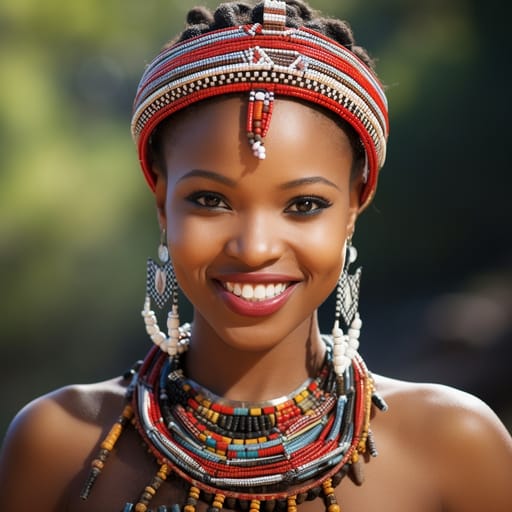
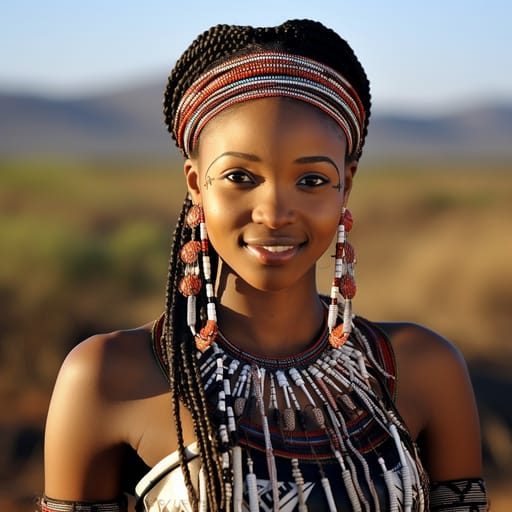
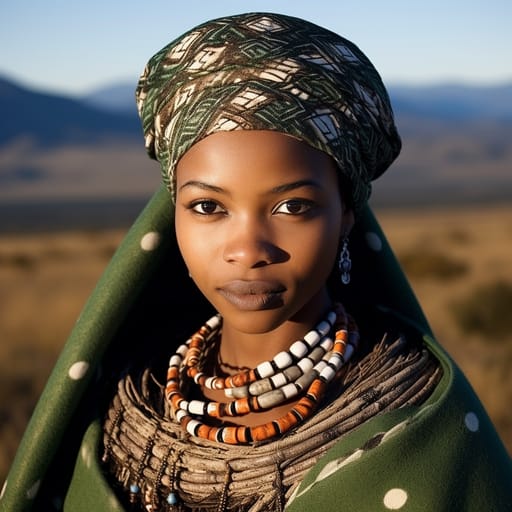
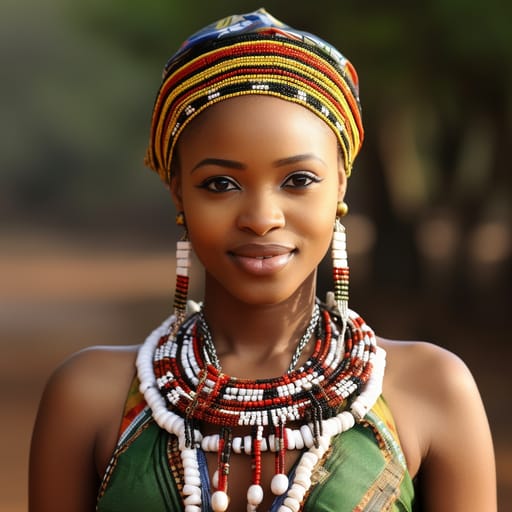
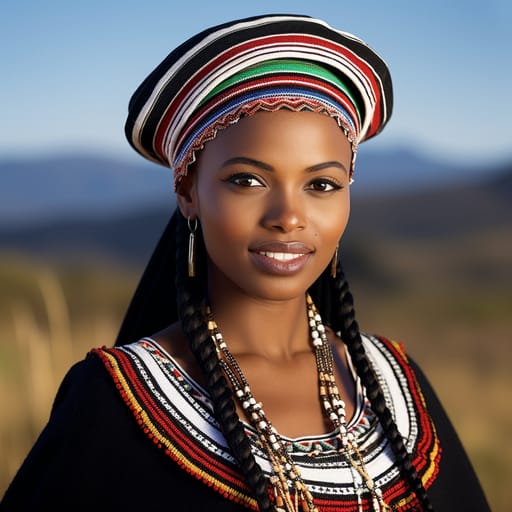

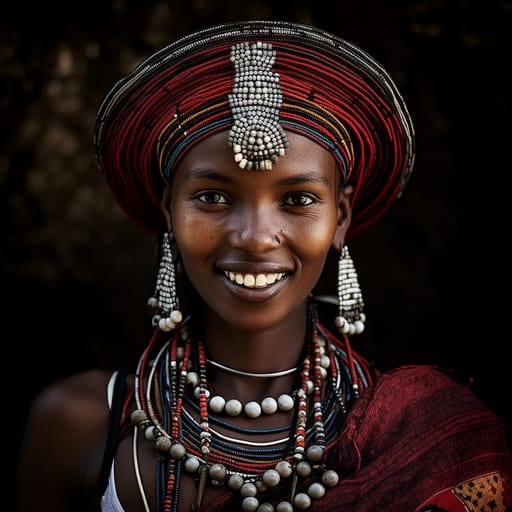
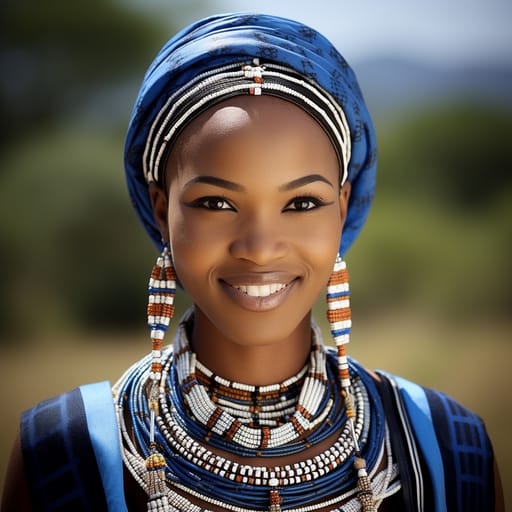
Typical Dhimba Phenotypes
Reference for AI generation: hair, eyes, skin, facial structure, build
Dhimba Body & Anatomy Reference
Per-feature anatomical profile for AI nude generation: Bantu / Khoisan Southern African phenotype
Dhimba Boobs & Breasts
The typical Dhimba bust is medium cup, full but moderate projection, in line with the wider Bantu / Khoisan Southern African pattern. Areolas usually fall in the 30-44mm range, with medium-brown to deep-brown areolar pigmentation. Compared with the heavier West African bust, Dhimba breasts sit forward and are generally moderately full; less projecting than West African norm. A faithful AI render of Dhimba tits keeps that shape and areola size.
Dhimba Ass & Hips
Butt shape among Dhimba women: the distinctive Khoisan-influenced steatopygic profile in some sub-populations (San, Khoekhoe); broader gluteal projection in Bantu-speaking groups, over wide iliac crests with notable lordosis in Khoisan-descended sub-populations. This follows Bantu / Khoisan Southern African ancestry and looks quite unlike the slim Cushitic East African profile. An accurate Dhimba ass in adult AI imagery keeps both the silhouette and the overall build (mesomorph; Khoisan-descended sub-populations show distinctive steatopygic fat deposition) instead of a generic average.
Dhimba Vagina & Pussy
Vulvar anatomy among Dhimba women: deep-brown labial pigmentation; the elongated labia minora documented in some Khoisan-descended populations. Pubic hair tends to be tightly-coiled coarse texture, in the usual inverted-triangle pattern. Both follow Bantu / Khoisan Southern African pigmentation, which is why Dhimba pussy renders should not fall back on a pale, sparse Western template.
Dhimba Dicks & Penis
The Dhimba cock profile, from Bantu / Khoisan Southern African anthropometric data: regional mean ~14cm erect; moderate-to-above-average girth; deep-brown shaft pigmentation. Pubic hair has a tightly-coiled coarse texture and forms the usual inverted-V pattern. Whether Dhimba men are circumcised follows religious and cultural practice rather than phenotype.
Dhimba Body, Curves & Build
Build and curves among Dhimba women follow the Bantu / Khoisan Southern African pattern: mesomorph; Khoisan-descended sub-populations show distinctive steatopygic fat deposition, mean adult female BMI 24-28. Proportions matter as much as skin tone, so Dhimba figures should keep their regional height and limb ratios.
Dhimba Skin Tone & Hair Texture
The Dhimba skin range is medium-brown to deep-brown (Fitzpatrick V-VI); lighter in Khoisan-descended populations, and hair tends to be tightly-coiled 4A-4C; the distinctive 'peppercorn' tight-spiral texture in Khoisan-descended populations. That combination marks the Bantu / Khoisan Southern African phenotype, and skin tone is the trait AI generators most often get wrong for Dhimba women.
Explore phenotype categories
Structured taxonomy with peer-reviewed scales · 22 anatomical categories
Erotic Poses & Sex Positions
From the pose catalog: 219 named positions with reference skeletons
Frequently asked questions about Dhimba people
Where is the Dhimba homeland?
The Dhimba homeland is Lower Kunene River valley, Namibe Province, Angola (and Kunene Region, Namibia) in Southern Africa.
What language do Dhimba people speak?
Dhimba people primarily speak Otjidhimba (Zemba), a Herero-cluster Bantu language (Niger-Congo).
What religion do Dhimba people practice?
The predominant religion among Dhimba people is Traditional animism (ancestor veneration).






Make your own Dhimba images
Five a day, free, no credits to buy. The studio starts from this group's phenotype data, so you can set body type, pose and style and keep the traits accurate.
Start with Dhimba