Help us get this right
Does this portrait look right for Bodo?
One tap. It takes a second and it is recorded.
3 say it looks right, 1 says it looks off.
Bodo Erotic
Bodoland (India)
Bathouism, Hinduism
Mech, Kachari
About Bodo People
The Bodo are the largest of the plains tribes of Assam, concentrated in the foothills and floodplain north of the Brahmaputra in what is now the Bodoland Territorial Region. They are an old presence in the eastern Himalayan frontier — the kind of group whose name sits beneath several others, since Mech, Kachari, Dimasa, Tiwa and Rabha all trace lineages back to a broader Bodo-Kachari world that once held political weight from Cooch Behar to the Dimasa hills before successive kingdoms fragmented and Sanskritized over the medieval centuries.
Their language belongs to the Sal branch of Sino-Tibetan, a cousin to Garo and more distantly to the Bodo-Garo languages of the hills, and it sits awkwardly among Indo-Aryan neighbors like Assamese — a tonal, agglutinative outlier in a region that long pressured minority tongues toward assimilation. That pressure is not abstract. The push to keep Bodo in schools, in print, and in official use was the spine of a long political movement; Bodo is now written in Devanagari and recognized in the Indian constitution's Eighth Schedule, an outcome won rather than granted.
Religion among the Bodo runs along two main currents that often overlap in the same household. Bathouism is the indigenous tradition, organized around the worship of Bathoubwrai — the supreme deity — represented not by an idol but by a living sijou plant (a species of Euphorbia) planted in a small earthen altar in the courtyard, ringed by a bamboo fence with five pairs of stakes representing the five fundamental elements. It is a domestic religion, tied to the homestead. Alongside it, many Bodo households practice forms of Hinduism, often the reformist Brahma Dharma introduced in the late nineteenth century, and a smaller but visible Christian minority has grown since the colonial period.
Daily life still leans agricultural — rice, areca, mustard — and the loom is genuinely central rather than ceremonially so; the dokhona, the wrapped and tied women's garment woven at home, is everyday dress, not festival costume. The Bwisagu festival marks the Assamese new year in April with the kherai dance and the bamboo flute and kham drum, and it functions as much as a community reset as a religious occasion. The Mech, settled further west into the Bengal duars and the Nepal Terai, and the Kachari, identifying more strongly with the older royal lineage, are recognizable branches of the same people rather than separate groups.
Related ethnic groups
Groups that share Bodo's homeland, region, language, or religious tradition. These are likely candidates for comparative phenotype reference.
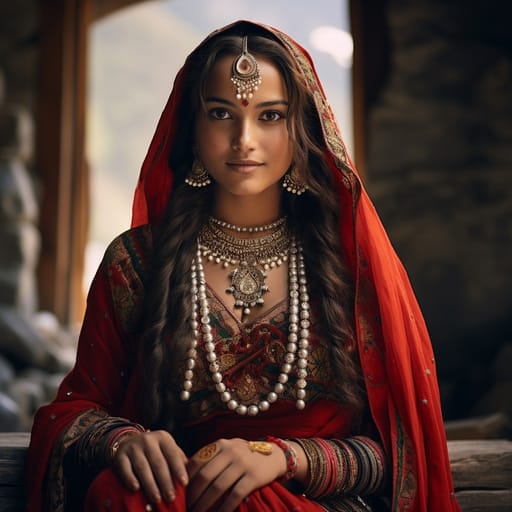
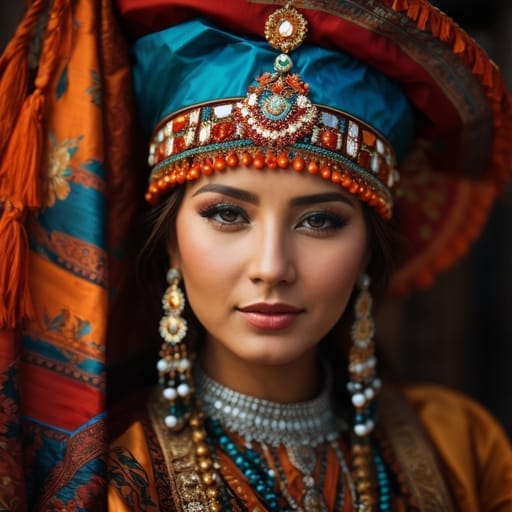
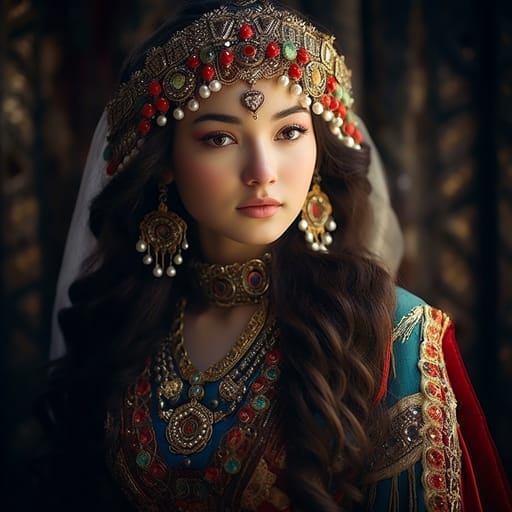
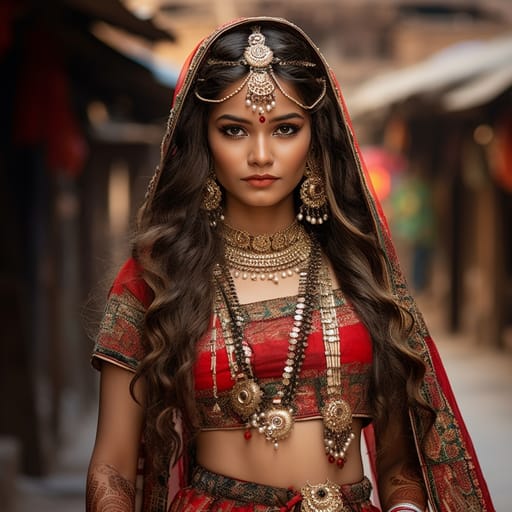
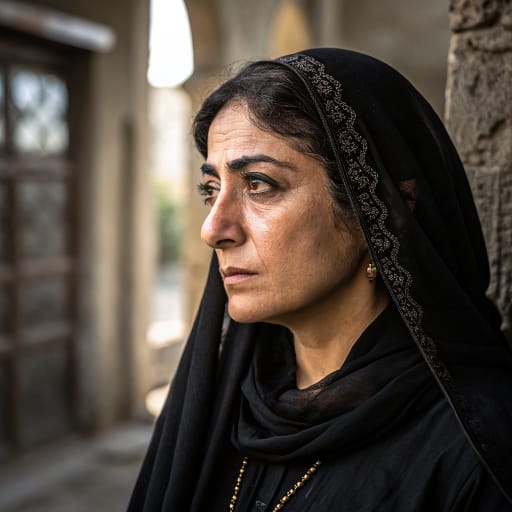
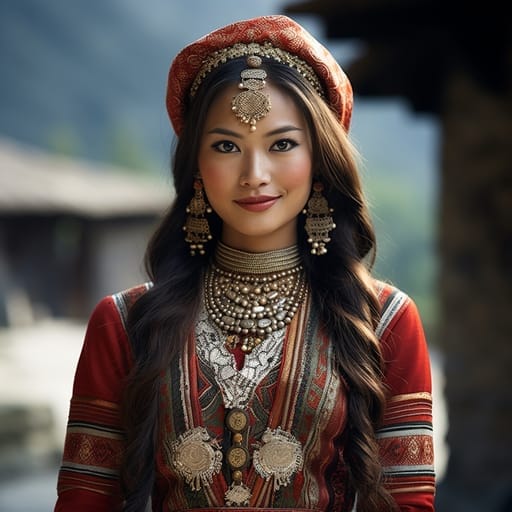
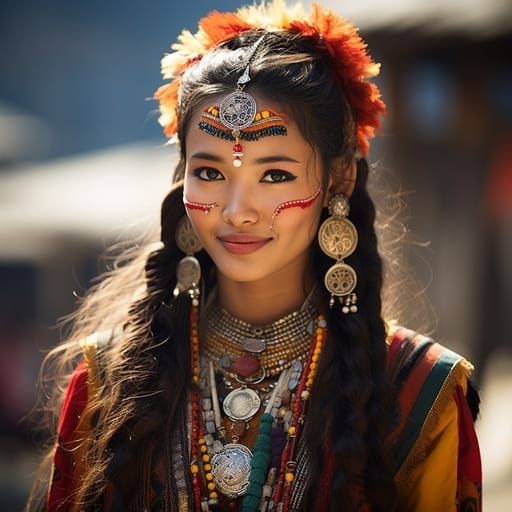
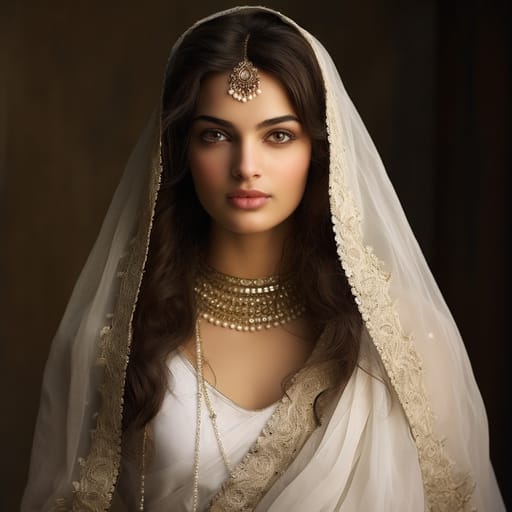
Typical Bodo Phenotypes
Reference for AI generation: hair, eyes, skin, facial structure, build
The Bodo are an indigenous Sino-Tibetan-speaking people of the Brahmaputra Valley and the Bodoland foothills, and their phenotype reflects that lineage clearly — they sit visibly apart from the Indo-Aryan and Dravidian-descended populations that dominate most of South Asia, and read as a Northeast Indian / Tibeto-Burman population first.
Hair is uniformly black to very dark brown, almost always straight, with a coarse round-shafted texture that holds heavy weight without much wave. Premature graying is uncommon. Facial and body hair runs sparse on men, consistent with broader Tibeto-Burman patterns, and beards tend to be thin and patchy rather than dense.
Eyes are dark brown to near-black. The epicanthic fold is present in the great majority of Bodos — typically a softer, partial fold rather than the deep monolid common further north — giving the eye a gently almond-shaped opening with a slight upward outer canthus. True double-fold eyelids occur but are the minority.
Skin tone clusters in the warm-medium range, roughly Fitzpatrick III–IV, with a distinct yellow-olive undertone that distinguishes Bodos from the redder or more umber undertones seen in neighboring Assamese caste-Hindu and tribal Khasi populations. Outdoor agrarian life darkens exposed skin noticeably; covered skin reads several shades lighter.
Facial structure is the clearest tell: relatively flat midface, broad and prominent zygomatic (cheek) bones, a short nose with a low-to-medium bridge and moderately wide alae, and a rounded, sometimes slightly receding chin. Lips are medium in fullness — neither thin nor pronounced. The boxers Ankushita and Jamuna Boro show the build template well: compact, muscular, broad-shouldered for stature.
Stature runs short to medium, with adult men commonly 160–168 cm and women 150–158 cm, and body composition tending toward lean-stocky with low limb-to-torso ratios. Variation between the Mech (western, more Bengal-adjacent) and Kachari branches is minor and largely a matter of slightly lighter skin and looser facial features in Mech populations rather than any sharp morphological break.
Bodo Body & Anatomy Reference
Per-feature anatomical profile for AI nude generation: Indo-Aryan / Dravidian South Asian phenotype
Bodo Boobs & Breasts
Bodo tits and boobs run medium-to-large cup, moderate-to-full projection, the classic Indo-Aryan / Dravidian South Asian bust profile. Bodo nipples and areolas show medium-brown to dark-brown areolar pigmentation against the wheatish-to-brown skin tone, with areolar diameter typically in the 32-46mm range and forward-set positioning rather than the smaller East Asian bust profile. Bodo breasts trend full and soft, generally fuller than the East Asian norm, a function of the endomorph-to-mesomorph with fuller hip deposition body habitus and the mean adult female BMI 22-25. For anatomically accurate AI-generated Bodo nudes the render preserves the medium-to-large cup, moderate-to-full projection shape, 32-46mm areolas with medium-brown to dark-brown pigmentation, and the torso proportions of the Indo-Aryan / Dravidian South Asian phenotype.
Bodo Ass & Hips
Bodo hips and butt usually read as medium-to-full, moderate-to-high projection, classic curvy hip profile. The skeletal base is medium-to-wide iliac crests, full gluteal-femoral fat distribution, the Indo-Aryan / Dravidian South Asian pattern. Set against the slim hip profile of East Asian women, the difference is easy to see, and the hip-to-waist ratio is often what identifies Bodo women in photos.
Bodo Vagina & Pussy
Expect medium-brown to dark-brown labial pigmentation, fuller labia minora projection on Bodo women, in keeping with Indo-Aryan / Dravidian South Asian ancestry. The pubic hair is straight-to-wavy coarse texture, dense distribution. Coloring should run evenly from the wheatish to brown skin of the thighs to the labia, and Bodo nude imagery should keep the hair's straight-to-wavy coarse texture.
Bodo Dicks & Penis
Bodo dick and penile anatomy in adult AI generation should anchor on the regional reference data: regional mean ~13cm erect, moderate girth, and medium-brown shaft pigmentation. The Bodo cock profile reflects the Indo-Aryan / Dravidian South Asian population's anthropometric measurements. The shaft pigmentation should track the surrounding wheatish to brown skin tone, and the pubic hair should keep its straight-to-wavy coarse texture in the typical inverted-V escutcheon.
Bodo Body, Curves & Build
Bodo body type: endomorph-to-mesomorph with fuller hip deposition, with mean adult female BMI 22-25. This is the typical Indo-Aryan / Dravidian South Asian build. Height range, shoulder-to-hip ratio and fat distribution all follow from it, which is what an accurate Bodo nude body should show.
Bodo Skin Tone & Hair Texture
Bodo skin tone falls in the wheatish to brown (Fitzpatrick III-V) band, the surface signal most often miscalibrated by generic AI nude generators. Bodo hair texture is typically straight-to-wavy 1A-2B, dense, dark-brown to black, characteristic of the Indo-Aryan / Dravidian South Asian phenotype. In Bodo nude renders the skin should hold that band consistently across the body.
Data depth
0/100Coverage of image-grounded phenotype observations · drives AI generation diversity
- Sample size
- 0/40· 0 images
- Image quality
- 0/30· 0% high
- Confidence
- 0/20
- Source diversity
- 0/10
- ·No image observations yet
Explore phenotype categories
Structured taxonomy with peer-reviewed scales · 22 anatomical categories
Notable Bodo People
11 reference figures, sourced from Wikipedia
- Rajni Basumatary, Filmmaker and actress
- Ankushita Boro, Indian boxer
- Jamuna Boro, Indian boxer
- Pramod Boro, Former President of ABSU, President of UPPL, CEM of Bodoland Territorial Council
- Harishankar Brahma, 19th Chief Election Commissioner of India
- Upendra Nath Brahma, Boro activist, known by the title Bodofa
- Sansuma Khunggur Bwiswmuthiary, former Member of parliament
- Hagrama Mohilary, president of Bodoland People's Front political party and former Chief Executi…
- Ranjit Shekhar Mooshahary, former governor of Meghalaya, retired IPS officer, former director-general of…
- Halicharan Narzary, Indian footballer
- Proneeta Swargiary, [citation needed] Dance India Dance (season 5) Winner
Erotic Poses & Sex Positions
From the pose catalog: 219 named positions with reference skeletons
Frequently asked questions about Bodo people
Where is the Bodo homeland?
The Bodo homeland is Bodoland (India) in Southern Asia.
What language do Bodo people speak?
Bodo people primarily speak Sino-Tibetan / Sal / Bodo.
What religion do Bodo people practice?
The predominant religion among Bodo people is Bathouism, Hinduism.
What does a typical Bodo woman look like?
Bodo women typically have straight black to very dark brown hair and dark brown eyes with a soft, partial epicanthic fold. Skin sits in the Fitzpatrick III to IV range with a distinct yellow-olive undertone. Faces have a relatively flat midface, broad, prominent cheekbones, a short nose with a low-to-medium bridge and medium lips, and women commonly stand 150 to 158 cm with a compact build.






Make your own Bodo images
Five a day, free, no credits to buy. The studio starts from this group's phenotype data, so you can set body type, pose and style and keep the traits accurate.
Start with Bodo