Help us get this right
Does this portrait look right for Bannock?
Nobody has judged this one yet. You would be the first.
Bannock Erotic
Fort Hall Reservation in southeastern Idaho, with a traditional range across southern Idaho, northern Nevada, southeastern Oregon and western Wyoming.
Bannock, a dialect of Northern Paiute (Western Numic, Uto-Aztecan); Shoshoni and English are also spoken at Fort Hall.
Traditional ceremonial practice, including the Sun Dance, alongside Christian denominations.
A Northern Paiute offshoot within the Numic-speaking peoples of the Great Basin, enrolled today with the Northern Shoshone as the Shoshone-Bannock Tribes.
About Bannock People
The Bannock are defined less by a homeland than by a move. They started out Northern Paiute, people of the sagebrush country in what is now northern Nevada and southeastern Oregon, and at some point in the seventeenth or eighteenth century, with horses newly in hand, they pushed east onto the Snake River plain and settled in among the Northern Shoshone. Nearly everything else follows from that. They hunted with the Shoshone, camped with them, married into them, fought beside them, and were counted with them by every treaty commissioner who came through. What they did not do was change languages. Bannock is a dialect of Northern Paiute, in the Western Numic branch of Uto-Aztecan. Shoshoni is Central Numic. The two are cousins rather than twins, and a speaker of one does not simply understand the other. Two centuries of shared camps, shared kin and a shared reservation have not collapsed the difference.
The horse made them fast and made them a power in the region. They ranged east into Wyoming and Montana for buffalo, worked the salmon runs on the Snake and its tributaries, and came back each spring to the camas prairies, where women dug the blue-flowered bulb that carried Great Basin families through winter. Camas is why there was a war. The 1868 treaty signed at Fort Bridger tied the Bannock to the Fort Hall Reservation in southeastern Idaho and, as they understood it, left them their digging grounds on Camas Prairie. The treaty as copied out said Kansas Prairie, a clerk's slip that proved convenient for everyone but the Bannock. Settlers ran hogs on the prairie, the hogs ate the bulbs out of the ground, rations at Fort Hall were thin, and in 1878 Buffalo Horn led a rising that ran west into Oregon and was finished inside of four months. He was killed in the first weeks of it.
Fort Hall is still where the Bannock are, a reservation of more than half a million acres above the Snake River near Pocatello, run by an elected business council shared with the Shoshone. The Sun Dance is kept. The Shoshone-Bannock Festival each August fills the grounds with dancers, hand game players and Indian relay riders from across the West. The hardest thing to hold is the language: fluent Bannock speakers are few and mostly old, and the tribes teach both Shoshoni and Bannock, one community carrying two languages on the budget most would spend on one.
Related ethnic groups
Groups that share Bannock's homeland, region, language, or religious tradition. These are likely candidates for comparative phenotype reference.
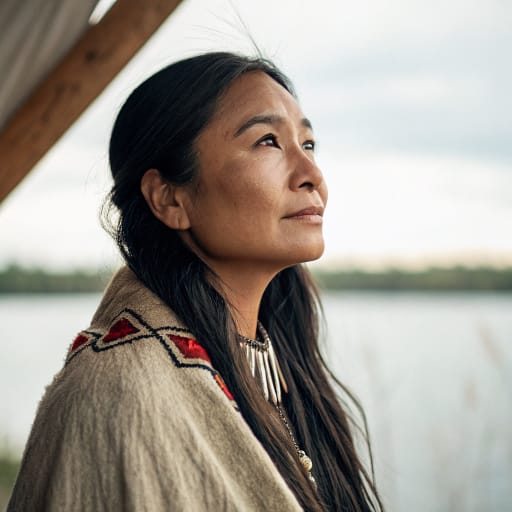
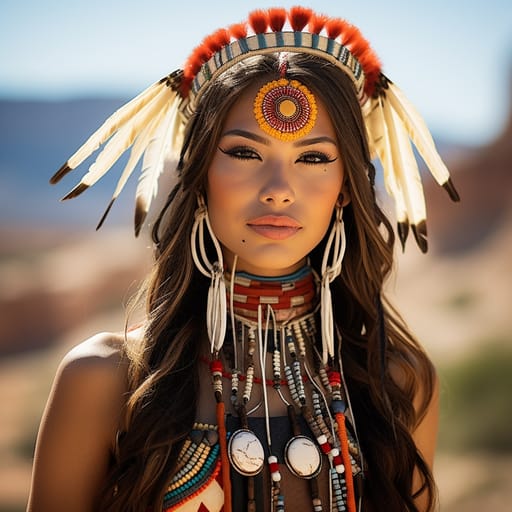
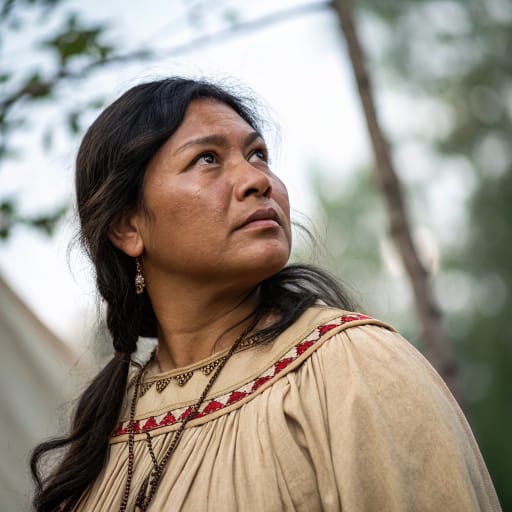
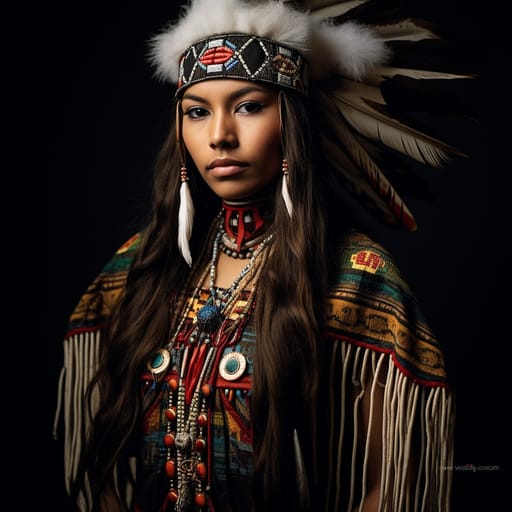
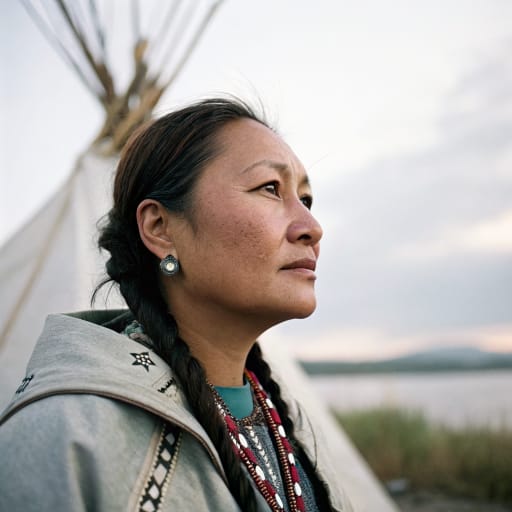
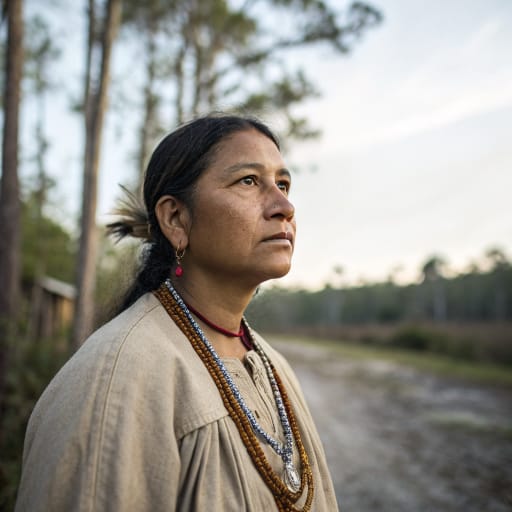
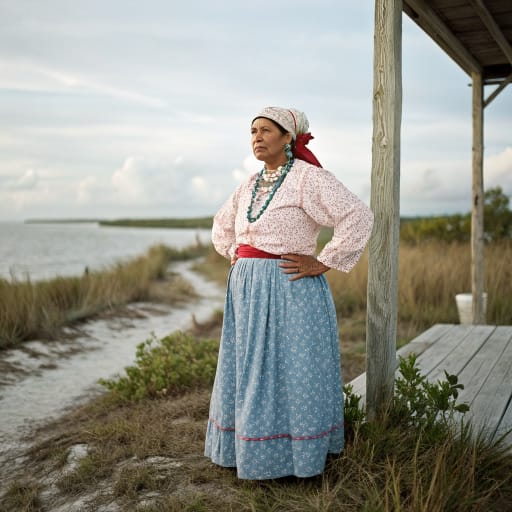
Typical Bannock Phenotypes
Reference for AI generation: hair, eyes, skin, facial structure, build
Bannock Body & Anatomy Reference
Indigenous Northern American / Algonquian-Iroquoian phenotype: anatomy reference for AI nude generation
Bannock Boobs & Breasts
Bannock tits and boobs run medium cup, moderate projection, the classic Indigenous Northern American / Algonquian-Iroquoian bust profile. Bannock nipples and areolas show medium-brown areolar pigmentation against the copper-to-medium-brown skin tone, with areolar diameter typically in the 30-44mm range and forward-set positioning rather than the smaller East Asian bust. Bannock breasts trend full and moderate projection, a function of the mesomorph, broader frame in northern Indigenous populations body habitus and the mean adult female BMI 25-28. For anatomically accurate AI-generated Bannock nudes the render preserves the medium cup, moderate projection shape, 30-44mm areolas with medium-brown pigmentation, and the torso proportions of the Indigenous Northern American / Algonquian-Iroquoian phenotype.
Bannock Ass & Hips
Bannock hips and butt usually read as medium, moderate-to-full projection. The skeletal base is medium iliac crests, the Indigenous Northern American / Algonquian-Iroquoian pattern. Set against the slim East Asian narrow-hip profile, the difference is easy to see, and the hip-to-waist ratio is often what identifies Bannock women in photos.
Bannock Vagina & Pussy
Expect medium-brown labial pigmentation on Bannock women, in keeping with Indigenous Northern American / Algonquian-Iroquoian ancestry. The pubic hair is straight medium-coarse texture. Coloring should run evenly from the copper to medium-brown skin of the thighs to the labia, and Bannock nude imagery should keep the hair's straight medium-coarse texture.
Bannock Dicks & Penis
Bannock dick and penile anatomy in adult AI generation should anchor on the regional reference data: regional mean ~13cm erect, moderate girth, and medium-brown shaft pigmentation. The Bannock cock profile reflects the Indigenous Northern American / Algonquian-Iroquoian population's anthropometric measurements. The shaft pigmentation should track the surrounding copper to medium-brown skin tone, and the pubic hair should keep its straight medium-coarse texture in the typical inverted-V escutcheon.
Bannock Body, Curves & Build
Bannock body type: mesomorph, broader frame in northern Indigenous populations, with mean adult female BMI 25-28. This is the typical Indigenous Northern American / Algonquian-Iroquoian build. Height range, shoulder-to-hip ratio and fat distribution all follow from it, which is what an accurate Bannock nude body should show.
Bannock Skin Tone & Hair Texture
Bannock skin tone falls in the copper to medium-brown (Fitzpatrick III-V) band, the surface signal most often miscalibrated by generic AI nude generators. Bannock hair texture is typically straight 1A, dark-brown to black, often thick and dense, characteristic of the Indigenous Northern American / Algonquian-Iroquoian phenotype. In Bannock nude renders the skin should hold that band consistently across the body.
Explore phenotype categories
Structured taxonomy with peer-reviewed scales · 22 anatomical categories
Erotic Poses & Sex Positions
From the pose catalog: 219 named positions with reference skeletons
Frequently asked questions about Bannock people
Where is the Bannock homeland?
The Bannock homeland is Fort Hall Reservation in southeastern Idaho, with a traditional range across southern Idaho, northern Nevada, southeastern Oregon and western Wyoming. in North America.
What language do Bannock people speak?
Bannock people primarily speak Bannock, a dialect of Northern Paiute (Western Numic, Uto-Aztecan); Shoshoni and English are also spoken at Fort Hall..
What religion do Bannock people practice?
The predominant religion among Bannock people is Traditional ceremonial practice, including the Sun Dance, alongside Christian denominations..






Make your own Bannock images
Five a day, free, no credits to buy. The studio starts from this group's phenotype data, so you can set body type, pose and style and keep the traits accurate.
Start with Bannock