No portrait yet
Apalachee Erotic
The Florida Panhandle between the Aucilla and Ochlockonee rivers, around present-day Tallahassee, United States; descendant community in central Louisiana.
Apalachee (Muskogean), extinct since the nineteenth century
Mississippian ceremonial religion, then Catholicism after the Franciscan missions of the 1630s; descendants remain Catholic.
Muskogean-speaking peoples of the Southeastern Woodlands; represented today by the Talimali Band of Louisiana.
About Apalachee People
The Apalachee were a Muskogean-speaking farming people of the Florida Panhandle, dominant in that country for centuries until English-allied raiders broke their towns apart in 1704. Their descendants live today in central Louisiana, where a community organized as the Talimali Band is recognized by the state though not by the federal government. Apalachee territory ran between the Aucilla and Ochlockonee rivers at the head of Apalachee Bay, and it looked nothing like the sandy scrub most people picture when they think of Florida. The red clay hills around present-day Tallahassee hold deep, workable soil, and the Apalachee farmed it hard, producing maize surpluses large enough to make them both wealthy and worth attacking. Their ancestors raised the mound center at Lake Jackson and buried their elite with hammered copper ornaments. By the sixteenth century they had a reputation among neighbors, and then among Spaniards, as formidable archers who gave no ground: Panfilo de Narvaez blundered into their country in 1528 and left in a hurry, and Hernando de Soto spent the winter of 1539 occupying their principal town, Anhaica.
Franciscans arrived in 1633, and the missions took hold here in a way they rarely did elsewhere in the Southeast. Within a generation the Apalachee Province was the breadbasket of Spanish Florida, its corn hauled east to feed St. Augustine, and San Luis de Talimali served as the colony's western capital: a joint Spanish and Apalachee town whose council house, a round building of poles and thatch, could hold a couple of thousand people. Baptism did not mean giving up everything. The Apalachee kept playing their ball game, a rough town-against-town contest fought over a small deerskin ball and a goalpost crowned with an eagle's nest, heavily wagered on and hard on the players, until a friar wrote a treatise against it in 1676 and got it banned. In 1688 Apalachee chiefs sent a letter to the king of Spain composed in their own language, which survives as one of the very few texts anyone has in Apalachee. The end came fast. In 1704 James Moore led Carolina militia and Creek allies through the province, burning missions and carrying off thousands into slavery, and the survivors scattered toward St. Augustine, Pensacola, Mobile, and finally the Red River in Louisiana. The language died in the nineteenth century. The name did not: a cartographer's guess carried it several hundred miles north, and the Appalachian Mountains bear it still.
Related ethnic groups
Groups that share Apalachee's homeland, region, language, or religious tradition. These are likely candidates for comparative phenotype reference.

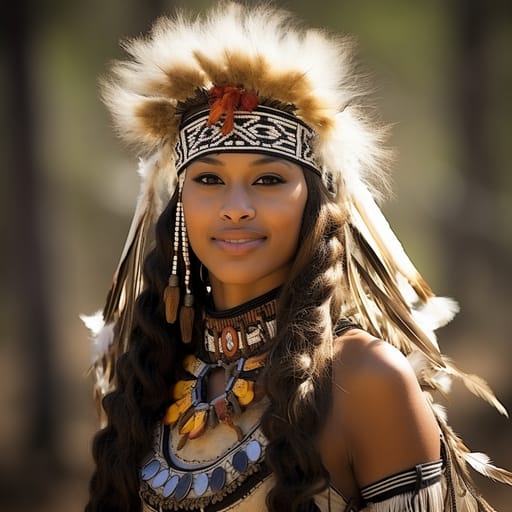
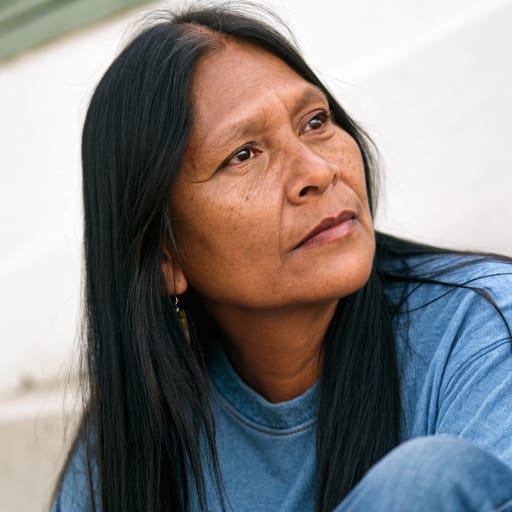
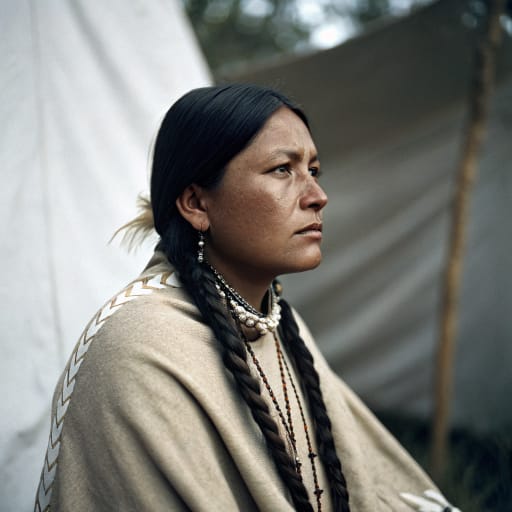
Typical Apalachee Phenotypes
Reference for AI generation: hair, eyes, skin, facial structure, build
Apalachee Body & Anatomy Reference
Per-feature anatomical profile for AI nude generation: Indigenous Northern American / Algonquian-Iroquoian phenotype
Apalachee Boobs & Breasts
Apalachee boobs follow the Indigenous Northern American / Algonquian-Iroquoian profile: medium cup, moderate projection. Areolar diameter is usually 30-44mm, and the coloring is medium-brown areolar pigmentation against the copper-to-medium-brown skin tone. Breast shape tracks body composition (mesomorph, broader frame in northern Indigenous populations, mean adult female BMI 25-28), so Apalachee breasts tend to be full and moderate projection. Expect a forward-set shape, not the smaller East Asian bust.
Apalachee Ass & Hips
Apalachee ass and hip morphology presents as medium, moderate-to-full projection, distinctly different from the slim East Asian narrow-hip profile. The Apalachee pelvic profile shows medium iliac crests, anchored in the Indigenous Northern American / Algonquian-Iroquoian skeletal pattern. Apalachee butt shots in adult AI imagery should render the medium, moderate-to-full projection silhouette with the overall build (mesomorph, broader frame in northern Indigenous populations) and the fat distribution typical of the Indigenous Northern American / Algonquian-Iroquoian phenotype.
Apalachee Vagina & Pussy
Apalachee pussy anatomy typically shows medium-brown labial pigmentation. Pubic hair is usually straight medium-coarse texture. In AI-generated Apalachee nudes, labial color should blend into the copper to medium-brown skin with a gradual transition, and the hair should keep its straight medium-coarse texture.
Apalachee Dicks & Penis
Penis reference for Apalachee men: regional mean ~13cm erect, moderate girth. Coloring: medium-brown shaft pigmentation. An accurate Apalachee cock in AI imagery matches the surrounding copper to medium-brown skin rather than a generic porn default. Circumcision depends on religion and custom, not ancestry.
Apalachee Body, Curves & Build
The Apalachee figure is generally mesomorph, broader frame in northern Indigenous populations, with mean adult female BMI 25-28, characteristic of Indigenous Northern American / Algonquian-Iroquoian ancestry. AI image tools tend to flatten regional body types into a few stock shapes; here the Apalachee build is kept as its own reference.
Apalachee Skin Tone & Hair Texture
Skin: copper to medium-brown (Fitzpatrick III-V). Hair: straight 1A, dark-brown to black, often thick and dense. Both are typical of Indigenous Northern American / Algonquian-Iroquoian ancestry. The most common mistake in AI nudes of Apalachee women is a body rendered lighter than the face.
Explore phenotype categories
Structured taxonomy with peer-reviewed scales · 22 anatomical categories
Erotic Poses & Sex Positions
From the pose catalog: 219 named positions with reference skeletons
Frequently asked questions about Apalachee people
Where is the Apalachee homeland?
The Apalachee homeland is The Florida Panhandle between the Aucilla and Ochlockonee rivers, around present-day Tallahassee, United States; descendant community in central Louisiana. in North America.
What language do Apalachee people speak?
Apalachee people primarily speak Apalachee (Muskogean), extinct since the nineteenth century.
What religion do Apalachee people practice?
The predominant religion among Apalachee people is Mississippian ceremonial religion, then Catholicism after the Franciscan missions of the 1630s; descendants remain Catholic..






Make your own Apalachee images
Five a day, free, no credits to buy. The studio starts from this group's phenotype data, so you can set body type, pose and style and keep the traits accurate.
Start with Apalachee