The Himba and the Herero-kin of the Kaokoveld and southwest Angola
July 9, 2026
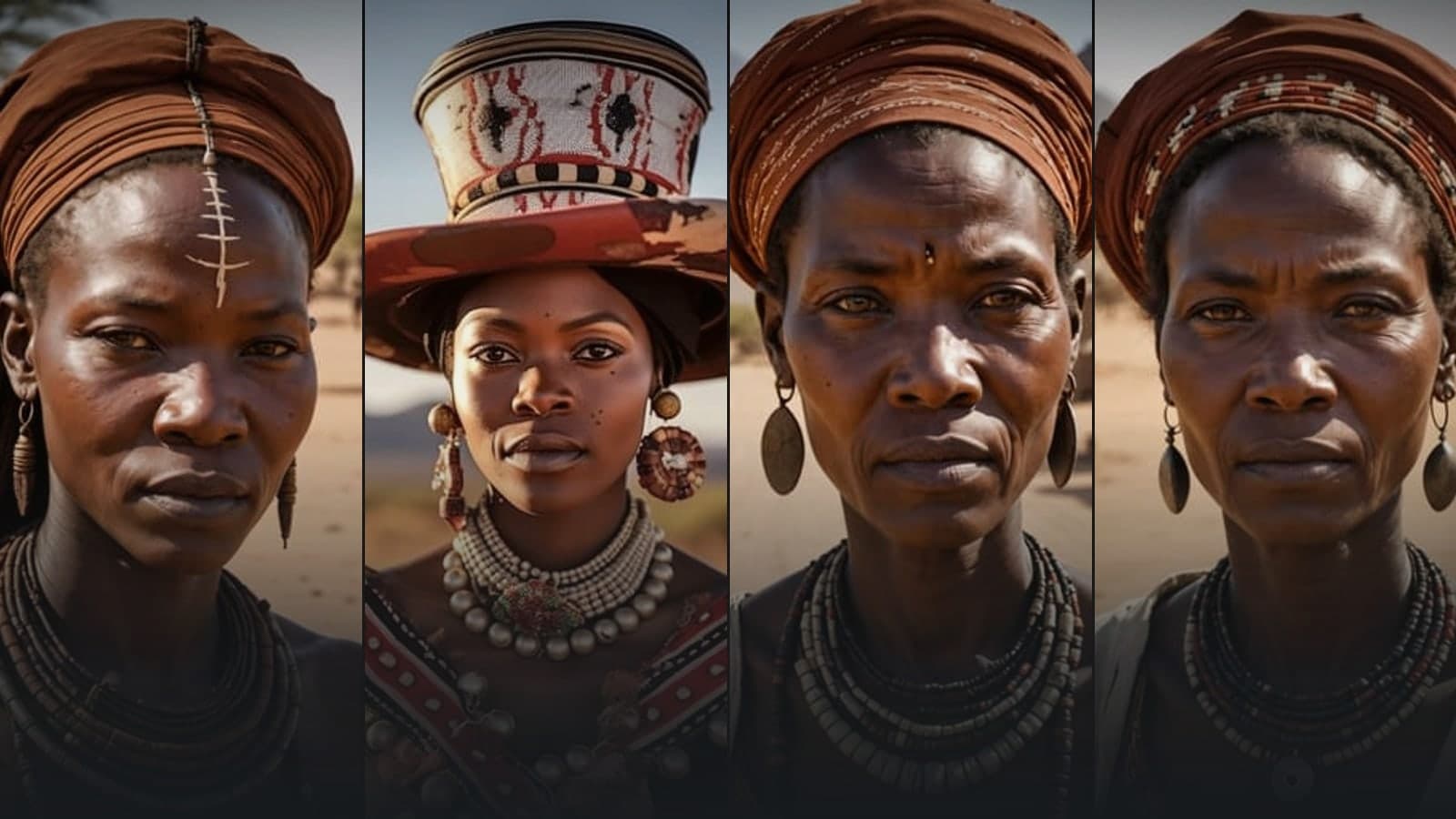
The arid Kaokoveld, the mountainous northwest corner of Namibia, and the Cunene River basin that separates it from southern Angola are home to a cluster of closely related Bantu-speaking pastoralist peoples. At its center are the Himba, whose women, coated head to foot in the red ochre paste called otjize, are among the most photographed people in Africa. But the Himba are one branch of a larger family of Herero-speaking herders, and reading them alongside their kin, the Dhimba, Mucubal, Hakaona, Cuvale, and others, shows how a single pastoral tradition diversified across a harsh landscape and a colonial border.
As with every catalog cluster, the profiles here are modal descriptions of characteristic practice, not predictions about individuals. Otjize, hairstyle, and dress signal age and marital status and are cultural rather than fixed traits. See reading the phenotype catalog for the interpretive rules.
One language, many herds
The peoples of this cluster mostly speak dialects of Herero (Otjiherero), a Bantu language of the Niger-Congo family, or the closely related Nyaneka-Nkhumbi languages just to the north in Angola. They descend from Bantu-speaking cattle herders who moved into the southwest African drylands over the last several centuries. The Himba, whose autonym is OvaHimba, are the group that remained in the Kaokoveld practicing an older, more mobile pastoralism while other Herero moved south and adopted different ways of life. Across the Cunene in Angola, the Dhimba (Tjimba) are effectively the same people divided by an international boundary.
The wider family fans out from there:
- The Mucubal (Mucubai) of southwest Angola's Namibe and Huila provinces, cattle herders known for the ompota headdress worn by married women and for distinctive geometric body ornament.
- The Hakaona and Cuvale, Herero-related pastoralist groups of the same Angolan drylands, each with its own hairstyle and adornment grammar.
- The Nyaneka, an agropastoral people of the Huila plateau who speak a Nyaneka-Nkhumbi language and are culturally adjacent to the Herero-kin proper.
- The Herero themselves and the related Mbanderu, whose women, by contrast with the Himba, are known for the Victorian-derived otjikaiva dress and horn-shaped headdress adopted during the German colonial period, a striking illustration of how far a single people's visual signature can diverge.
Society, cattle, and the sacred fire
Understanding why the Himba look the way they do means understanding how they live. The Himba economy centers on cattle, goats, and sheep, with cattle serving as the primary measure of wealth and status while daily milk and meat come largely from the goat herds. Homesteads are small, cone-shaped huts of saplings, mud, and dung arranged around a central livestock enclosure. Between the main hut and the cattle pen burns the okuruwo, the sacred ancestral fire, which is never allowed to go out and which links the living family to its ancestors and, through them, to the high god Mukuru. A designated fire-keeper tends it, and much of daily ritual life orients around the line running from the hut through the fire to the cattle enclosure.
Himba society is organized through a distinctive double-descent system, meaning each person belongs simultaneously to a patriclan (oruzo) traced through the father and a matriclan (eanda) traced through the mother, with each line governing different rights and inheritances. This is a rare kinship arrangement globally and one of the features that has drawn anthropologists to the group. Herding and long dry-season migrations in search of pasture fall largely to men and boys, while women manage the homestead, milk the livestock, gather firewood and water, and perform the elaborate daily body care for which the group is known. That division of labor is directly why the otjize signature is so consistent and so thoroughly documented: the maintenance of the body is women's daily work and a marker of social competence.
The Angolan kin groups share the pastoral base but adapt it to their own settings. The Mucubal, for instance, combine cattle-keeping with some cultivation on the Angolan plateau and are known for a rich tradition of oral poetry and for age-based initiation, while the semi-nomadic Cuvale held to a more strictly cattle-centered life that brought them into repeated conflict with the colonial Portuguese administration.
Phenotype and the otjize signature
In terms of the skin atlas, these are dark-skinned southern-Bantu populations, modal Fitzpatrick V to VI. Body build follows the tall, relatively linear pattern common to cattle-herding peoples of the region. But the defining visual feature of the cluster is not skin or build; it is what the Himba and their kin do to the surface of the body.
Himba women apply otjize daily, a paste of butterfat, red ochre (hematite), and aromatic omuzumba resin, to skin and hair. The result is a deep, uniform reddish sheen that protects against the intense sun and biting insects and embodies a local ideal of beauty tied to the color red, which stands for earth and blood and thus for life. Because water is scarce in the Kaokoveld, women do not bathe with water but cleanse with daily smoke baths of aromatic herbs, renewing the otjize rather than washing it away. This regimen makes the otjize covering a semi-permanent second skin, which is why Himba appearance reads as so consistent in the photographic record.
Hair is the second axis of the signature. Himba hairstyle is a precise code: young girls wear plaits pointed forward, women of marriageable age wear plaits framing the face, and married women or new mothers crown their ochre-caked braids with the erembe, a headpiece of tanned goatskin. Each of the kin groups has its own version of this code. The Mucubal ompota, a headdress built on a wooden or basketry frame and worn by married women, is a different solution to the same social problem of signaling status through the head.
A cluster split by a colonial border
The most important thing to understand about this group is that the Namibia-Angola border cuts straight through it. The Himba of the Kaokoveld and the Dhimba of southern Angola are the same pastoral tradition; the Mucubal, Hakaona, Cuvale, and Nyaneka are their less internationally famous Angolan cousins, far less documented precisely because decades of Angolan civil war closed the region to outside researchers and photographers. As a result, public familiarity is heavily lopsided: the Himba are globally recognized while the Angolan Herero-kin remain thinly documented in accessible reference sources despite sharing the same descent, economy, and adornment logic.
The phenotype atlas catalogs each group as its own entry, cross-linked to its kin so the whole family can be read together, which restores the connections that the border and the war obscured.
Where to start
- Begin with the Himba as the reference case, then follow the sibling links to the Dhimba across the Angolan border.
- For the less-documented Angolan branch, read the Mucubal, Hakaona, and Cuvale entries as a set.
- For the striking case of a single people whose visual signature diverged completely, compare the Himba with the Victorian-dress Herero and Mbanderu.
- The full cluster sits under the Southern Africa region hub.
Topics
More articles

Butt shape by ethnicity: what an MRI study found and what our database records
Sep 20, 2026
The Wodaabe and the Gerewol: male beauty, the yaake dance, and the Fulani pastoral world
Jul 9, 2026
San peoples of the Kalahari: the Khomani, Ju|'hoan, Taa, and their forager kin
Jul 9, 2026
The peoples of the Lower Omo Valley: Mursi, Suri, Karo, Hamar, and their neighbors
Jul 9, 2026