Help us get this right
Does this portrait look right for Mbanderu?
One tap. It takes a second and it is recorded.
1 says it looks right, 0 say it looks off.
Mbanderu Erotic
Omaheke Region near Gobabis, eastern Namibia (and western Botswana)
Otjiherero (Herero), a Bantu language (Niger-Congo)
Christianity and ancestral veneration
About Mbanderu People
The Mbanderu (endonym Ovambanderu), also called the Eastern Herero, are a Herero-speaking pastoralist people of eastern Namibia and the adjoining borderlands of Botswana, concentrated in the Omaheke sandveld around Gobabis. They share a language, a cattle-centred culture and a common origin with the wider Ovaherero, but they maintain a separate identity, their own traditional leadership and a distinct historical memory. Herero oral tradition holds that the Mbanderu separated from the main body of Herero during the long southward migrations that brought these peoples into present-day Namibia.
Society and subsistence
Mbanderu life traditionally centres on cattle, kept on the sparse grazing of the Kalahari sandveld and watered from wells and, in modern times, boreholes. Cattle are the measure of wealth, the substance of bridewealth and the focus of ancestral ritual, while smallstock and some cultivation supplement the diet. Descent is reckoned through the Herero double system of a patrilineal oruzo, which controls the sacred fire and ritual cattle, and a matrilineal eanda, through which livestock wealth is inherited. A holy fire (okuruwo) links each homestead to its ancestors. The Mbanderu suffered catastrophic losses during the German colonial war of 1904 to 1908, when many Herero and Mbanderu were killed or driven into the desert, an event that remains central to their collective memory and to their assertion of a distinct polity under their own chiefs.
Appearance and adornment
Like other Herero women, Mbanderu women are widely recognised for the ohorokova, a long, full-skirted Victorian-style gown built over several petticoats, adopted in the nineteenth century under German missionary influence and since transformed into a proud emblem of Herero identity. It is worn with the otjikaiva, a horizontal cloth headdress whose two points deliberately echo the horns of cattle, the animal at the heart of the culture. Garments are made in bold patterned fabrics, and each community and occasion has its favoured colours. Men wear tailored uniforms on ceremonial days, reflecting the martial history of the group. In everyday rural settings dress is plainer, but the horned headdress and flowing gown remain the defining visual signature of Mbanderu women.
The Mbanderu number in the tens of thousands and today combine stock-farming with town and wage-based livelihoods. They remain a well-documented Herero people, notable for a strong sense of separate identity within the broader Ovaherero nation of Namibia and Botswana.
Related ethnic groups
Groups that share Mbanderu's homeland, region, language, or religious tradition. These are likely candidates for comparative phenotype reference.
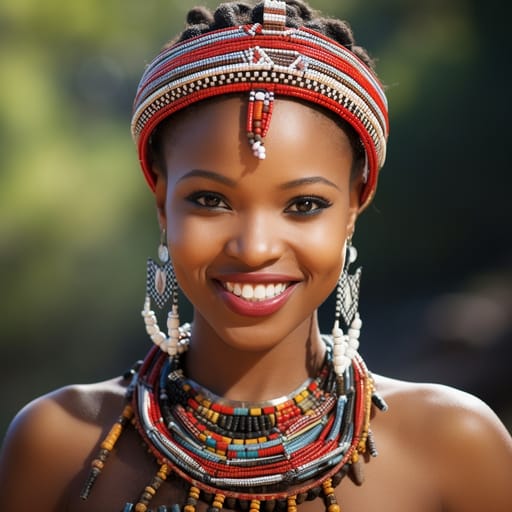
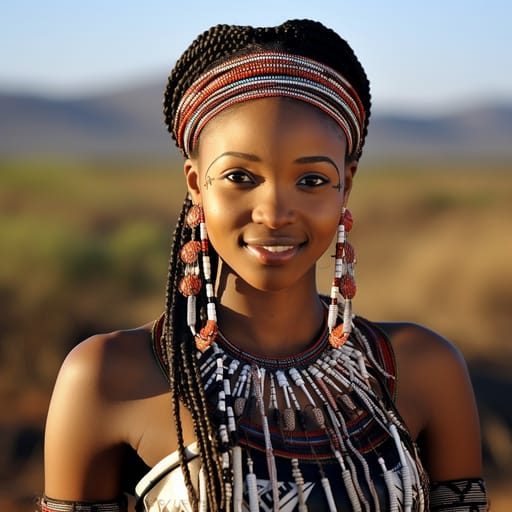
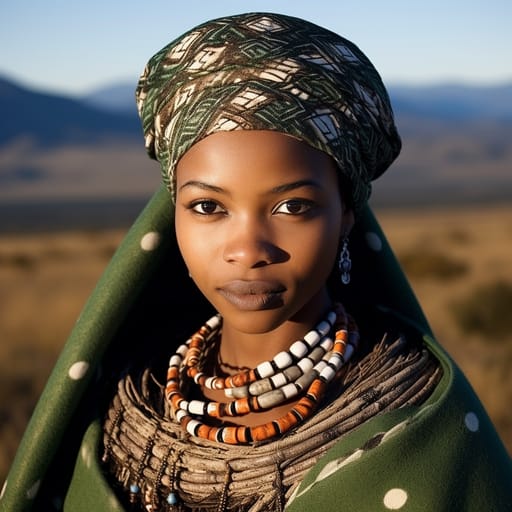
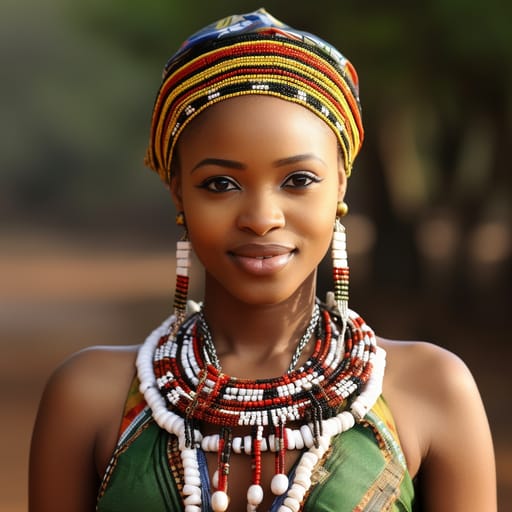
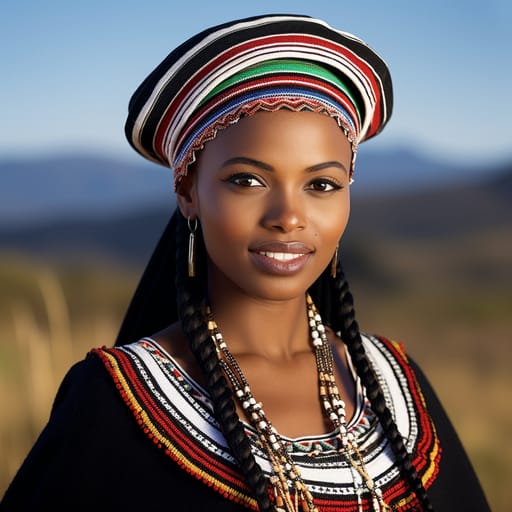

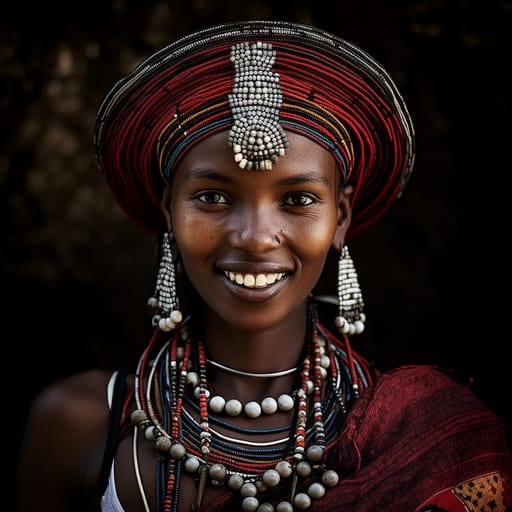
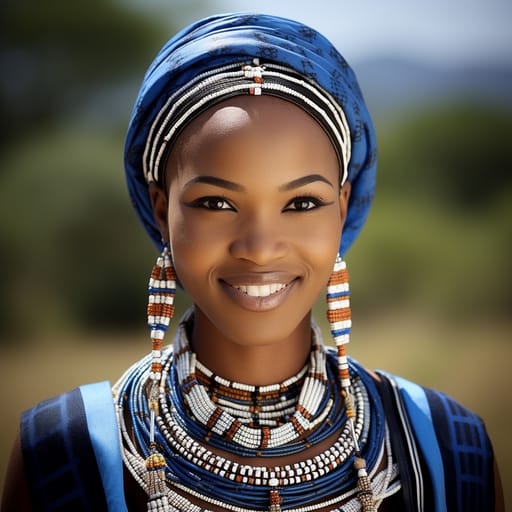
Typical Mbanderu Phenotypes
Reference for AI generation: hair, eyes, skin, facial structure, build
Mbanderu Body & Anatomy Reference
Anatomy by feature, Bantu / Khoisan Southern African phenotype
Mbanderu Boobs & Breasts
Mbanderu tits and boobs run medium cup, full but moderate projection, the classic Bantu / Khoisan Southern African bust profile. Mbanderu nipples and areolas show medium-brown to deep-brown areolar pigmentation, with areolar diameter typically in the 30-44mm range and forward-set positioning rather than the heavier West African bust. Mbanderu breasts trend moderately full; less projecting than West African norm, a function of the mesomorph; Khoisan-descended sub-populations show distinctive steatopygic fat deposition body habitus and the mean adult female BMI 24-28. For anatomically accurate AI-generated Mbanderu nudes the render preserves the medium cup, full but moderate projection shape, 30-44mm areolas with medium-brown to deep-brown pigmentation, and the torso proportions of the Bantu / Khoisan Southern African phenotype.
Mbanderu Ass & Hips
Mbanderu hips and butt usually read as the distinctive Khoisan-influenced steatopygic profile in some sub-populations (San, Khoekhoe); broader gluteal projection in Bantu-speaking groups. The skeletal base is wide iliac crests with notable lordosis in Khoisan-descended sub-populations, the Bantu / Khoisan Southern African pattern. Set against the slim Cushitic East African profile, the difference is easy to see, and the hip-to-waist ratio is often what identifies Mbanderu women in photos.
Mbanderu Vagina & Pussy
Expect deep-brown labial pigmentation; the elongated labia minora documented in some Khoisan-descended populations on Mbanderu women, in keeping with Bantu / Khoisan Southern African ancestry. The pubic hair is tightly-coiled coarse texture. Coloring should run evenly from the medium-brown to deep-brown skin of the thighs to the labia, and Mbanderu nude imagery should keep the hair's tightly-coiled coarse texture.
Mbanderu Dicks & Penis
Mbanderu dick and penile anatomy in adult AI generation should anchor on the regional reference data: regional mean ~14cm erect, moderate-to-above-average girth, and deep-brown shaft pigmentation. The Mbanderu cock profile reflects the Bantu / Khoisan Southern African population's anthropometric measurements. The shaft pigmentation should track the surrounding medium-brown to deep-brown skin tone, and the pubic hair should keep its tightly-coiled coarse texture in the typical inverted-V escutcheon.
Mbanderu Body, Curves & Build
Mbanderu body type: mesomorph; Khoisan-descended sub-populations show distinctive steatopygic fat deposition, with mean adult female BMI 24-28. This is the typical Bantu / Khoisan Southern African build. Height range, shoulder-to-hip ratio and fat distribution all follow from it, which is what an accurate Mbanderu nude body should show.
Mbanderu Skin Tone & Hair Texture
Mbanderu skin tone falls in the medium-brown to deep-brown (Fitzpatrick V-VI); lighter in Khoisan-descended populations band, the surface signal most often miscalibrated by generic AI nude generators. Mbanderu hair texture is typically tightly-coiled 4A-4C; the distinctive 'peppercorn' tight-spiral texture in Khoisan-descended populations, characteristic of the Bantu / Khoisan Southern African phenotype. In Mbanderu nude renders the skin should hold that band consistently across the body.
Explore phenotype categories
Structured taxonomy with peer-reviewed scales · 22 anatomical categories
Erotic Poses & Sex Positions
From the pose catalog: 219 named positions with reference skeletons
Frequently asked questions about Mbanderu people
Where is the Mbanderu homeland?
The Mbanderu homeland is Omaheke Region near Gobabis, eastern Namibia (and western Botswana) in Southern Africa.
What language do Mbanderu people speak?
Mbanderu people primarily speak Otjiherero (Herero), a Bantu language (Niger-Congo).
What religion do Mbanderu people practice?
The predominant religion among Mbanderu people is Christianity and ancestral veneration.






Make your own Mbanderu images
Five a day, free, no credits to buy. The studio starts from this group's phenotype data, so you can set body type, pose and style and keep the traits accurate.
Start with Mbanderu