The Wodaabe and the Gerewol: male beauty, the yaake dance, and the Fulani pastoral world
July 9, 2026
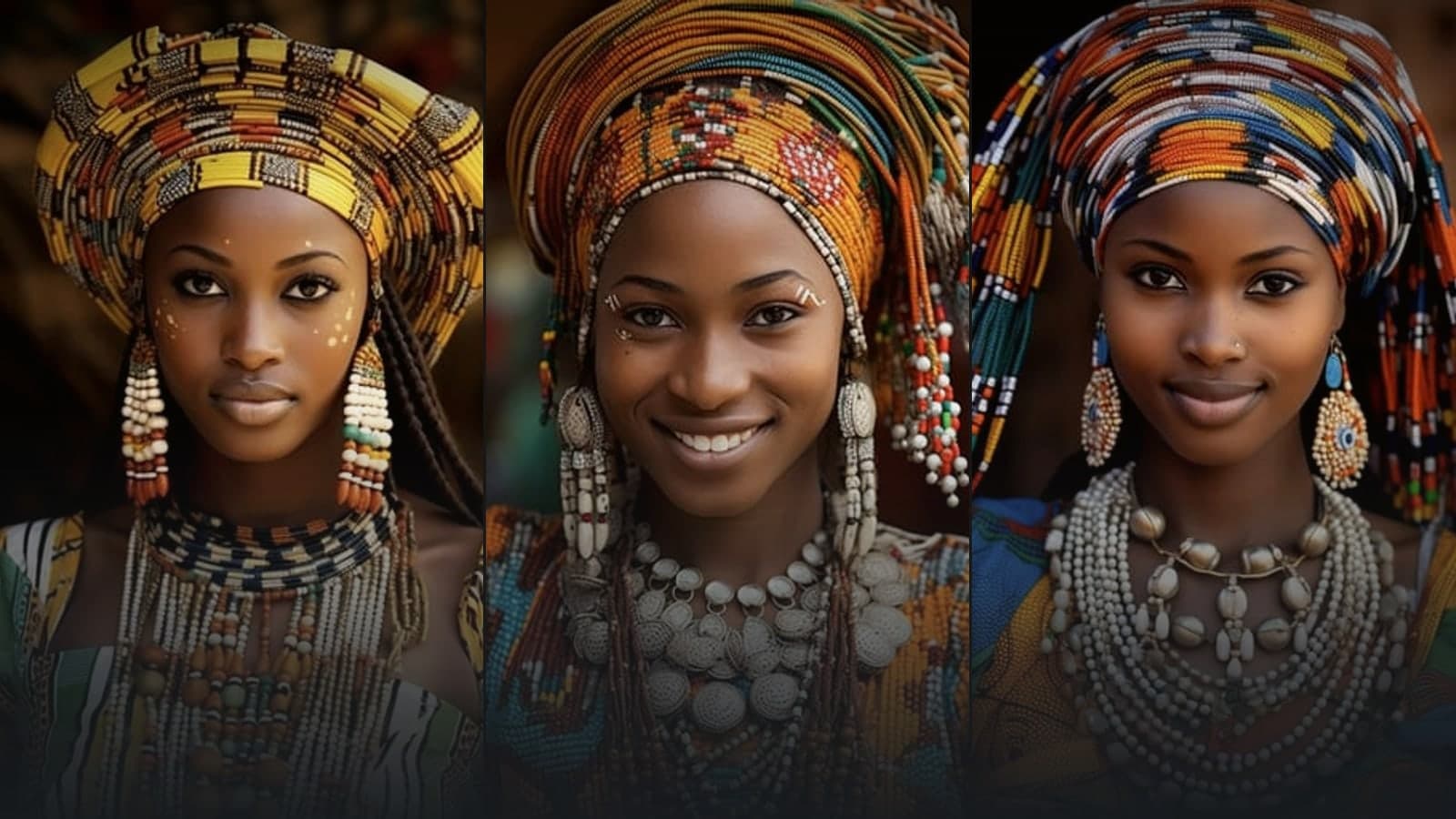
Across the Sahel, from Niger and Chad through northern Nigeria and Cameroon, the Wodaabe are known for something that inverts a familiar expectation: an annual ceremony in which the men, not the women, adorn themselves elaborately and compete to be judged the most beautiful. The Gerewol, and its signature yaake dance, has made this small nomadic people one of the most recognizable in West Africa. This article places the Wodaabe within their larger pastoral world, the Fulani, and explains what the ceremony is and how to read the group's entry in the phenotype atlas.
As always, the descriptions here are modal, meaning they report the characteristic pattern for the population rather than predicting any individual, and the adornment described is ceremonial choice tied to ritual, not a fixed trait. See reading the phenotype catalog.
Who the Wodaabe are
The Wodaabe (also spelled Bororo or Mbororo, though those names are sometimes used more broadly) are a subgroup of the Fulani, the vast pastoralist people spread in a belt across the whole of West and Central Africa. The Fulani, called Fulbe in their own language and Peul in French sources, number in the tens of millions and range from fully settled town-dwellers to fully nomadic cattle herders. The Wodaabe sit at the nomadic extreme. Their name is often glossed as "people of the taboo," a reference to the strict code of conduct, pulaaku, that governs Fulani social life and that the Wodaabe follow in an especially demanding form: reserve, patience, modesty, and care of the body and herd.
They speak Fula (Fulfulde), a Niger-Congo language of the Atlantic branch, and herd distinctive long-horned zebu cattle across the dry rangelands of Niger, Chad, northern Nigeria, and Cameroon. Their world borders and overlaps that of the other Sahelian peoples the atlas catalogs, the Hausa, Songhai, and Kanuri, with whom they trade cattle, milk, and grain.
The Gerewol and the yaake
The Gerewol is a series of courtship and reunion ceremonies held at the end of the rainy season, when the scattered nomadic lineages gather at traditional meeting grounds. Its most photographed element is the yaake, a dance in which young men make themselves up with great care and perform for hours before a line of young women who act as judges.
The male makeup follows a deliberate aesthetic. The face is painted, often in red or yellow ochre, to lighten and unify the complexion; a line is drawn down the nose and across the lips to emphasize their length and symmetry; the eyes and teeth are the focus of the performance. The dancers roll their eyes and bare their teeth in exaggerated expressions because, in the Wodaabe ideal of beauty, the whiteness of the eyes and teeth against dark skin is the central mark of health and attractiveness. Height, a long straight nose, and a graceful carriage complete the ideal. The men wear ostrich-plume headdresses that add to their apparent height and sway with the dance.
The French anthropologist Marguerite Dupire produced the classic mid-twentieth-century ethnography of Wodaabe and wider Fulani society, and the Gerewol has since been the subject of extensive documentary coverage. What the coverage sometimes obscures is that the ceremony is not only a beauty contest but a structured occasion for courtship, including the socially recognized institution of the teegal, a marriage of choice that can be formed at the gathering, alongside the reaffirmation of lineage ties after months of dispersal.
Pulaaku and the pastoral year
The Gerewol only makes sense against the background of how the Wodaabe live the rest of the year. For most of the year the lineages are dispersed, moving their long-horned zebu across the Sahel in small family groups, following the rains and the pasture in a constant search for grazing and water. Life is materially spare and physically demanding, and it is governed by pulaaku, the Fulani moral code that the Wodaabe follow in a particularly exacting form. Pulaaku prizes semteende (reserve and modesty), munyal (patience and fortitude), hakkilo (care and forethought), and a general mastery of the emotions. A Wodaabe is expected to show restraint in public, to bear hardship without complaint, and, strikingly, to show no open affection toward a spouse or one's own children in front of elders.
That code is exactly what makes the Gerewol so charged. The seasonal gatherings, the worso reunions where births, marriages, and deaths of the scattered year are collectively marked, are among the few occasions when the reserve of pulaaku is suspended and open display is not only allowed but demanded. The men's hours-long self-presentation and the women's frank public judgment of them invert the everyday rule of restraint. Read this way, the ceremony is not a quaint spectacle but the release valve of a demanding ethical system and the social machinery that keeps a dispersed nomadic people knit together, arranging marriages and renewing lineage ties across enormous distances.
The pastoral base is under pressure. Recurrent Sahelian drought, the southward march of the desert, competition with farmers over land and water, and government programs pushing sedentarization have all narrowed the room for full nomadism. Many Wodaabe now combine herding with wage labor and market trade, and the Gerewol itself has become an object of tourism, which brings both income and the familiar distortions of being watched.
Phenotype in the Sahelian context
In terms of the skin atlas, the Wodaabe and Fulani generally are dark-skinned, modal Fitzpatrick V to VI, though Fulani populations across the belt show a range. The Fulani are frequently described in the ethnographic literature as relatively tall and linear in build with narrower facial features than some of their neighbors, a pattern often linked to their pastoralist history and to genetic connections that stretch across the Sahel; the phenotype atlas records these as modal tendencies with real internal variation, not as sharp boundaries.
The eye atlas is worth reading alongside the Wodaabe entry for a specific reason: the yaake makes the eyes the explicit focus of an entire aesthetic system. The contrast the dancers cultivate, bright sclera against dark iris and skin, is a culturally elaborated version of a feature the atlas catalogs across all populations, and the Wodaabe case is a vivid illustration of how a universal trait becomes the centerpiece of a specific local ideal of beauty.
Why the Wodaabe are documented the way they are
Interest in the Wodaabe is driven almost entirely by the Gerewol, which reliably draws photographers and film crews because it upends the Western default of the adorned woman and the plain man. That produces steady public curiosity that is served by tourism and documentary sources rather than by any reference catalog that situates the Wodaabe within the Fulani world they belong to. The catalog's contribution is to link the Wodaabe entry to the wider Fula population and to their Sahelian neighbors, so the ceremony can be read as one expression of a large and internally diverse pastoral civilization rather than as an isolated curiosity.
Where to start
- Begin with the Wodaabe entry for the Gerewol and yaake, then read the broader Fula (Fulani) entry to see the pastoral world they belong to.
- For the Sahelian neighbors they trade and share territory with, read the Hausa, Songhai, and Kanuri entries.
- The cluster sits under the Western Africa region hub.
Topics
More articles

Butt shape by ethnicity: what an MRI study found and what our database records
Sep 20, 2026
San peoples of the Kalahari: the Khomani, Ju|'hoan, Taa, and their forager kin
Jul 9, 2026
The peoples of the Lower Omo Valley: Mursi, Suri, Karo, Hamar, and their neighbors
Jul 9, 2026
The Himba and the Herero-kin of the Kaokoveld and southwest Angola
Jul 9, 2026