The peoples of the Lower Omo Valley: Mursi, Suri, Karo, Hamar, and their neighbors
July 9, 2026
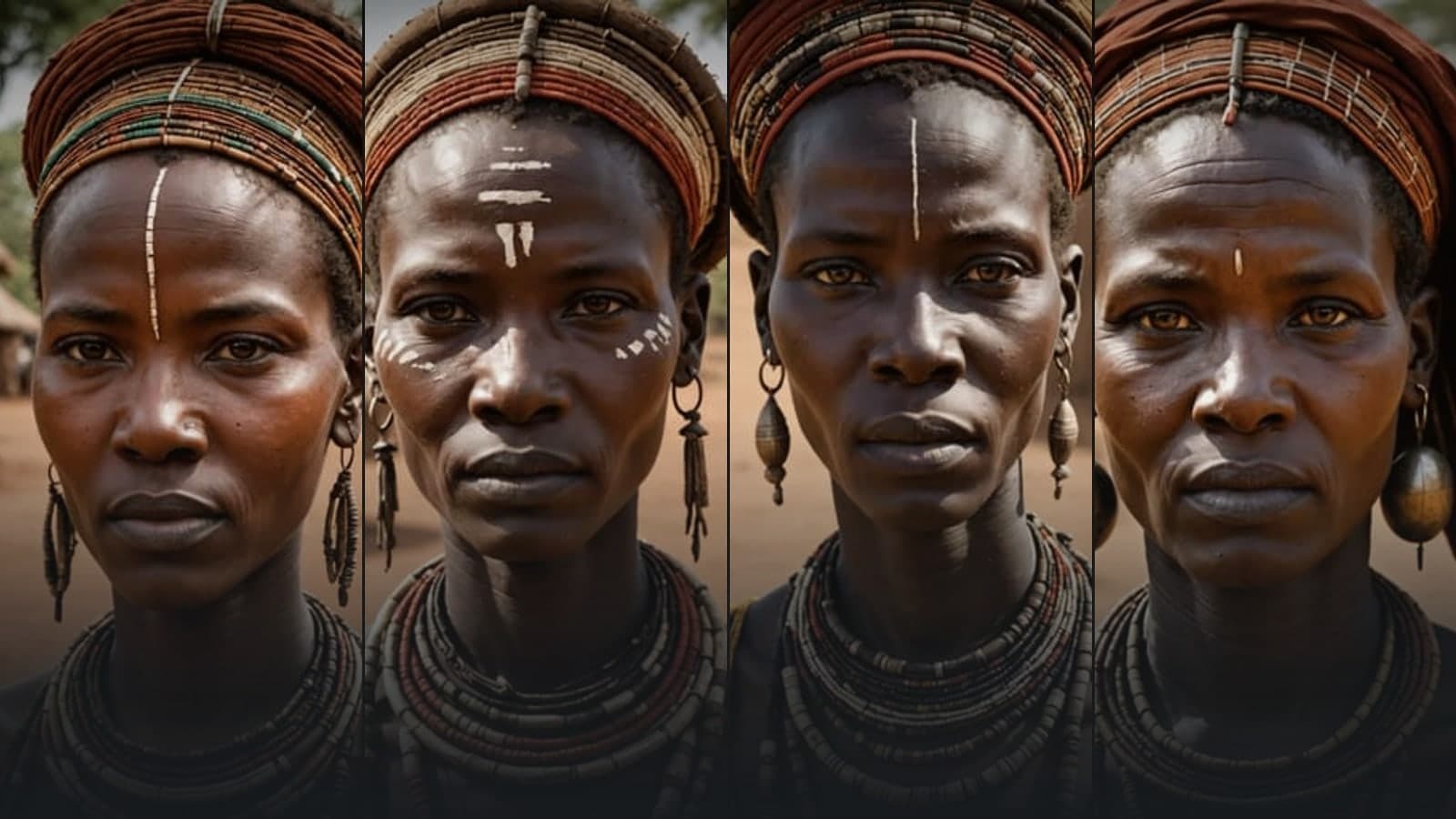
The Lower Omo Valley in southwestern Ethiopia is one of the most ethnographically documented regions on earth. Along the last two hundred kilometers of the Omo River, before it drains into Lake Turkana, sixteen or so distinct peoples occupy a patchwork of floodplain, savanna, and volcanic highland. Their density of adornment practices, lip plates, elaborate scarification, full-body chalk and ochre painting, and improvised headdresses of horn, gourd, and vegetation, has made the valley a fixture of anthropological literature and photojournalism since the mid twentieth century. This article situates the groups the phenotype atlas catalogs from this cluster and explains what they share, where they differ, and how to read their entries.
A note on framing: the descriptions below are modal, meaning they report the typical or characteristic pattern for a population, not a prediction about any individual. Adornment practices in particular are cultural choices tied to age, marital status, and ceremony rather than fixed biological traits. See reading the phenotype catalog for what the profiles do and do not claim.
A shared setting, three language families
The valley peoples are not a single ethnic stock. They belong to three unrelated language families, which is a useful first cut when reading their pages.
- Nilo-Saharan (Surmic branch): the Mursi, Suri (also called Surma), Bodi (Me'en), and Kwegu. These are the lip-plate and stick-fighting cultures of the central and western valley.
- Afroasiatic (Omotic and Cushitic branches): the Hamar and their close kin the Banna and Bashada speak an Omotic language; the Tsamai and Arbore speak Cushitic languages.
- Nilotic (Eastern Nilotic): the Dassanech and Nyangatom of the southern delta, who share ancestry and cattle-culture patterns with the Toposa, Murle, and other groups across the borders in South Sudan.
Despite this linguistic diversity, most valley peoples converge on a common subsistence pattern: cattle herding combined with flood-retreat cultivation of sorghum and maize along the riverbanks, supplemented by fishing in drought years. Cattle are the axis of wealth, marriage payment, and ritual almost everywhere in the valley, with the partial exception of the fishing and hunting Kwegu.
Phenotype across the valley
In terms of the traits the skin atlas tracks, valley populations cluster at the darker end of the range, modal Fitzpatrick VI, consistent with an equatorial East African environment and long residence at low latitude. Body composition is characteristically lean and tall-limbed, the ectomorphic pastoralist build shared across the Nilotic and Surmic peoples of the wider region, though the agropastoral Omotic groups such as the Hamar trend slightly less linear.
What varies dramatically, and what draws the cameras, is not underlying phenotype but adornment. The valley is best understood as a set of distinct visual grammars applied to a broadly similar physical substrate.
The Mursi and Suri: lip plates and dueling
The Mursi (self-designation Mun) and their western neighbors the Suri are the internationally recognized lip-plate cultures. Among women, a slit is cut below the lower lip in adolescence and progressively stretched over months to hold a disc of fired clay or wood, the dhebi a tugoin, which in the largest examples exceeds twelve centimeters across. The plate is removable at will and is associated with beauty, self-possession, and social maturity rather than with any single fixed meaning. The anthropologist David Turton, who worked with the Mursi across several decades, documented how the practice waxed and waned with the group's political situation rather than following a static tradition.
Both groups paint the body in white chalk, ash, and ochre in bold graphic patterns and practice ceremonial dueling among young men. Among the Suri this is donga stick fighting, a physically dangerous contest that establishes reputation and marriage prospects. The closely related Bodi, or Me'en, are known separately for the Ka'el ox-fattening ceremony, in which men compete to grow the largest body on a diet of milk and blood.
The Hamar: bull jumping and ochre ringlets
The Hamar, east of the Omo around the town of Dimeka, present a different visual signature. Women are known for thick locks of hair worked with ochre and butterfat into copper-colored ringlets called goscha, for heavy iron torques that mark marital seniority, and for cowrie-trimmed leather skirts. The defining rite is the bull-jumping ceremony, ukuli bula, in which an initiate runs across the backs of a line of cattle to pass into adulthood. The ethnographers Ivo Strecker and Jean Lydall produced the standard long-term account of Hamar society and ritual.
The Karo: the painters of the east bank
The Karo are among the smallest peoples in the valley, numbering only a few thousand along the east bank of the Omo, yet they are among the most photographed because of the sophistication of their body painting. Both sexes cover the torso and face in chalk, ochre, and pulverized mineral pigment in designs that imitate the plumage of guinea fowl and the patterning of other animals, applied fresh for dances and ceremonies. Men set their hair in a painted clay bun, the barre, holding ostrich feathers that signal a successful hunt or kill.
The delta peoples: Dassanech, Nyangatom, and the border cultures
At the southern end of the valley, where the Omo builds its delta into Lake Turkana, the Dassanech and Nyangatom are Nilotic cattle peoples whose cousins spread across the Kenyan and South Sudanese borders. They share cattle-and-sorghum subsistence, age-set political organization, and beadwork traditions with the Toposa, Murle, and the pastoralist peoples of the Ilemi Triangle. The Dassanech are notable for incorporating hunting, fishing, and even scavenged materials such as bottle caps into their ornament, a sign of their position at the ecological and economic margin of the region.
Smaller valley peoples round out the cluster: the Cushitic-speaking Arbore and Tsamai, who occupy the ecological transition between the highland and the lowland groups and act as traders and intermediaries, and the Kwegu, a small forager-fisher people who live in a client relationship with their Mursi and Bodi neighbors.
Why this cluster is documented the way it is
The Omo Valley occupies an unusual place in the visual record. It has been the subject of constant ethnographic film, tourism, and photojournalism, from the work of Turton and the Strecker-Lydall team through decades of National Geographic and independent documentary coverage. That produces a large, curiosity-driven public interest in these peoples that is almost entirely served by ethnographic and tourism sources rather than by any dedicated reference catalog. The phenotype atlas treats each group as a distinct entry with its own homeland, language, and appearance profile, cross-linked to its valley neighbors so the cluster can be read as the interrelated system it actually is.
A word on ethics closes the picture. The valley is under intense pressure from large-scale irrigation and dam development on the Omo, which threatens the flood-retreat cultivation the entire system depends on. Several of these peoples number only in the low thousands. The catalog documents them as living cultures with contemporary histories, not as a timeless spectacle. Readers who want the methodological basis for that stance should consult the site's ethics and methodology pages.
Where to start
- Begin with the two most documented cultures: the Mursi and the Hamar, then follow the sibling links on each page to their valley neighbors.
- For the painting traditions specifically, read the Karo and Suri entries side by side.
- The full valley cluster and its wider East African context sits under the Eastern Africa region hub.
Topics
More articles

Butt shape by ethnicity: what an MRI study found and what our database records
Sep 20, 2026
The Wodaabe and the Gerewol: male beauty, the yaake dance, and the Fulani pastoral world
Jul 9, 2026
San peoples of the Kalahari: the Khomani, Ju|'hoan, Taa, and their forager kin
Jul 9, 2026
The Himba and the Herero-kin of the Kaokoveld and southwest Angola
Jul 9, 2026