Help us get this right
Does this portrait look right for Welayta?
One tap. It takes a second and it is recorded.
1 says it looks right, 0 say it looks off.
Welayta Erotic
Wolayitia (Ethiopia)
Christianity / Protestantism
About Welayta People
The Welayta (also Wolaita or Wolayta) anchor a densely populated stretch of southern Ethiopia between the Omo River and the Rift Valley lakes, in a homeland they call Wolayitta. For centuries before Menelik II's armies absorbed it in the 1890s, this was an independent kingdom — the Wolaita Kawo ruled a hierarchical state with its own court, its own land tenure, and a long king list that the Welayta still recite as a backbone of identity. That memory of statehood, lost rather than absent, sets the Welayta apart from many of their neighbors and shapes how they talk about themselves: as a people who had a kingdom, not just a culture.
Wolayttatto Doonaa, the language, belongs to the Omotic branch of Afroasiatic — a branch whose very classification is still argued over by linguists, since Omotic looks both like its Cushitic cousins and unlike anything else in the family. It is mutually intelligible with Gamo, Gofa, and Dawro to varying degrees, and the four are sometimes lumped under the older label "North Ometo," though Welayta speakers tend to insist on the distinction. The language is written in a Latin-based orthography and is taught in regional schools; literature, radio, and a steady output of gospel music keep it in active public use rather than confined to the household.
Protestant Christianity arrived through Sudan Interior Mission work in the late 1920s and took unusually deep root, partly because the older Ethiopian Orthodox presence had been thin in the south and partly because conversion offered a route around the social grading imposed after imperial incorporation. Today the Welayta are one of the most heavily Protestant peoples in Ethiopia, with the Kale Heywet church especially prominent; Sunday observance, hymn-singing in Wolayttatto, and abstention from tella and arake are markers of respectability in many households. Older practices — reverence for the spirits associated with particular landscape features, the authority of the kawo's lineage, healing rites tied to specific clans — have not vanished so much as receded, surfacing at funerals and at the edges of agricultural life.
The country itself is highland and intensively farmed: enset (the so-called false banana) is the staple, supplemented by maize, sweet potato, and coffee on the lower slopes. Land scarcity is acute, and Welayta migration — to Addis Ababa, to commercial farms, to the Gulf — has become one of the defining facts of contemporary life, alongside a strong reputation in Ethiopian athletics and a distinctive style of polyphonic vocal music known as edho.
Related ethnic groups
Groups that share Welayta's homeland, region, language, or religious tradition. These are likely candidates for comparative phenotype reference.
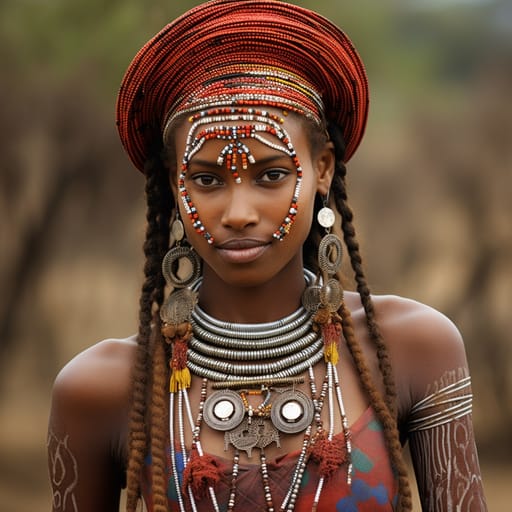
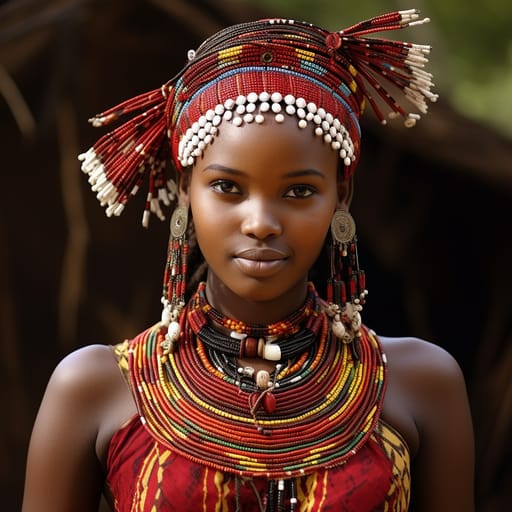
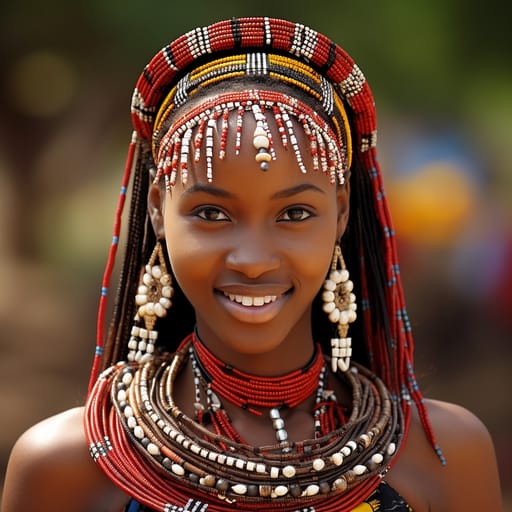
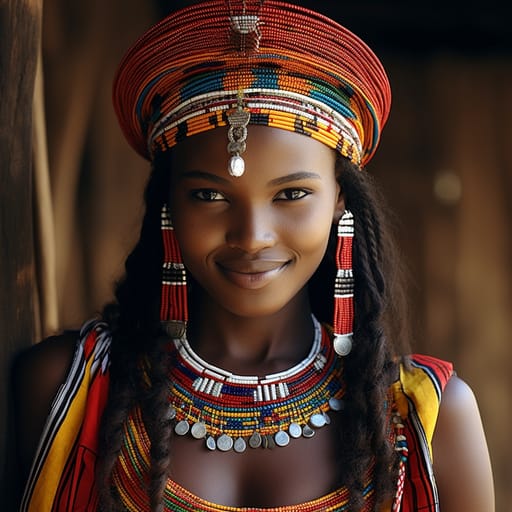
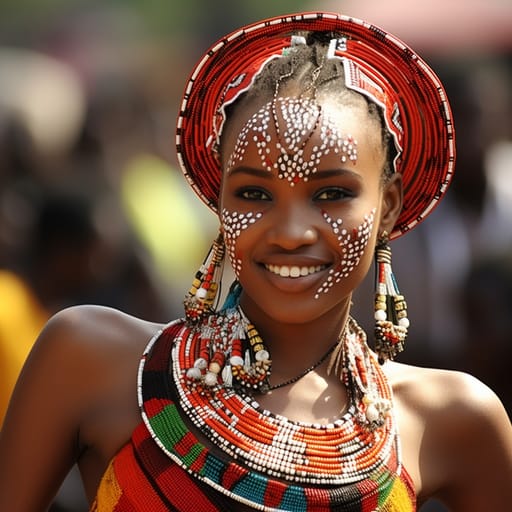
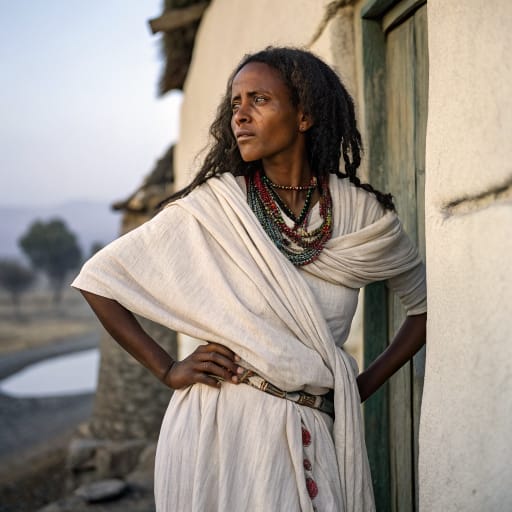
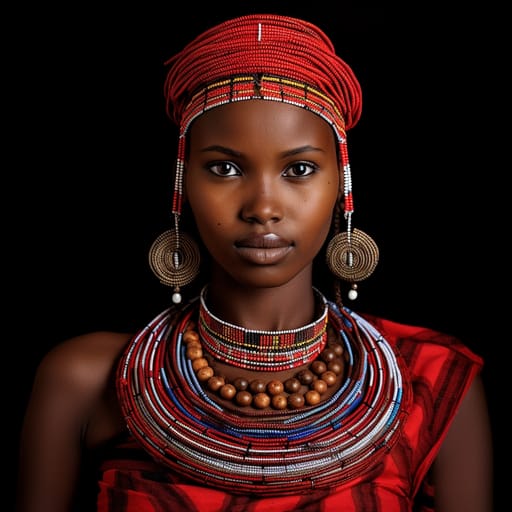
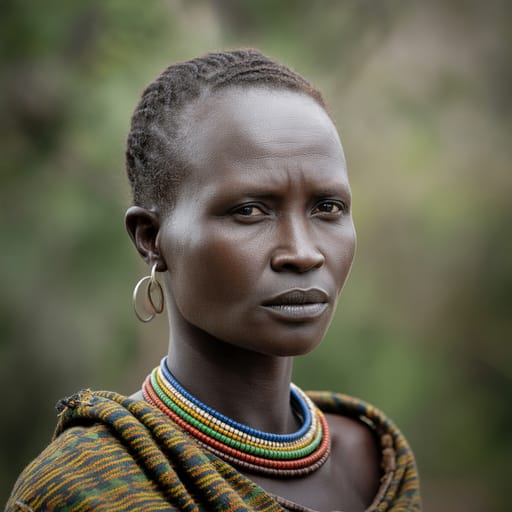
Typical Welayta Phenotypes
Reference for AI generation: hair, eyes, skin, facial structure, build
The Welayta are an Omotic-speaking people of southern Ethiopia, and their phenotype sits within the broader Ethiopian Highland cluster — distinct from both Cushitic-Semitic northerners (Amhara, Tigray) and from the lowland Nilotic peoples to the southwest. The dominant impression is moderate features layered onto medium-to-dark skin: not the sharp, narrow-nosed slimness of highland Tigrayans, nor the broad-featured robustness of Nilotic groups, but something positioned between.
Hair is uniformly black or near-black, tightly coiled — Type 4a–4b predominates, occasionally 3c at the looser end, worn close-cropped on men and often in braided or natural styles on women. Eyes are dark brown to black, almond-shaped with a slight upward outer canthus; epicanthic folds are absent. Skin tones cluster in Fitzpatrick V, ranging into deep VI, with warm reddish-brown and cool olive-brown undertones both common. Sun exposure does not dramatically shift the baseline — the homeland sits at 1,800–2,500m elevation, so most Welayta carry the high-UV-adapted pigmentation of the southern highlands without the deeper black of lowland Omo Valley peoples.
Facial structure is the giveaway. Noses are medium-bridged with moderate alar width — narrower than West African averages, broader than Tigrayan or Amhara norms. Lips are full but not everted, with a defined cupid's bow. Cheekbones are prominent and high-set, jaws taper to a relatively narrow chin, and foreheads are broad. The overall face reads oval rather than round or long. Hailemariam Desalegn, the former prime minister, shows the typical Welayta facial geometry clearly — high cheekbones, medium nose, defined jawline.
Build runs lean and wiry. Average male stature lands around 168–172cm, female around 158–162cm — moderate for highland East Africa. Limbs are long relative to torso, shoulders narrow-to-medium, hips narrow on men and moderately wider on women. Body fat distribution is low at baseline, with musculature defined rather than bulky, reflecting both genetics and the agricultural mountain economy of the Wolayitta zone.
Welayta Body & Anatomy Reference
Anatomy by feature, Cushitic / Nilo-Cushitic East African phenotype
Welayta Boobs & Breasts
The typical Welayta bust is small-to-medium-cup, high-set, conical, in line with the wider Cushitic / Nilo-Cushitic East African pattern. Areolas usually fall in the 28-38mm range, with moderate-to-high areolar pigmentation against the brown-to-deep-brown skin tone. Compared with the lateral spread of the West African phenotype, Welayta breasts sit forward and are generally firmer and less projecting than the African-American or West African norm. A faithful AI render of Welayta tits keeps that shape and areola size.
Welayta Ass & Hips
Butt shape among Welayta women: small-to-medium, high-set, rounded, over narrow-to-medium iliac crests, longer torso-to-leg ratio. This follows Cushitic / Nilo-Cushitic East African ancestry and looks quite unlike the wide-set heavy-projection West African or African-American norm. An accurate Welayta ass in adult AI imagery keeps both the silhouette and the overall build (lean ectomorph-to-mesomorph) instead of a generic average.
Welayta Vagina & Pussy
Vulvar anatomy among Welayta women: brown-to-deep-brown labial pigmentation, narrow-to-medium labia minora projection. Pubic hair tends to be tightly-coiled coarse texture, densely distributed, in the usual inverted-triangle pattern. Both follow Cushitic / Nilo-Cushitic East African pigmentation, which is why Welayta pussy renders should not fall back on a pale, sparse Western template.
Welayta Dicks & Penis
The Welayta cock profile, from Cushitic / Nilo-Cushitic East African anthropometric data: regional mean ~13.5cm erect; moderate girth, ~12cm circumference; deeper-pigmented than the West African norm. Pubic hair has a tightly-coiled coarse texture and forms the usual inverted-V pattern. Whether Welayta men are circumcised follows religious and cultural practice rather than phenotype.
Welayta Body, Curves & Build
Build and curves among Welayta women follow the Cushitic / Nilo-Cushitic East African pattern: lean ectomorph-to-mesomorph, mean adult female BMI 19-22. Proportions matter as much as skin tone, so Welayta figures should keep their regional height and limb ratios.
Welayta Skin Tone & Hair Texture
The Welayta skin range is brown to deep brown (Fitzpatrick V-VI), and hair tends to be tight 4A-4C coil, often worn natural or in braided/twisted protective styles. That combination marks the Cushitic / Nilo-Cushitic East African phenotype, and skin tone is the trait AI generators most often get wrong for Welayta women.
Data depth
59/100Coverage of image-grounded phenotype observations · drives AI generation diversity
- Sample size
- 15/40· 7 images
- Image quality
- 29/30· 57% high
- Confidence
- 15/20· mean 0.83
- Source diversity
- 0/10· wikipedia
- ·Small sample (n<10)
- ·Wikipedia-only source, not population-representative
Observed Distribution: Image Sample
Empirical observations from analyzed photographs · supplementary signal, not population truth
Sample: 7 images analyzed (7 wikipedia). Quality: 4 high, 3 medium, 0 low, 0 very_low. Avg analyzer confidence: 0.83.
Skin tone (Fitzpatrick): V (86%), VI (14%)
Hair color: black (71%), gray/white (29%)
Hair texture: curly (14%), coily (86%)
Eye color: dark brown (100%)
Epicanthic fold: 0% present, 100% absent, 0% unclear
Caveats: Sample size 7 is small, so the observed distribution should be treated as suggestive, not definitive. Sample is 100% Wikipedia notable people, which skews toward male, public-life, and modern figures, not population-representative.
Last aggregated: May 7, 2026
Explore phenotype categories
Structured taxonomy with peer-reviewed scales · 22 anatomical categories
Notable Welayta People
10 reference figures, sourced from Wikipedia
- Teklewold Atnafu, Governor of National Bank of Ethiopia since 2000s to February 2020 and chair …
- Hailemariam Desalegn, Former Prime Minister of Ethiopia from 2012-2018
- Getahun Garedew, Ethiopian politician serving as Director general of FDRE environmental protec…
- Endrias Geta, Ethiopian politician serving as State Minister of Ministry of Irrigation and …
- Dagato Kumbe, Ethiopian politician serving as Deputy commissioner of Ethiopian Investment C…
- Shewit Shanka, Ethiopian politician who is serving as minister of Ministry of Culture and Sp…
- Roman Tesfaye, First Lady of Ethiopia (2012-2018). Previously held senior management positio…
- Teshome Toga, Ethiopia's Ambassador to EU, Speaker of the 3rd House of the Peoples' Represe…
- Samuel Urkato, Minister of Science and Higher Education since 18 August 2020. He was preside…
- Haileberhan Zena, Ethiopian politician who is serving as Deputy chief executive of Federal Hous…
Erotic Poses & Sex Positions
From the pose catalog: 219 named positions with reference skeletons
Frequently asked questions about Welayta people
Where is the Welayta homeland?
The Welayta homeland is Wolayitia (Ethiopia) in Eastern Africa.
What language do Welayta people speak?
Welayta people primarily speak Afroasiatic / Omotic / Wolayitta.
What religion do Welayta people practice?
The predominant religion among Welayta people is Christianity / Protestantism.






Make your own Welayta images
Five a day, free, no credits to buy. The studio starts from this group's phenotype data, so you can set body type, pose and style and keep the traits accurate.
Start with Welayta