Help us get this right
Does this portrait look right for Tetela?
Nobody has judged this one yet. You would be the first.
Tetela Erotic
Sankuru province and adjacent parts of the central Congo basin, Democratic Republic of the Congo, with a large community in Kinshasa.
Otetela (Niger-Congo, Bantu Zone C), with Lingala and Swahili widely used as regional lingua francas.
Mostly Christian, Catholic and Methodist, alongside continuing ancestral practice and divination.
Northern forest and southern savanna communities; closely tied to the Kusu, within the wider Mongo-related Bantu cluster of the central Congo.
About Tetela People
The Tetela occupy the seam where the Congo rainforest thins into savanna, spread across Sankuru in the central Democratic Republic of the Congo, with Lodja, Katako-Kombe and Lomela as their market towns. That seam runs through the culture too. Northern communities are forest people who hunt, tap palm wine and clear gardens out of secondary growth; southern ones farm open grassland and have long traded across it with the Luba and Songye. They call themselves Batetela in the Bantu plural and their language Otetela, a Zone C Bantu language whose closest relatives are Kusu and the Mongo speech of the forest to the north. It is not intelligible to a Tshiluba speaker from Kasai, which is one reason Lingala does so much work in the region's towns and Swahili in the trading corridors to the east.
Unlike the Kuba kingdom to the west or the Luba states to the south, the Tetela never built a centralized monarchy. Authority sat with lineage heads and village chiefs, an arrangement that made them hard to conquer and hard to speak for. Two men made the name known anyway. Ngongo Leteta, a Tetela commander who raided for the Swahili-Arab ivory and slave networks before switching to the Congo Free State, was executed by his new allies in 1893, and the resentment fed a run of mutinies by Tetela soldiers in the Force Publique between 1895 and 1900 that shook colonial control of the interior. Six decades later Patrice Lumumba, born at Onalua in Katako-Kombe, made Tetela a word in the vocabulary of independence politics, and Sankuru has been Lumumbist ground ever since.
Most Tetela today are Christian. American Methodists built their station at Wembo Nyama in the 1910s and Catholic missions took root at Tshumbe, and both still run the schools and clinics that hold rural Sankuru together. Older practice has not vanished so much as folded in: ancestors are consulted, diviners are paid, and misfortune is read as having a cause. Population figures are guesswork, since the country has not held a census since 1984, but a rough million is the usual estimate. Roads out of Sankuru are bad enough that Kinshasa can feel further away than it did in 1960, and a great many Tetela now live in that city rather than in the province.
Related ethnic groups
Groups that share Tetela's homeland, region, language, or religious tradition. These are likely candidates for comparative phenotype reference.
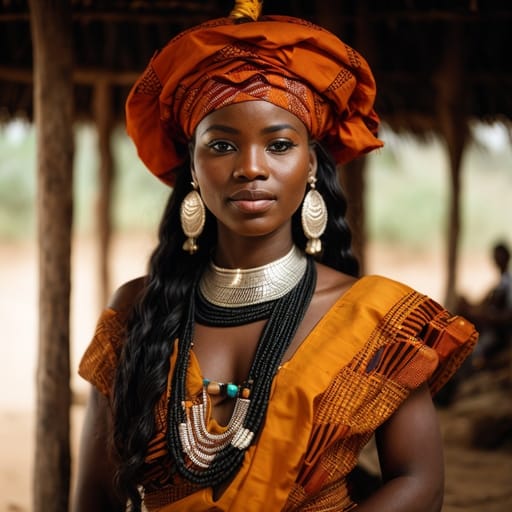
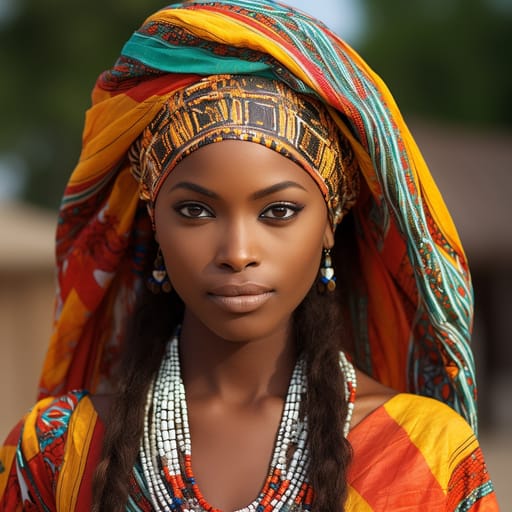
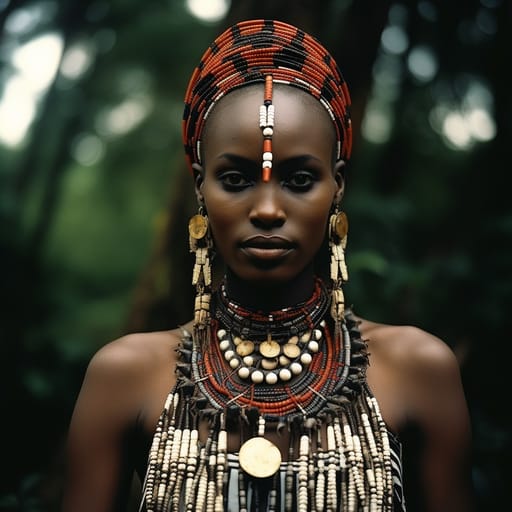
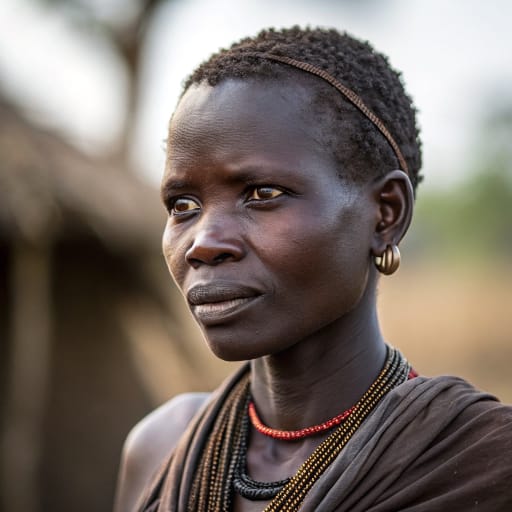
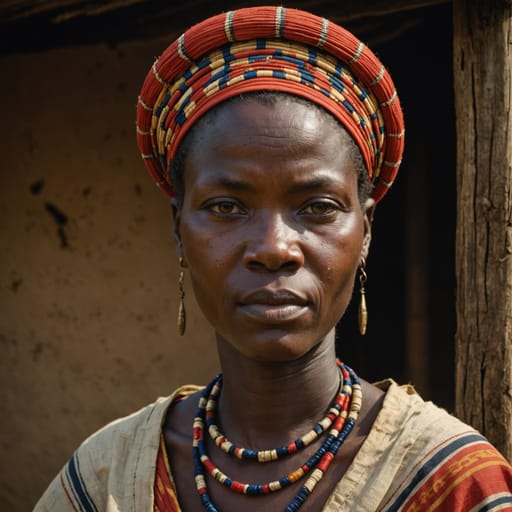
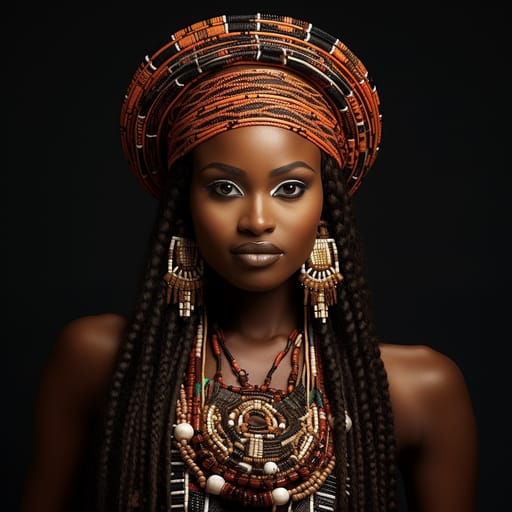
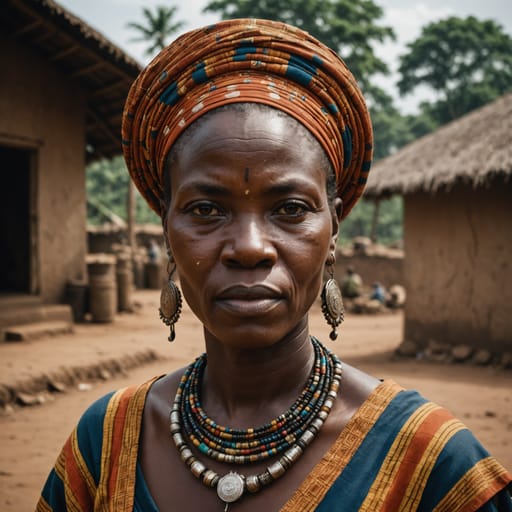
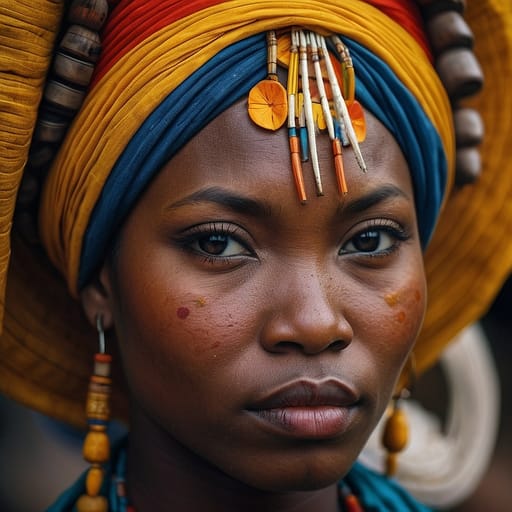
Typical Tetela Phenotypes
Reference for AI generation: hair, eyes, skin, facial structure, build
Tetela Body & Anatomy Reference
Per-feature anatomical profile for AI nude generation: Bantu / Central African Niger-Congo phenotype
Tetela Boobs & Breasts
The typical Tetela bust is medium-to-large cup, full, projecting, in line with the wider Bantu / Central African Niger-Congo pattern. Areolas usually fall in the 32-48mm range, with deep-brown areolar pigmentation against the deep-brown skin tone. Compared with the smaller East African conical profile, Tetela breasts sit forward and are generally fuller projection than East African; comparable to West African norm. A faithful AI render of Tetela tits keeps that shape and areola size.
Tetela Ass & Hips
Butt shape among Tetela women: full, projected, wide-set glutes, over broad iliac crests, gynoid pelvic pattern. This follows Bantu / Central African Niger-Congo ancestry and looks quite unlike the slim narrow-hip Cushitic East African profile. An accurate Tetela ass in adult AI imagery keeps both the silhouette and the overall build (mesomorph with strong gluteal-femoral fat deposition) instead of a generic average.
Tetela Vagina & Pussy
Vulvar anatomy among Tetela women: deep-brown labial pigmentation, fuller labia minora. Pubic hair tends to be tightly-coiled coarse texture, dense distribution, in the usual inverted-triangle pattern. Both follow Bantu / Central African Niger-Congo pigmentation, which is why Tetela pussy renders should not fall back on a pale, sparse Western template.
Tetela Dicks & Penis
The Tetela cock profile, from Bantu / Central African Niger-Congo anthropometric data: regional mean ~14cm erect; above-average girth; deep-brown shaft pigmentation. Pubic hair has a tightly-coiled coarse texture and forms the usual inverted-V pattern. Whether Tetela men are circumcised follows religious and cultural practice rather than phenotype.
Tetela Body, Curves & Build
Build and curves among Tetela women follow the Bantu / Central African Niger-Congo pattern: mesomorph with strong gluteal-femoral fat deposition, mean adult female BMI 23-26. Proportions matter as much as skin tone, so Tetela figures should keep their regional height and limb ratios.
Tetela Skin Tone & Hair Texture
The Tetela skin range is deep-brown (Fitzpatrick VI), and hair tends to be tight 4A-4C coil. That combination marks the Bantu / Central African Niger-Congo phenotype, and skin tone is the trait AI generators most often get wrong for Tetela women.
Explore phenotype categories
Structured taxonomy with peer-reviewed scales · 22 anatomical categories
Erotic Poses & Sex Positions
From the pose catalog: 219 named positions with reference skeletons
Frequently asked questions about Tetela people
Where is the Tetela homeland?
The Tetela homeland is Sankuru province and adjacent parts of the central Congo basin, Democratic Republic of the Congo, with a large community in Kinshasa. in Central Africa.
What language do Tetela people speak?
Tetela people primarily speak Otetela (Niger-Congo, Bantu Zone C), with Lingala and Swahili widely used as regional lingua francas..
What religion do Tetela people practice?
The predominant religion among Tetela people is Mostly Christian, Catholic and Methodist, alongside continuing ancestral practice and divination..






Make your own Tetela images
Five a day, free, no credits to buy. The studio starts from this group's phenotype data, so you can set body type, pose and style and keep the traits accurate.
Start with Tetela