No portrait yet
Tellem Erotic
The Bandiagara Escarpment and its surroundings in central Mali, in what is now Dogon Country
Unknown (unclassified; no record of the language survives)
Unknown; indigenous beliefs known only from cave burials and grave goods
Came after the earlier Toloy on the escarpment and were followed by the Dogon, who absorbed some of them; tradition links others to the Kurumba of Burkina Faso
About Tellem People
The Tellem lived on and around the Bandiagara Escarpment in central Mali from roughly the 11th to the 16th century. They faded from view as Dogon settlers took over the cliffs. Some were probably absorbed into Dogon communities. Tradition says others moved away toward what is now Burkina Faso, and some writers link them to the Kurumba there. They left no writing and no surviving name for themselves. Tellem is a Dogon word, usually translated as "we found them," and that is how they are remembered: the people who were already there.
The cliff is what sets them apart. The escarpment is a sandstone wall that runs for about 150 kilometers. The Tellem built granaries and small mud-brick structures into its ledges and caves, some so high on the face that reaching them today takes ropes and nerve. They used the hardest caves to reach as shared burial places. Dogon stories say the Tellem could fly, and the Dogon still raise their own dead into some of the old caves by rope. The Tellem were not the first people on the cliff. Well over a thousand years earlier, a people called the Toloy had stored grain in clay granaries in the same rock.
Most of what is known comes from Dutch archaeologists who worked in the burial caves from the 1960s on. The dry, sheltered caves kept things that normally rot: cotton tunics and caps, blankets, skirts of plant fiber, wooden headrests, bows, baskets and pottery. The textiles are among the oldest surviving cotton cloth in West Africa, and they show that weaving was well established by the 11th century. Studies of the skeletons have argued that the Tellem and the Dogon were physically distinct populations. That fits the Dogon view of the Tellem as a separate people, not their own ancestors.
The Tellem language is lost, and their beliefs can only be read from the graves, where the dead were laid out with care alongside cloth, headrests and everyday objects. The art market adds confusion. Carved wooden figures with arms raised overhead, crusted with old offerings, are routinely sold as "Tellem." But the Dogon found and reused older pieces and carved in similar styles, so the label is looser than it sounds. The escarpment itself is the firmer legacy. It is now a UNESCO World Heritage Site, and the empty Tellem buildings still hang above the Dogon villages below.
Related ethnic groups
Groups that share Tellem's homeland, region, language, or religious tradition. These are likely candidates for comparative phenotype reference.
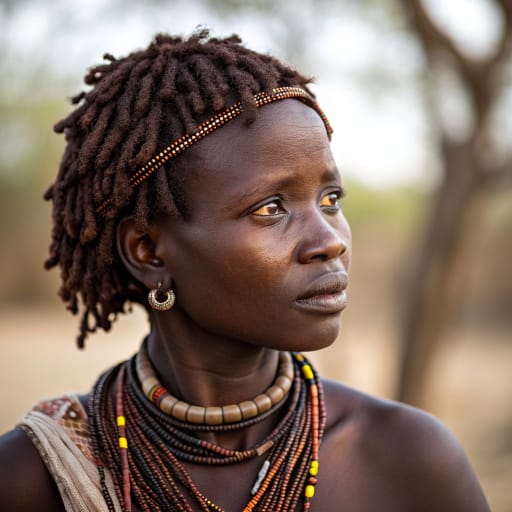



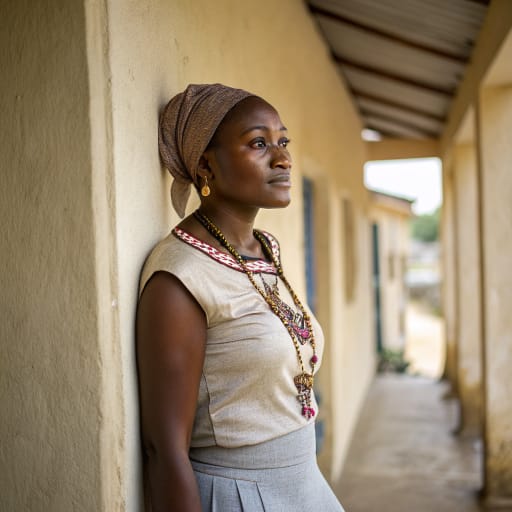
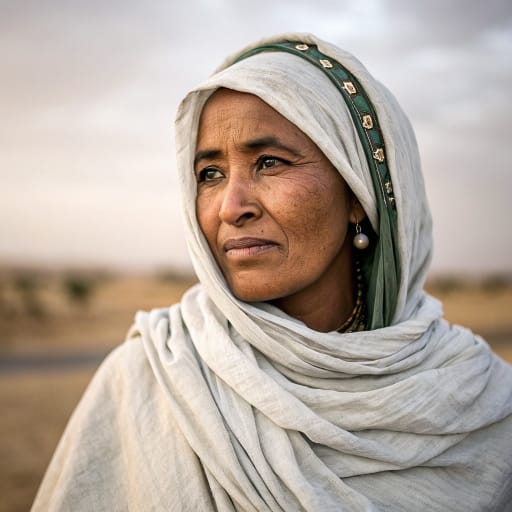
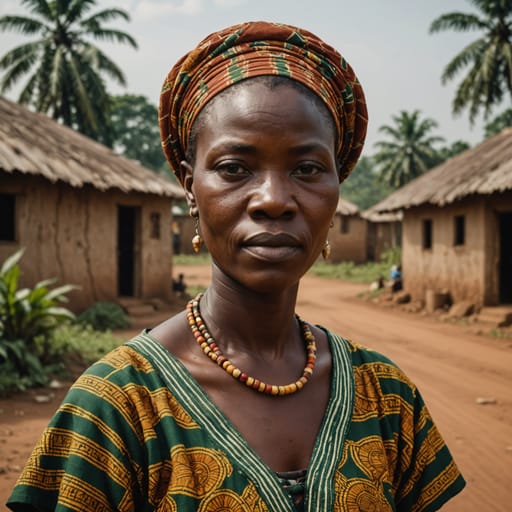
Typical Tellem Phenotypes
Reference for AI generation: hair, eyes, skin, facial structure, build
Tellem Body & Anatomy Reference
Anatomy by feature, West African Niger-Congo phenotype
Tellem Boobs & Breasts
Bust reference for Tellem women: medium-to-large cup, full, projecting, which is typical of West African Niger-Congo ancestry. Areolas measure about 35-50mm across, with deep-brown to near-black pigmentation. Body type (mesomorph with strong gluteal-femoral fat distribution) shapes the bust as well, so Tellem tits are usually fuller and more projecting than the East African norm. In AI imagery, keep the forward-set shape rather than drifting toward the smaller conical Cushitic East African profile.
Tellem Ass & Hips
The Tellem ass is typically wide-set, full, heavily projected glutes, which sets it apart from the slim narrow-hip Cushitic East African profile. Underneath, the pelvis shows wide iliac crests, broad gynoid pelvic pattern, high glute-to-waist ratio, part of the West African Niger-Congo skeletal pattern. For Tellem butt pics and AI renders, match that silhouette and the overall build (mesomorph with strong gluteal-femoral fat distribution).
Tellem Vagina & Pussy
Tellem pussy and vulvar anatomy presents deep-brown to near-black labial pigmentation, fuller labia minora, consistent with the West African Niger-Congo phenotype's pigmentation pattern. Tellem pubic hair is typically tightly-coiled coarse texture, densely distributed, in the inverted-triangle pattern. For anatomically accurate Tellem pussy renders the labial coloration should match the surrounding medium-brown to deep-brown skin tone with a continuous gradient, and the hair should keep its tightly-coiled coarse texture.
Tellem Dicks & Penis
Tellem dicks follow the West African Niger-Congo reference data: regional mean ~14-15cm erect; above-average girth, ~13cm circumference; deep-brown-to-near-black shaft pigmentation. Shaft color should track the medium-brown to deep-brown skin tone with a smooth change toward the glans, and Tellem pubic hair keeps its tightly-coiled coarse texture.
Tellem Body, Curves & Build
Tellem body type and overall build presents as mesomorph with strong gluteal-femoral fat distribution, with mean adult female BMI 24-27: the characteristic West African Niger-Congo habitus. Tellem curves and proportions should keep the regional skeletal frame (height, shoulder-to-hip ratio, limb proportions) rather than a generic mesomorph default.
Tellem Skin Tone & Hair Texture
Tellem skin sits in the medium-brown to deep-brown (Fitzpatrick V-VI) band. Hair is typically tight 4A-4C coil, often worn natural, braided, or relaxed, in keeping with the West African Niger-Congo phenotype. In nude renders the skin should stay one even tone from face to body, and body, pubic and head hair should match.
Explore phenotype categories
Structured taxonomy with peer-reviewed scales · 22 anatomical categories
Erotic Poses & Sex Positions
From the pose catalog: 219 named positions with reference skeletons
Frequently asked questions about Tellem people
Where is the Tellem homeland?
The Tellem homeland is The Bandiagara Escarpment and its surroundings in central Mali, in what is now Dogon Country in Western Africa.
What language do Tellem people speak?
Tellem people primarily speak Unknown (unclassified; no record of the language survives).
What religion do Tellem people practice?
The predominant religion among Tellem people is Unknown; indigenous beliefs known only from cave burials and grave goods.






Make your own Tellem images
Five a day, free, no credits to buy. The studio starts from this group's phenotype data, so you can set body type, pose and style and keep the traits accurate.
Start with Tellem