No portrait yet
Shughni Erotic
The Panj River valleys of the western Pamirs: Shughnan and Roshtqala districts and the town of Khorog in Gorno-Badakhshan, Tajikistan, and Shighnan District in Badakhshan Province, Afghanistan.
Shughni, including the Shakhdara and Bajuwi varieties (Eastern Iranian, Pamir group); Tajik Persian used for literacy
Nizari Ismaili Shia Islam, under the Aga Khan
One of the Pamiri peoples; the Shughni-Rushani cluster also takes in Rushani, Khufi, Bartangi and Roshorvi, with Sarikoli across the border in China
About Shughni People
The Shughni live in the gorges of the Panj, the river that eventually becomes the Amu Darya, in the western Pamirs. Their villages sit on alluvial fans where side streams spill into the main valley, narrow shelves of irrigable ground under rock walls that climb thousands of feet straight up. They are the most numerous of the Pamiri peoples, and their language does the work of a regional lingua franca: a Rushani, Khufi or Bartangi speaker in Khorog is about as likely to use Shughni as Tajik. Worth saying plainly, since the assumption usually runs the other way: Shughni is not a kind of Tajik. It is Eastern Iranian, the branch that also produced Pashto and, centuries ago, Sogdian, and a Persian speaker from Dushanbe cannot follow it at all. Nearly every Shughni speaks Tajik as well and does all their reading and writing in it, because Shughni has never settled on an alphabet. A Latin script was tried in the 1930s and Cyrillic proposals have circulated since, but neither moved far beyond a small shelf of published work. The language lives at home, in music, and in argument.
The border is the hard fact of their modern history. Anglo-Russian boundary settlements in the 1890s fixed the frontier on the Panj and cut Shughnan in two, leaving relatives on facing banks who could see one another's fields and, for most of the twentieth century, could not cross. On the northern side the Shughni are Tajik citizens, on the southern side Afghan. Both are Nizari Ismailis, followers of the Aga Khan, in two countries whose majorities are Sunni. Badakhshani Ismailism looks back to Nasir Khusraw, the eleventh century poet and philosopher who took refuge in these mountains, and his verses are still recited at the charogh-rawshan, the lamp ceremony held over the dead. Mosques are scarce and not really the point. The ritual space is the house: a Pamiri chid stands on five wooden pillars named for the family of the Prophet, under a skylight of four squares set at angles inside one another for earth, water, air and fire, so a household eats dinner beneath a diagram of its own cosmology. Soviet rule brought schooling and a literacy rate that put Pamiris well above their share of the Tajik professional class. The civil war of the 1990s brought blockade and near starvation, broken largely by Aga Khan Development Network convoys hauled in over the Kyrgyz passes. Khorog now has a university and a long, unresolved argument with Dushanbe.
Related ethnic groups
Groups that share Shughni's homeland, region, language, or religious tradition. These are likely candidates for comparative phenotype reference.
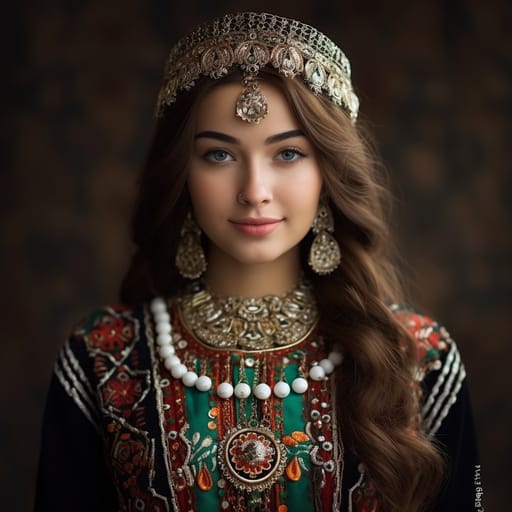
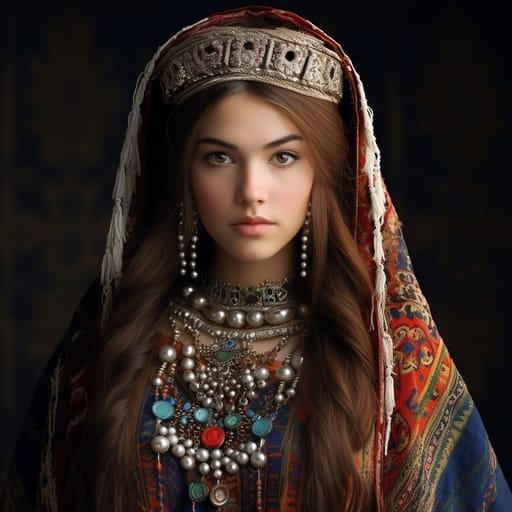
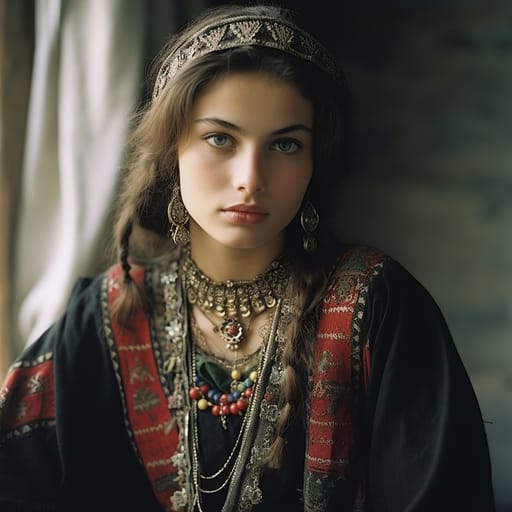
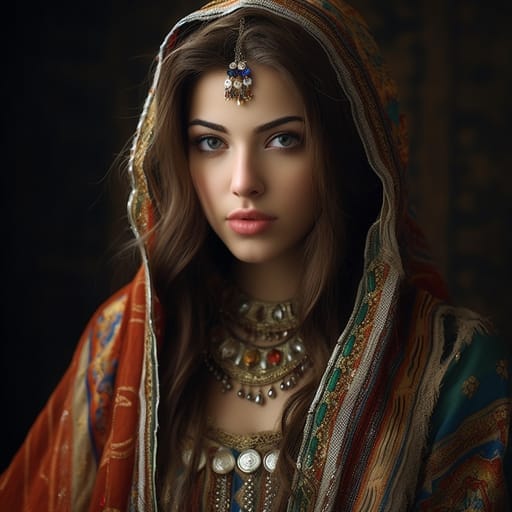
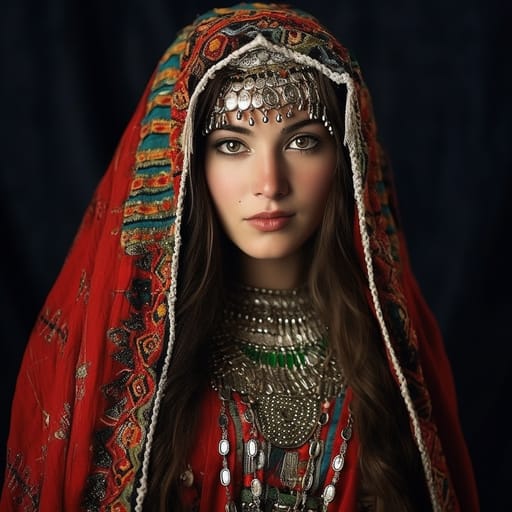
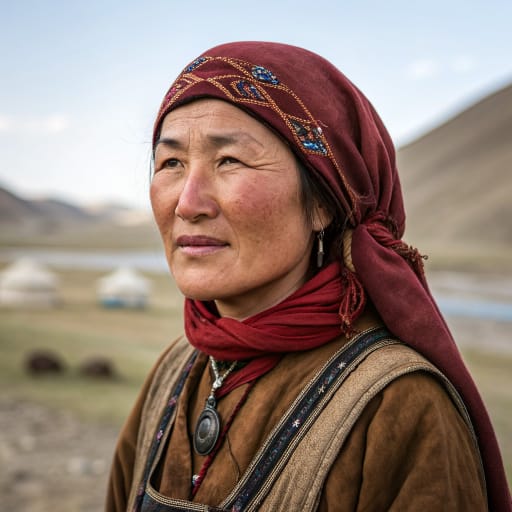
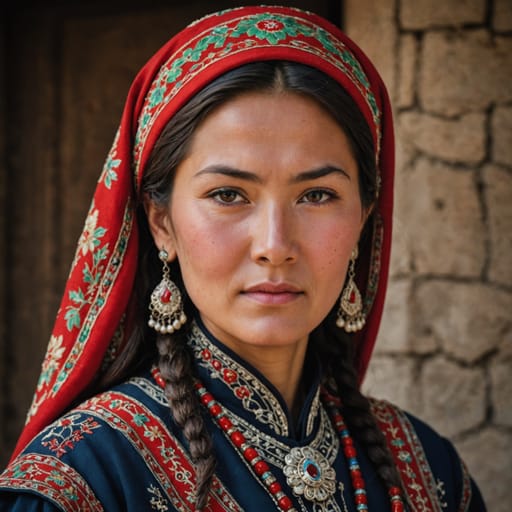
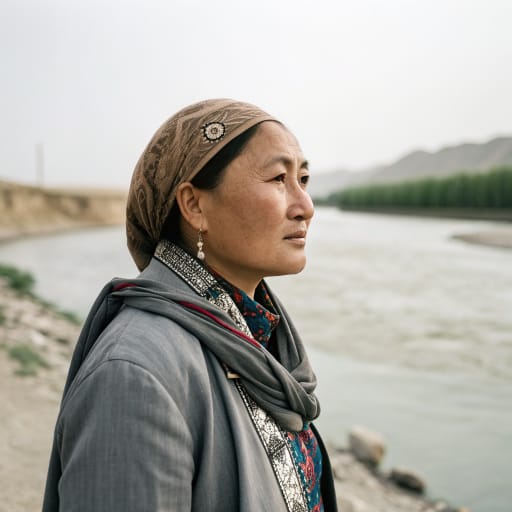
Typical Shughni Phenotypes
Reference for AI generation: hair, eyes, skin, facial structure, build
Shughni Body & Anatomy Reference
Anatomy by feature, Central Asian Turkic-Mongolic phenotype
Shughni Boobs & Breasts
Shughni tits and boobs run medium cup, moderate projection, the classic Central Asian Turkic-Mongolic bust profile. Shughni nipples and areolas show medium-brown areolar pigmentation against the tan-to-light-brown skin tone, with areolar diameter typically in the 30-42mm range and forward-set positioning rather than the smaller East Asian bust. Shughni breasts trend full and modestly projecting, a function of the mesomorph, broader frame than the East Asian norm body habitus and the mean adult female BMI 23-26. For anatomically accurate AI-generated Shughni nudes the render preserves the medium cup, moderate projection shape, 30-42mm areolas with medium-brown pigmentation, and the torso proportions of the Central Asian Turkic-Mongolic phenotype.
Shughni Ass & Hips
Shughni hips and butt usually read as medium, moderate projection, broader hip profile than the East Asian norm. The skeletal base is medium iliac crests, moderate gluteal-femoral fat deposition, the Central Asian Turkic-Mongolic pattern. Set against the slim East Asian narrow-hip profile, the difference is easy to see, and the hip-to-waist ratio is often what identifies Shughni women in photos.
Shughni Vagina & Pussy
Expect medium-brown labial pigmentation on Shughni women, in keeping with Central Asian Turkic-Mongolic ancestry. The pubic hair is straight-to-wavy medium-coarse texture. Coloring should run evenly from the tan to light-brown skin of the thighs to the labia, and Shughni nude imagery should keep the hair's straight-to-wavy medium-coarse texture.
Shughni Dicks & Penis
Shughni dick and penile anatomy in adult AI generation should anchor on the regional reference data: regional mean ~13cm erect, moderate girth, and medium-brown shaft pigmentation. The Shughni cock profile reflects the Central Asian Turkic-Mongolic population's anthropometric measurements. The shaft pigmentation should track the surrounding tan to light-brown skin tone, and the pubic hair should keep its straight-to-wavy medium-coarse texture in the typical inverted-V escutcheon.
Shughni Body, Curves & Build
Shughni body type: mesomorph, broader frame than the East Asian norm, with mean adult female BMI 23-26. This is the typical Central Asian Turkic-Mongolic build. Height range, shoulder-to-hip ratio and fat distribution all follow from it, which is what an accurate Shughni nude body should show.
Shughni Skin Tone & Hair Texture
Shughni skin tone falls in the tan to light-brown (Fitzpatrick III-IV) band, the surface signal most often miscalibrated by generic AI nude generators. Shughni hair texture is typically straight 1A-1B, dark-brown to black, characteristic of the Central Asian Turkic-Mongolic phenotype. In Shughni nude renders the skin should hold that band consistently across the body.
Explore phenotype categories
Structured taxonomy with peer-reviewed scales · 22 anatomical categories
Erotic Poses & Sex Positions
From the pose catalog: 219 named positions with reference skeletons
Frequently asked questions about Shughni people
Where is the Shughni homeland?
The Shughni homeland is The Panj River valleys of the western Pamirs: Shughnan and Roshtqala districts and the town of Khorog in Gorno-Badakhshan, Tajikistan, and Shighnan District in Badakhshan Province, Afghanistan. in Central Asia.
What language do Shughni people speak?
Shughni people primarily speak Shughni, including the Shakhdara and Bajuwi varieties (Eastern Iranian, Pamir group); Tajik Persian used for literacy.
What religion do Shughni people practice?
The predominant religion among Shughni people is Nizari Ismaili Shia Islam, under the Aga Khan.






Make your own Shughni images
Five a day, free, no credits to buy. The studio starts from this group's phenotype data, so you can set body type, pose and style and keep the traits accurate.
Start with Shughni