No portrait yet
Sakata Erotic
South of Lake Mai-Ndombe in Mai-Ndombe Province, western Democratic Republic of the Congo, centered on the Kutu area
Sakata, also called Kisakata (Bantu, Niger-Congo); Lingala and French widely used
Christianity, mainly Catholic, alongside ancestral beliefs
Counted within the wider Anamongo family of Mongo-related central Congo peoples
About Sakata People
The Sakata, also called Basakata, are a Bantu-speaking people of Mai-Ndombe, the part of the western Democratic Republic of the Congo where the equatorial forest starts to break up into grassland and strips of woodland along the rivers. They are set apart by their own language, Kisakata, and by their ties to a specific stretch of land south of Lake Mai-Ndombe, with the town of Kutu as a common point of reference. They are usually counted among the Anamongo, the broad family of central Congo peoples linked by history and custom to the Mongo. Kisakata, though, is its own Bantu language, not a dialect of Mongo. Lingala, the language of trade, music and radio across the western Congo, is the everyday second language, and French comes in through school and official paperwork.
The history that hangs over the region is colonial. In the 1890s the lake and the land around it became part of King Leopold II's Crown Domain inside the Congo Free State, and the lake itself carried his name. The rubber regime there was notoriously harsh, and the district is remembered as one of the worst hit by the killing, flight and disease of that era. Belgian rule kept the royal name on the map. Only in the early 1970s, during Mobutu's authenticity campaign, did the lake officially become Mai-Ndombe, Lingala for black water, after its tea-dark color. Mai-Ndombe as a province is newer still: it was split off from the old Bandundu province in 2015.
For most Sakata, daily life is rural and practical: cassava fields, fishing, hunting and gathering in the remaining forest, and long trips to market by road, canoe or river barge. Most Sakata are Christian, largely Catholic, a legacy of colonial-era missions. Older ideas about ancestors, healers and the hidden causes of bad luck have not disappeared. As elsewhere in the Congo, they tend to sit alongside church life rather than clash with it openly. Customary chiefs still have a say in local land and family matters, next to the state administration. Like people from every corner of the province, many Sakata have also moved downriver to Kinshasa, where family networks and hometown associations keep the language and village ties going.
Related ethnic groups
Groups that share Sakata's homeland, region, language, or religious tradition. These are likely candidates for comparative phenotype reference.
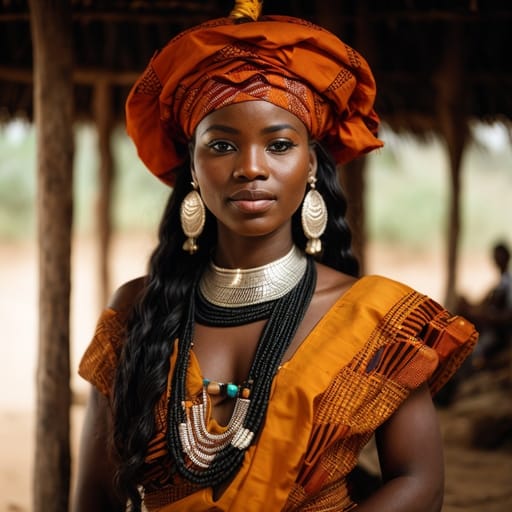
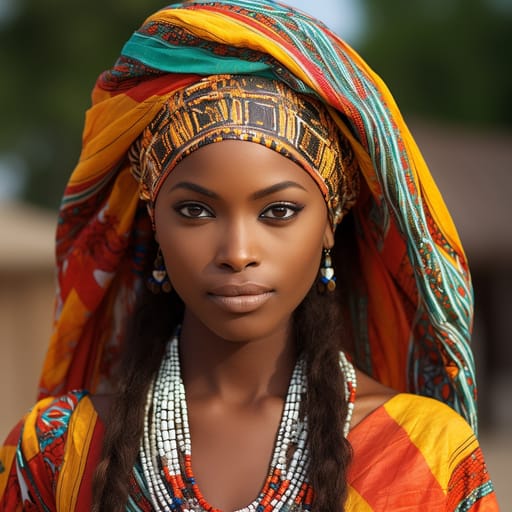
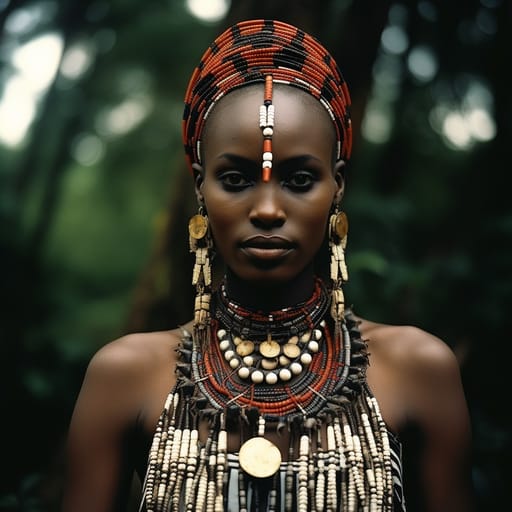
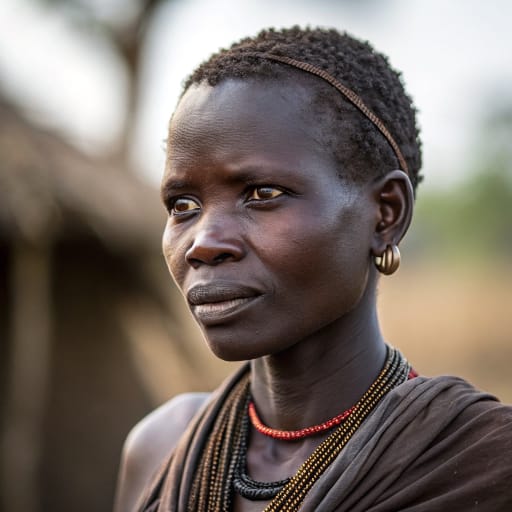
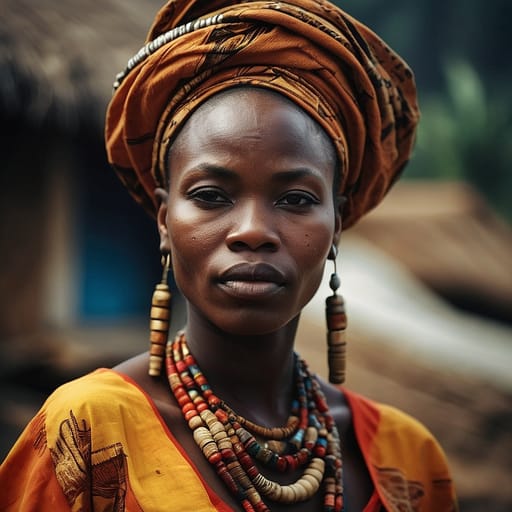
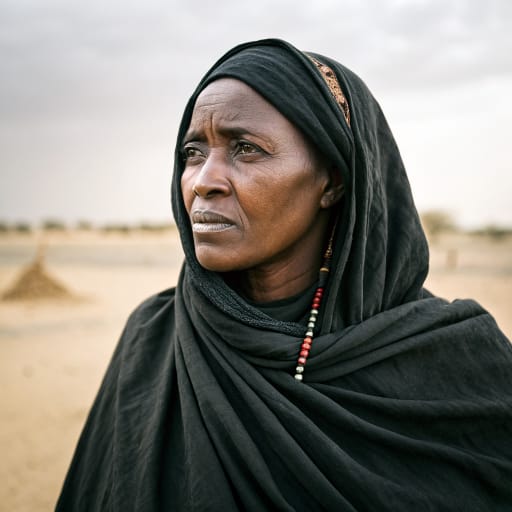
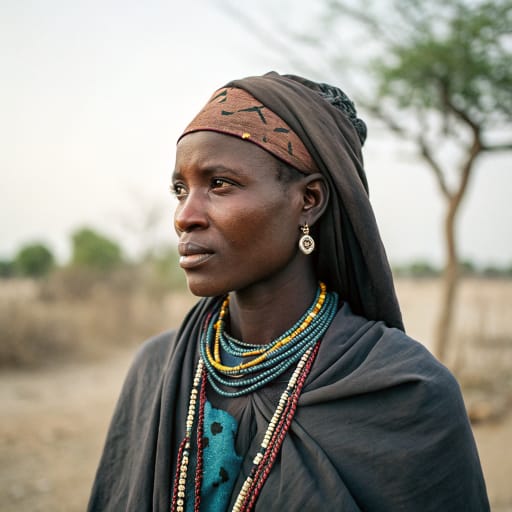
Typical Sakata Phenotypes
Reference for AI generation: hair, eyes, skin, facial structure, build
Sakata Body & Anatomy Reference
Bantu / Central African Niger-Congo phenotype: anatomy reference for AI nude generation
Sakata Boobs & Breasts
The typical Sakata bust is medium-to-large cup, full, projecting, in line with the wider Bantu / Central African Niger-Congo pattern. Areolas usually fall in the 32-48mm range, with deep-brown areolar pigmentation against the deep-brown skin tone. Compared with the smaller East African conical profile, Sakata breasts sit forward and are generally fuller projection than East African; comparable to West African norm. A faithful AI render of Sakata tits keeps that shape and areola size.
Sakata Ass & Hips
Butt shape among Sakata women: full, projected, wide-set glutes, over broad iliac crests, gynoid pelvic pattern. This follows Bantu / Central African Niger-Congo ancestry and looks quite unlike the slim narrow-hip Cushitic East African profile. An accurate Sakata ass in adult AI imagery keeps both the silhouette and the overall build (mesomorph with strong gluteal-femoral fat deposition) instead of a generic average.
Sakata Vagina & Pussy
Vulvar anatomy among Sakata women: deep-brown labial pigmentation, fuller labia minora. Pubic hair tends to be tightly-coiled coarse texture, dense distribution, in the usual inverted-triangle pattern. Both follow Bantu / Central African Niger-Congo pigmentation, which is why Sakata pussy renders should not fall back on a pale, sparse Western template.
Sakata Dicks & Penis
The Sakata cock profile, from Bantu / Central African Niger-Congo anthropometric data: regional mean ~14cm erect; above-average girth; deep-brown shaft pigmentation. Pubic hair has a tightly-coiled coarse texture and forms the usual inverted-V pattern. Whether Sakata men are circumcised follows religious and cultural practice rather than phenotype.
Sakata Body, Curves & Build
Build and curves among Sakata women follow the Bantu / Central African Niger-Congo pattern: mesomorph with strong gluteal-femoral fat deposition, mean adult female BMI 23-26. Proportions matter as much as skin tone, so Sakata figures should keep their regional height and limb ratios.
Sakata Skin Tone & Hair Texture
The Sakata skin range is deep-brown (Fitzpatrick VI), and hair tends to be tight 4A-4C coil. That combination marks the Bantu / Central African Niger-Congo phenotype, and skin tone is the trait AI generators most often get wrong for Sakata women.
Explore phenotype categories
Structured taxonomy with peer-reviewed scales · 22 anatomical categories
Erotic Poses & Sex Positions
From the pose catalog: 219 named positions with reference skeletons
Frequently asked questions about Sakata people
Where is the Sakata homeland?
The Sakata homeland is South of Lake Mai-Ndombe in Mai-Ndombe Province, western Democratic Republic of the Congo, centered on the Kutu area in Central Africa.
What language do Sakata people speak?
Sakata people primarily speak Sakata, also called Kisakata (Bantu, Niger-Congo); Lingala and French widely used.
What religion do Sakata people practice?
The predominant religion among Sakata people is Christianity, mainly Catholic, alongside ancestral beliefs.






Make your own Sakata images
Five a day, free, no credits to buy. The studio starts from this group's phenotype data, so you can set body type, pose and style and keep the traits accurate.
Start with Sakata