Help us get this right
Does this portrait look right for Piro?
One tap. It takes a second and it is recorded.
0 say it looks right, 1 says it looks off.
Piro Erotic
Rio Grande valley of central New Mexico around Socorro, with the related Tompiro in the Salinas basin east of the Manzano Mountains; after 1680, the El Paso area of Texas and Chihuahua (United States, Mexico)
Piro, extinct (Tanoan, within Kiowa-Tanoan; classification debated because the record is thin); Tompiro closely related
Pueblo ceremonial religion; Roman Catholic under Franciscan missions from the 1620s, practiced alongside Pueblo tradition among descendants
Rio Grande Piro and the Tompiro of the Salinas pueblos; part of the Pueblo peoples; descendants at Socorro del Sur, Senecú del Sur and the Piro-Manso-Tiwa community of Tortugas, New Mexico
About Piro People
The Piro were a Pueblo people who farmed the Rio Grande valley of central New Mexico, from around present-day Belen south past Socorro, from at least the 1300s until the 1680s. War, drought and raiding then drove the survivors south to the El Paso valley, and their descendants count themselves today among the Piro-Manso-Tiwa community of Tortugas near Las Cruces. Their towns were the southernmost of the Rio Grande pueblos, so they were the first farming towns that Spanish expeditions met on the way north up the river. That position shaped nearly everything that happened to them. They built compact towns of adobe and stone and grew corn, beans and squash on the floodplain. East of the Manzano Mountains, the closely related Tompiro held Abó and Las Humanas, the ruin now called Gran Quivira, and traded salt from the basin lakes to the Plains. The Piro language is usually placed in the Tanoan family beside Tiwa, Tewa and Towa. It survives mainly in short word lists written down in the nineteenth and early twentieth centuries, when only a few elderly speakers remained, and linguists still debate where it fits.
In 1598 a Piro town fed corn to Juan de Oñate's hungry colonizing column, and the Spanish named the place Socorro, Spanish for help. The city still carries the name. Franciscan missions followed at Socorro, Senecú, Sevilleta and Alamillo. For the next half century the Piro lived with tribute demands, forced labor and the suppression of their ceremonies, while Apache raids and drought pressed in from outside. Senecú was attacked and abandoned in 1675, and the Salinas towns emptied in the same decade. When the northern pueblos rose against Spain in 1680, most Piro did not join the revolt. Many followed the retreating colonists south instead, and a Spanish force returning upriver the next year burned the empty villages. The Piro never went back. Refugees founded Socorro del Sur and Senecú del Sur near El Paso, where a mission church still stands in Socorro, Texas. Over the following generations they married into Manso, Tiwa and Mexican families until their language fell silent. Their legacy is clearest at Tortugas. Every December the community climbs Tortugas Mountain for the feast of Our Lady of Guadalupe, a Catholic devotion kept with drum and dance, and people there still call themselves Piro, although the federal government has never recognized them.
Related ethnic groups
Groups that share Piro's homeland, region, language, or religious tradition. These are likely candidates for comparative phenotype reference.
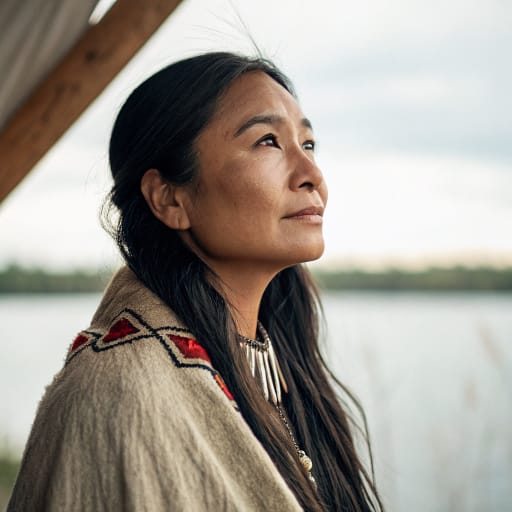
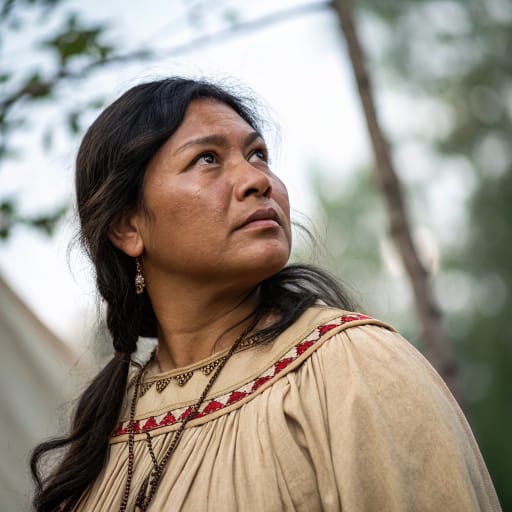
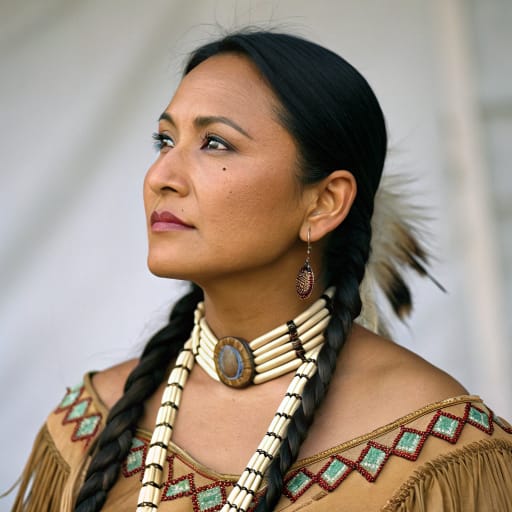
Typical Piro Phenotypes
Reference for AI generation: hair, eyes, skin, facial structure, build
Piro Body & Anatomy Reference
Per-feature anatomical profile for AI nude generation: Indigenous Northern American / Algonquian-Iroquoian phenotype
Piro Boobs & Breasts
Piro boobs follow the Indigenous Northern American / Algonquian-Iroquoian profile: medium cup, moderate projection. Areolar diameter is usually 30-44mm, and the coloring is medium-brown areolar pigmentation against the copper-to-medium-brown skin tone. Breast shape tracks body composition (mesomorph, broader frame in northern Indigenous populations, mean adult female BMI 25-28), so Piro breasts tend to be full and moderate projection. Expect a forward-set shape, not the smaller East Asian bust.
Piro Ass & Hips
Piro ass and hip morphology presents as medium, moderate-to-full projection, distinctly different from the slim East Asian narrow-hip profile. The Piro pelvic profile shows medium iliac crests, anchored in the Indigenous Northern American / Algonquian-Iroquoian skeletal pattern. Piro butt shots in adult AI imagery should render the medium, moderate-to-full projection silhouette with the overall build (mesomorph, broader frame in northern Indigenous populations) and the fat distribution typical of the Indigenous Northern American / Algonquian-Iroquoian phenotype.
Piro Vagina & Pussy
Piro pussy anatomy typically shows medium-brown labial pigmentation. Pubic hair is usually straight medium-coarse texture. In AI-generated Piro nudes, labial color should blend into the copper to medium-brown skin with a gradual transition, and the hair should keep its straight medium-coarse texture.
Piro Dicks & Penis
Penis reference for Piro men: regional mean ~13cm erect, moderate girth. Coloring: medium-brown shaft pigmentation. An accurate Piro cock in AI imagery matches the surrounding copper to medium-brown skin rather than a generic porn default. Circumcision depends on religion and custom, not ancestry.
Piro Body, Curves & Build
The Piro figure is generally mesomorph, broader frame in northern Indigenous populations, with mean adult female BMI 25-28, characteristic of Indigenous Northern American / Algonquian-Iroquoian ancestry. AI image tools tend to flatten regional body types into a few stock shapes; here the Piro build is kept as its own reference.
Piro Skin Tone & Hair Texture
Skin: copper to medium-brown (Fitzpatrick III-V). Hair: straight 1A, dark-brown to black, often thick and dense. Both are typical of Indigenous Northern American / Algonquian-Iroquoian ancestry. The most common mistake in AI nudes of Piro women is a body rendered lighter than the face.
Explore phenotype categories
Structured taxonomy with peer-reviewed scales · 22 anatomical categories
Erotic Poses & Sex Positions
From the pose catalog: 219 named positions with reference skeletons
Frequently asked questions about Piro people
Where is the Piro homeland?
The Piro homeland is Rio Grande valley of central New Mexico around Socorro, with the related Tompiro in the Salinas basin east of the Manzano Mountains; after 1680, the El Paso area of Texas and Chihuahua (United States, Mexico) in North America.
What language do Piro people speak?
Piro people primarily speak Piro, extinct (Tanoan, within Kiowa-Tanoan; classification debated because the record is thin); Tompiro closely related.
What religion do Piro people practice?
The predominant religion among Piro people is Pueblo ceremonial religion; Roman Catholic under Franciscan missions from the 1620s, practiced alongside Pueblo tradition among descendants.






Make your own Piro images
Five a day, free, no credits to buy. The studio starts from this group's phenotype data, so you can set body type, pose and style and keep the traits accurate.
Start with Piro