No portrait yet
Okchai Erotic
Upper Creek country on the Coosa and Tallapoosa rivers in central Alabama, United States; forcibly moved in the 1830s to Indian Territory, now Oklahoma
Muscogee (Muskogean)
Traditional Muscogee ceremonial religion centered on the square ground and Green Corn ceremony; Christianity, mainly Baptist and Methodist, since the 19th century
Upper Creek tribal town of the Muscogee (Creek) Confederacy; descendants within the Muscogee (Creek) Nation of Oklahoma
About Okchai People
The Okchai were not a nation in the European sense. They were a town, an etvlwv in Muscogee, and in the old Creek world the town was what mattered most. Your town decided which square ground your family danced at, where you sat in council, and which headmen spoke for you when outsiders came to bargain. Okchai was one of the Upper Creek towns in the river country of central Alabama, along the Coosa and Tallapoosa rivers. Its name turns up often in colonial trade records, usually spelled Oakchoy.
Its people spoke Muscogee, the main language of a confederacy that also took in speakers of Hitchiti, Alabama and Koasati. Those are related Muskogean languages, but a Muscogee speaker could not simply follow them. Yuchi, Shawnee and Natchez newcomers joined later. Town life ran on a shared calendar. The square ground, four arbors facing a central fire, hosted councils and ball games. Each midsummer it hosted the Green Corn ceremony: a new fire, fasting, the yaupon black drink taken to purify, and the pardoning of most old grievances so the year could start clean. Clans passed down through the mother's line and cut across towns, so an Okchai household had duties to kin well beyond its own square.
Through the eighteenth century Okchai was caught in a contest among Britain, France and Spain for Creek trade and loyalty. Okchai headmen, among them the Gun Merchant and the Mortar, were prominent in that bargaining, which Creek leaders worked to keep any one empire from gaining the upper hand. The next century went badly for all the Upper towns. The Red Stick War of 1813 and 1814 set Creek against Creek, the Treaty of Fort Jackson stripped away millions of acres, and in the 1830s the towns were driven west to Indian Territory.
Towns carried their names with them. In Oklahoma the Muscogee rebuilt their square grounds and kept tribal town membership as a living part of who they are. Descendants of the Okchai are found today among citizens of the Muscogee (Creek) Nation, headquartered at Okmulgee. Many go to Baptist or Methodist churches, many stomp dance through summer nights at the ceremonial grounds, and some families do both.
Related ethnic groups
Groups that share Okchai's homeland, region, language, or religious tradition. These are likely candidates for comparative phenotype reference.
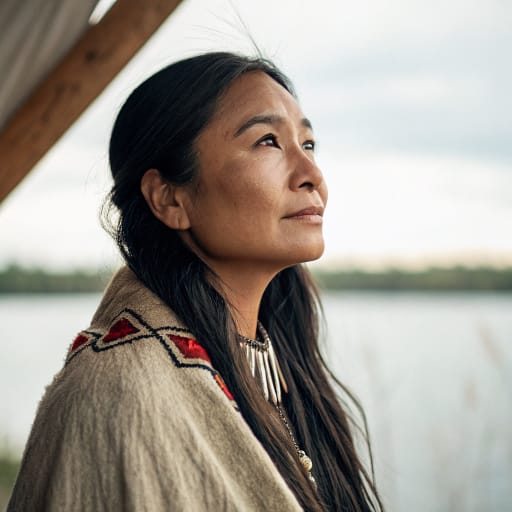
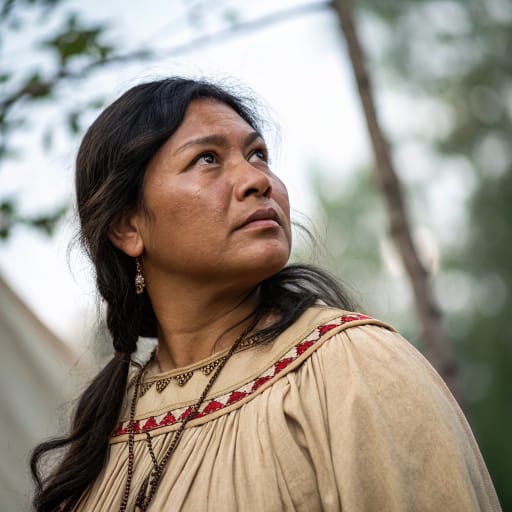
Typical Okchai Phenotypes
Reference for AI generation: hair, eyes, skin, facial structure, build
Okchai Body & Anatomy Reference
Per-feature anatomical profile for AI nude generation: Indigenous Northern American / Algonquian-Iroquoian phenotype
Okchai Boobs & Breasts
The typical Okchai bust is medium cup, moderate projection, in line with the wider Indigenous Northern American / Algonquian-Iroquoian pattern. Areolas usually fall in the 30-44mm range, with medium-brown areolar pigmentation against the copper-to-medium-brown skin tone. Compared with the smaller East Asian bust, Okchai breasts sit forward and are generally full and moderate projection. A faithful AI render of Okchai tits keeps that shape and areola size.
Okchai Ass & Hips
Butt shape among Okchai women: medium, moderate-to-full projection, over medium iliac crests. This follows Indigenous Northern American / Algonquian-Iroquoian ancestry and looks quite unlike the slim East Asian narrow-hip profile. An accurate Okchai ass in adult AI imagery keeps both the silhouette and the overall build (mesomorph, broader frame in northern Indigenous populations) instead of a generic average.
Okchai Vagina & Pussy
Vulvar anatomy among Okchai women: medium-brown labial pigmentation. Pubic hair tends to be straight medium-coarse texture, in the usual inverted-triangle pattern. Both follow Indigenous Northern American / Algonquian-Iroquoian pigmentation, which is why Okchai pussy renders should not fall back on a pale, sparse Western template.
Okchai Dicks & Penis
The Okchai cock profile, from Indigenous Northern American / Algonquian-Iroquoian anthropometric data: regional mean ~13cm erect; moderate girth; medium-brown shaft pigmentation. Pubic hair has a straight medium-coarse texture and forms the usual inverted-V pattern. Whether Okchai men are circumcised follows religious and cultural practice rather than phenotype.
Okchai Body, Curves & Build
Build and curves among Okchai women follow the Indigenous Northern American / Algonquian-Iroquoian pattern: mesomorph, broader frame in northern Indigenous populations, mean adult female BMI 25-28. Proportions matter as much as skin tone, so Okchai figures should keep their regional height and limb ratios.
Okchai Skin Tone & Hair Texture
The Okchai skin range is copper to medium-brown (Fitzpatrick III-V), and hair tends to be straight 1A, dark-brown to black, often thick and dense. That combination marks the Indigenous Northern American / Algonquian-Iroquoian phenotype, and skin tone is the trait AI generators most often get wrong for Okchai women.
Explore phenotype categories
Structured taxonomy with peer-reviewed scales · 22 anatomical categories
Erotic Poses & Sex Positions
From the pose catalog: 219 named positions with reference skeletons
Frequently asked questions about Okchai people
Where is the Okchai homeland?
The Okchai homeland is Upper Creek country on the Coosa and Tallapoosa rivers in central Alabama, United States; forcibly moved in the 1830s to Indian Territory, now Oklahoma in North America.
What language do Okchai people speak?
Okchai people primarily speak Muscogee (Muskogean).
What religion do Okchai people practice?
The predominant religion among Okchai people is Traditional Muscogee ceremonial religion centered on the square ground and Green Corn ceremony; Christianity, mainly Baptist and Methodist, since the 19th century.






Make your own Okchai images
Five a day, free, no credits to buy. The studio starts from this group's phenotype data, so you can set body type, pose and style and keep the traits accurate.
Start with Okchai