No portrait yet
Oirats Erotic
Altai region: western Mongolia, Xinjiang (China) and southern Siberia (Russia); the Kalmyk branch lives on the lower Volga in Kalmykia, Russia
Oirat, including the Kalmyk variety (Mongolic); written in Todo Bichig clear script in Xinjiang and Cyrillic in Kalmykia
Tibetan Buddhism (Gelug school), with older shamanic and folk practices
Western branch of the Mongols; subgroups include Dörbet, Torghut, Khoshut, Dzungar (Choros), Bayad, Zakhchin, Ööld, Myangad, Khoid and the Kalmyks of Russia
About Oirats People
The Oirats are the Mongols who went west and were never fully folded back into the Mongol mainstream. Their heartland is the Altai country where Mongolia, Xinjiang and Russian Siberia meet: high steppe, larch forest and salt lakes, a landscape that bred a herding economy harder and more scattered than that of the eastern Khalkha. From there they spread in three directions. The Torghuts crossed the Kazakh steppe in the early 1600s and settled on the lower Volga, where their descendants, the Kalmyks, remain today in the only Buddhist-majority region of Europe. The Khoshuts rode into Tibet and in 1642 installed the Fifth Dalai Lama as ruler of the country. The Dzungars built the last great nomadic empire of Inner Asia and fought the Qing for three generations before the Qianlong emperor destroyed them in the 1750s, a campaign of massacre, smallpox and flight that emptied Dzungaria and is now widely called a genocide.
Oirat identity began as an alliance rather than a bloodline: the Dörben Oirat, the Four Oirats, a confederation that rose as Chinggisid power faded and in 1449 captured a Ming emperor in battle. Today's subgroups, Dörbet, Torghut, Khoshut, Bayad, Zakhchin, Ööld, Myangad and the Kalmyks, all trace back to it. The Oirat language is Mongolic and close enough to Khalkha that linguists argue over whether it is a dialect or a separate tongue; speakers tend to insist on separate, and the Kalmyk variety has drifted further under Russian influence. The Oirats also have their own script. In 1648 a Khoshut monk, Zaya Pandita, reworked the vertical Mongolian script into Todo Bichig, the clear script, to record Oirat sounds precisely; it is still taught in Xinjiang, while Kalmykia switched to Cyrillic under Soviet rule. Faith is Tibetan Buddhism of the Gelug school, adopted in the same era and layered over older habits: fire offerings, milk sprinkled to the sky, reverence for mountains and springs. Kalmyks keep Zul, a midwinter festival of lamps at which the whole community turns a year older together. Wherever Oirats live, bards sing Jangar, an epic cycle about an ideal steppe kingdom that can run for nights on end. A red tassel on the crown of the hat, the ulan zala, has marked an Oirat since the fifteenth century. Two wounds organize Kalmyk memory: the 1771 return of most Volga Torghuts to Dzungaria, on which a large share died on the road, and the 1943 deportation of every Kalmyk to Siberia, reversed only in 1957.
Related ethnic groups
Groups that share Oirats's homeland, region, language, or religious tradition. These are likely candidates for comparative phenotype reference.
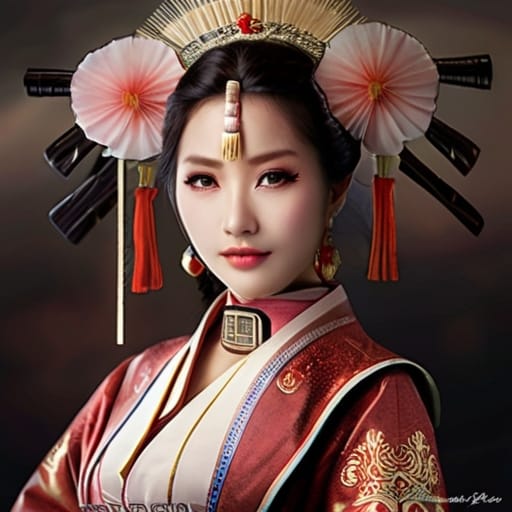
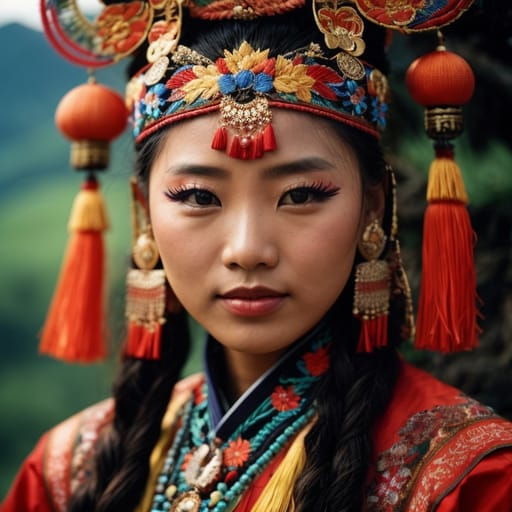
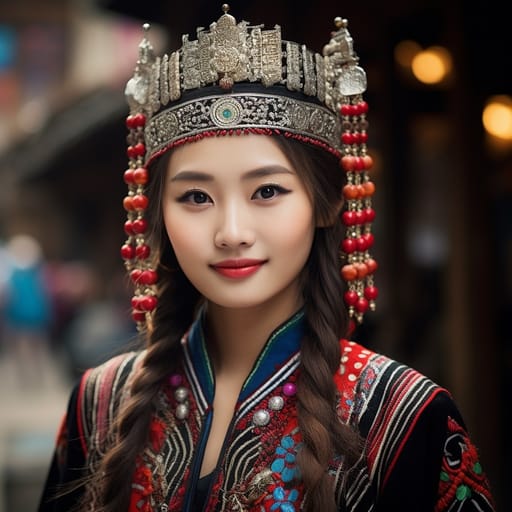

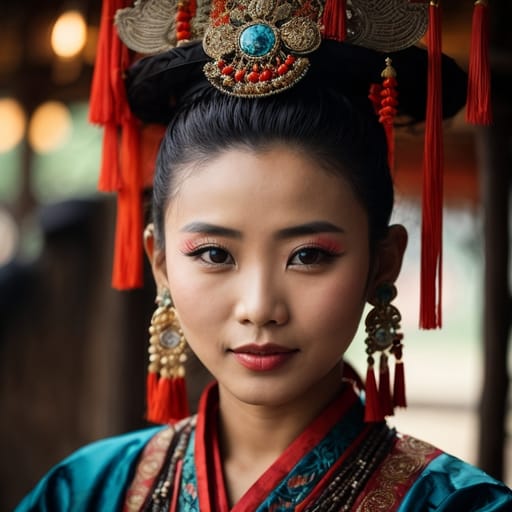
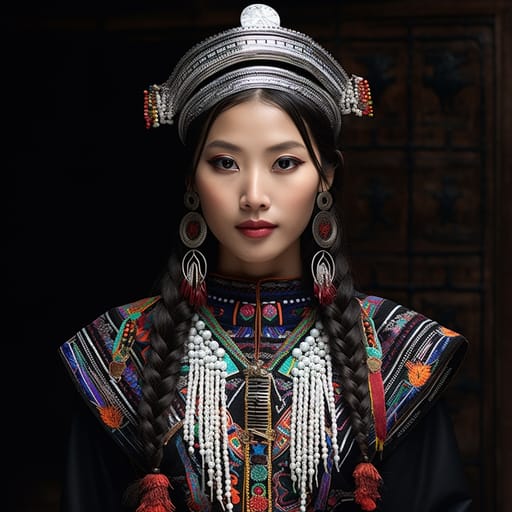
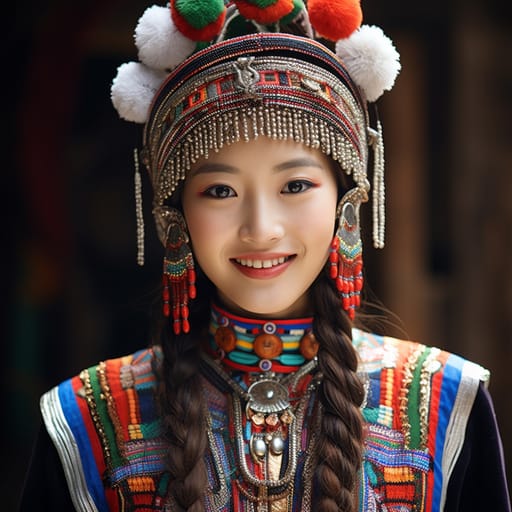
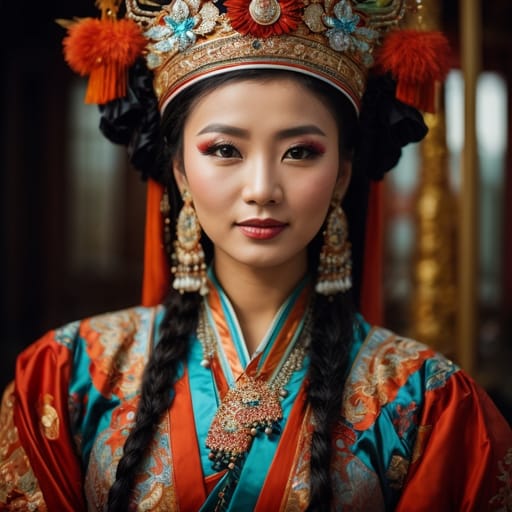
Typical Oirats Phenotypes
Reference for AI generation: hair, eyes, skin, facial structure, build
Oirats Body & Anatomy Reference
Per-feature anatomical profile for AI nude generation: East Asian Sinitic / Mongoloid phenotype
Oirats Boobs & Breasts
Oirats boobs follow the East Asian Sinitic / Mongoloid profile: small-to-medium cup, modest projection. Areolar diameter is usually 26-36mm, and the coloring is light-pink to medium-brown areolar pigmentation against the light-to-medium skin tone. Breast shape tracks body composition (ectomorph-to-mesomorph, lean frame, mean adult female BMI 20-23), so Oirats breasts tend to be firm and modestly projecting; smaller cup size than the South Asian or Western Asian average. Expect a forward-set shape, not the fuller South Asian or Levantine bust profile.
Oirats Ass & Hips
Oirats ass and hip morphology presents as small-to-medium, modest projection, narrower hip profile, distinctly different from the fuller projected glutes of the West African or Polynesian phenotype. The Oirats pelvic profile shows narrower iliac crests, less gluteal-femoral fat deposition, anchored in the East Asian Sinitic / Mongoloid skeletal pattern. Oirats butt shots in adult AI imagery should render the small-to-medium, modest projection, narrower hip profile silhouette with the overall build (ectomorph-to-mesomorph, lean frame) and the fat distribution typical of the East Asian Sinitic / Mongoloid phenotype.
Oirats Vagina & Pussy
Oirats pussy anatomy typically shows light-pink to medium-brown labial pigmentation, smaller labia minora. Pubic hair is usually straight fine texture, sparser distribution than the South Asian norm. In AI-generated Oirats nudes, labial color should blend into the light to medium skin with a gradual transition, and the hair should keep its straight fine texture.
Oirats Dicks & Penis
Penis reference for Oirats men: regional mean ~11-12cm erect, moderate girth. Coloring: light-brown shaft pigmentation. An accurate Oirats cock in AI imagery matches the surrounding light to medium skin rather than a generic porn default. Circumcision depends on religion and custom, not ancestry.
Oirats Body, Curves & Build
The Oirats figure is generally ectomorph-to-mesomorph, lean frame, with mean adult female BMI 20-23, characteristic of East Asian Sinitic / Mongoloid ancestry. AI image tools tend to flatten regional body types into a few stock shapes; here the Oirats build is kept as its own reference.
Oirats Skin Tone & Hair Texture
Skin: light to medium (Fitzpatrick II-IV). Hair: straight 1A, fine-to-medium, predominantly black. Both are typical of East Asian Sinitic / Mongoloid ancestry. The most common mistake in AI nudes of Oirats women is a body rendered lighter than the face.
Explore phenotype categories
Structured taxonomy with peer-reviewed scales · 22 anatomical categories
Erotic Poses & Sex Positions
From the pose catalog: 219 named positions with reference skeletons
Frequently asked questions about Oirats people
Where is the Oirats homeland?
The Oirats homeland is Altai region: western Mongolia, Xinjiang (China) and southern Siberia (Russia); the Kalmyk branch lives on the lower Volga in Kalmykia, Russia in East Asia.
What language do Oirats people speak?
Oirats people primarily speak Oirat, including the Kalmyk variety (Mongolic); written in Todo Bichig clear script in Xinjiang and Cyrillic in Kalmykia.
What religion do Oirats people practice?
The predominant religion among Oirats people is Tibetan Buddhism (Gelug school), with older shamanic and folk practices.






Make your own Oirats images
Five a day, free, no credits to buy. The studio starts from this group's phenotype data, so you can set body type, pose and style and keep the traits accurate.
Start with Oirats