No portrait yet
Ngizim Erotic
Potiskum and the farming districts to its east and south, Yobe State, northeastern Nigeria; formerly also parts of present-day Borno and Jigawa states.
Ngizim (Afroasiatic, West Chadic, Bade group); Hausa widely used as a second language, with a heavy layer of older Kanuri loanwords.
Predominantly Sunni Islam.
Part of the Bade-Ngizim cluster of West Chadic peoples, closest to the Bade and Duwai; related neighbors in Yobe State include the Karekare, Bole and Ngamo.
About Ngizim People
The Ngizim are the people of Potiskum. The town, now the largest city and the commercial engine of Yobe State in northeastern Nigeria, began as a Ngizim settlement, and the group's identity is still anchored to it and to the farming villages spread to its east and south. Estimates from the 1990s put them at about 80,000, a small people by Nigerian standards, ringed by larger neighbors: Kanuri to the east, Hausa and Fulani all around, and the related Bade, Karekare, Bole and Ngamo close by.
Their language, also called Ngizim, belongs to the West Chadic branch of the Afroasiatic family, which makes it a cousin of Hausa and a close sibling of Bade and Duwai, spoken just to the north. It is tonal, and centuries inside the orbit of the Bornu Empire left it full of Kanuri loanwords. Today the pressure comes from Hausa, the working language of markets, schools and radio across the north, and most Ngizim are at least bilingual. For a small language it is unusually well documented, largely thanks to the American linguist Russell Schuh, who produced a dictionary and later worked with local speakers on the Yobe Languages Research Project.
History explains the compact territory. When Bornu's rulers built their capital at Birni Ngazargamu in the late fifteenth century, the Ngizim sat on the western frontier and fought back, and the court chronicle of Mai Idris Alooma records repeated campaigns against them. They kept a reputation as hard fighters. Ngizim communities that once lived farther afield, in what are now Borno and Jigawa states, were gradually absorbed by their neighbors and no longer identify as Ngizim. Under British rule the Potiskum chiefdom was folded into the Fika Emirate, a Bole institution whose emir then moved his seat into Potiskum itself. A separate Potiskum emirate, locally Pataskum, under its own Mai was restored in 1993, abolished under military rule, and brought back in 2000. The town now hosts two royal courts.
Most Ngizim are Sunni Muslims, and Islam sets the rhythm of the week, the naming of children and the conduct of marriages. Conversion came later here than among the Kanuri, whose chroniclers treated the Ngizim as outsiders to the faith. Life is agricultural: millet, sorghum, beans and groundnuts grown in a short rainy season, with cattle moving through Potiskum's livestock market, one of the largest in Nigeria. The town's place on the main road made it a target during the Boko Haram insurgency, and bombings of markets and schools in the 2010s struck Ngizim families. The community stayed, and the restored emirate and the dictionary work are both signs of a small people intent on remaining distinct.
Related ethnic groups
Groups that share Ngizim's homeland, region, language, or religious tradition. These are likely candidates for comparative phenotype reference.
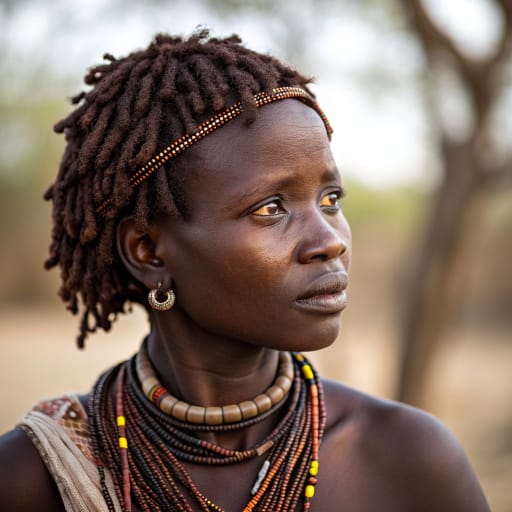
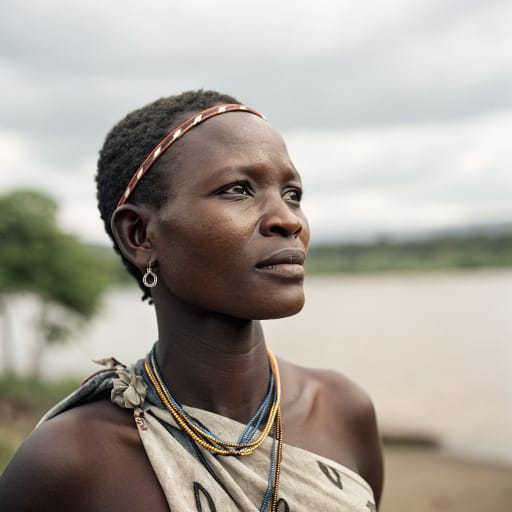
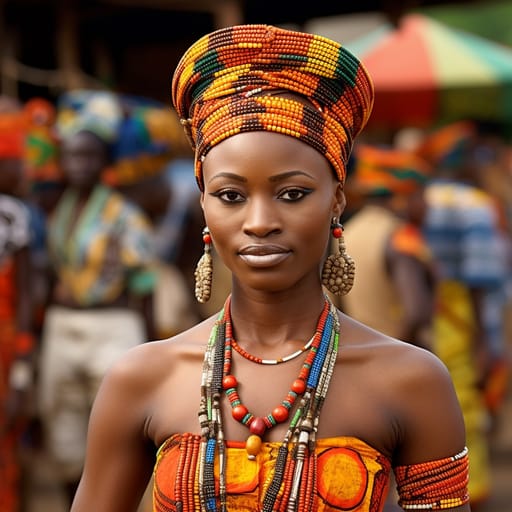
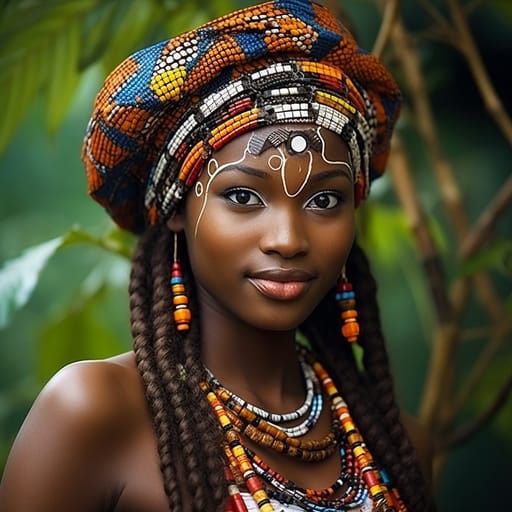
Typical Ngizim Phenotypes
Reference for AI generation: hair, eyes, skin, facial structure, build
Ngizim Body & Anatomy Reference
Anatomy by feature, West African Niger-Congo phenotype
Ngizim Boobs & Breasts
Ngizim tits and boobs run medium-to-large cup, full, projecting, the classic West African Niger-Congo bust profile. Ngizim nipples and areolas show deep-brown to near-black areolar pigmentation against the medium-to-deep-brown skin tone, with areolar diameter typically in the 35-50mm range and forward-set positioning rather than the smaller conical Cushitic East African profile. Ngizim breasts trend fuller and more projecting than the East African norm, a function of the mesomorph with strong gluteal-femoral fat distribution body habitus and the mean adult female BMI 24-27. For anatomically accurate AI-generated Ngizim nudes the render preserves the medium-to-large cup, full, projecting shape, 35-50mm areolas with deep-brown to near-black pigmentation, and the torso proportions of the West African Niger-Congo phenotype.
Ngizim Ass & Hips
Ngizim hips and butt usually read as wide-set, full, heavily projected glutes. The skeletal base is wide iliac crests, broad gynoid pelvic pattern, high glute-to-waist ratio, the West African Niger-Congo pattern. Set against the slim narrow-hip Cushitic East African profile, the difference is easy to see, and the hip-to-waist ratio is often what identifies Ngizim women in photos.
Ngizim Vagina & Pussy
Expect deep-brown to near-black labial pigmentation, fuller labia minora on Ngizim women, in keeping with West African Niger-Congo ancestry. The pubic hair is tightly-coiled coarse texture, densely distributed. Coloring should run evenly from the medium-brown to deep-brown skin of the thighs to the labia, and Ngizim nude imagery should keep the hair's tightly-coiled coarse texture.
Ngizim Dicks & Penis
Ngizim dick and penile anatomy in adult AI generation should anchor on the regional reference data: regional mean ~14-15cm erect, above-average girth, ~13cm circumference, and deep-brown-to-near-black shaft pigmentation. The Ngizim cock profile reflects the West African Niger-Congo population's anthropometric measurements. The shaft pigmentation should track the surrounding medium-brown to deep-brown skin tone, and the pubic hair should keep its tightly-coiled coarse texture in the typical inverted-V escutcheon.
Ngizim Body, Curves & Build
Ngizim body type: mesomorph with strong gluteal-femoral fat distribution, with mean adult female BMI 24-27. This is the typical West African Niger-Congo build. Height range, shoulder-to-hip ratio and fat distribution all follow from it, which is what an accurate Ngizim nude body should show.
Ngizim Skin Tone & Hair Texture
Ngizim skin tone falls in the medium-brown to deep-brown (Fitzpatrick V-VI) band, the surface signal most often miscalibrated by generic AI nude generators. Ngizim hair texture is typically tight 4A-4C coil, often worn natural, braided, or relaxed, characteristic of the West African Niger-Congo phenotype. In Ngizim nude renders the skin should hold that band consistently across the body.
Explore phenotype categories
Structured taxonomy with peer-reviewed scales · 22 anatomical categories
Erotic Poses & Sex Positions
From the pose catalog: 219 named positions with reference skeletons
Frequently asked questions about Ngizim people
Where is the Ngizim homeland?
The Ngizim homeland is Potiskum and the farming districts to its east and south, Yobe State, northeastern Nigeria; formerly also parts of present-day Borno and Jigawa states. in Western Africa.
What language do Ngizim people speak?
Ngizim people primarily speak Ngizim (Afroasiatic, West Chadic, Bade group); Hausa widely used as a second language, with a heavy layer of older Kanuri loanwords..
What religion do Ngizim people practice?
The predominant religion among Ngizim people is Predominantly Sunni Islam..






Make your own Ngizim images
Five a day, free, no credits to buy. The studio starts from this group's phenotype data, so you can set body type, pose and style and keep the traits accurate.
Start with Ngizim