Help us get this right
Does this portrait look right for Mattawoman?
Nobody has judged this one yet. You would be the first.
Mattawoman Erotic
Mattawoman Creek and the nearby Potomac shore in present-day Charles County, southern Maryland, United States.
Piscataway, also called Conoy (Eastern Algonquian, Algic family), closely related to Nanticoke; extinct.
Traditional Algonquian religion; Jesuit missions brought Catholicism to the Piscataway peoples from the 1640s, and most descendants today are Catholic.
A member nation of the Piscataway (Conoy) paramount chiefdom; related to the Nanticoke and Powhatan peoples. Descendants are counted among the Piscataway Indian Nation and the Piscataway Conoy Tribe.
About Mattawoman People
The Mattawoman were an Algonquian-speaking people of the Maryland shore of the Potomac, living along the creek that still carries their name in present-day Charles County from before English contact in 1608 until the 1680s, when raids and colonial pressure broke up their town. The survivors merged into the Piscataway, whose descendants in southern Maryland carry the line today.
John Smith mapped their town as Mataughquamend, usually glossed as "where one goes pleasantly." It was one of a string of river towns answering to the Piscataway tayac, the paramount chief on the Maryland side of the Potomac. The Mattawoman had their own werowance and their own ground: a slow tidal creek thick with spawning fish, marsh full of tuckahoe and waterfowl, and enough bottomland for corn, beans and squash. Houses were bent-sapling frames covered in bark or reed mats. Their speech was a dialect of Piscataway, an Eastern Algonquian language close to Nanticoke across the bay and kin to the Powhatan spoken over the river in Virginia. It survives in little more than a Jesuit's handwritten prayers and a scatter of place names.
Maryland's founding in 1634 put them in the path of a colony that wanted exactly the land they farmed. Jesuit missionaries worked the Potomac towns through the 1640s, and Catholicism took a lasting hold among the Piscataway peoples alongside older belief. In 1666 the Mattawoman were among the dozen nations that signed Articles of Peace and Amity with the proprietary government. The treaty promised protected land and in practice fenced them into it, on a reservation laid out between Mattawoman and Piscataway creeks while planters' cattle and hogs wrecked the cornfields. It also made them English allies, which made them targets. Susquehannock and Iroquois war parties struck south in the years after 1675, and a raid around 1681 carried off most of the Mattawoman town. Those who got away sheltered with the Piscataway at the fort in Zekiah Swamp.
After that the Mattawoman fade from the colony's records as a separate nation. Part of the combined Piscataway left Maryland in the 1690s, moving up the Potomac and eventually into Pennsylvania under Iroquois protection, where they were known as the Conoy. Others never left. Families stayed on in the back country of Charles and Prince George's counties, held together by kinship and parish, and Maryland recognized their descendants in 2012 as the Piscataway Indian Nation and the Piscataway Conoy Tribe. The name itself is still in daily use. Mattawoman Creek remains one of the most productive fish nurseries on the Chesapeake, and the recurring fights over development in its watershed are the latest argument over Mattawoman land.
Related ethnic groups
Groups that share Mattawoman's homeland, region, language, or religious tradition. These are likely candidates for comparative phenotype reference.
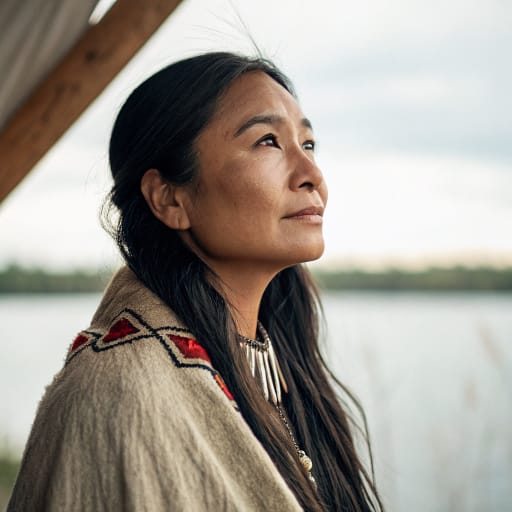
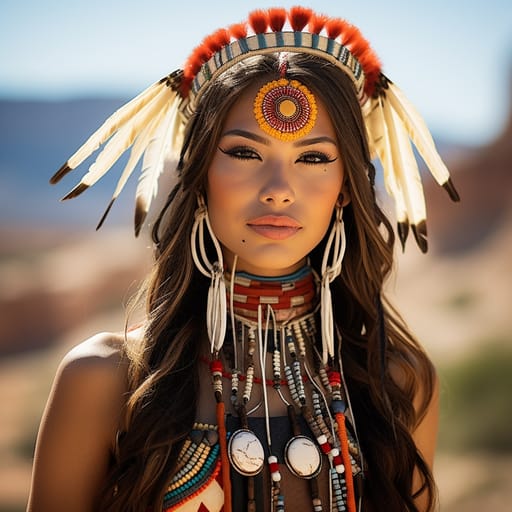
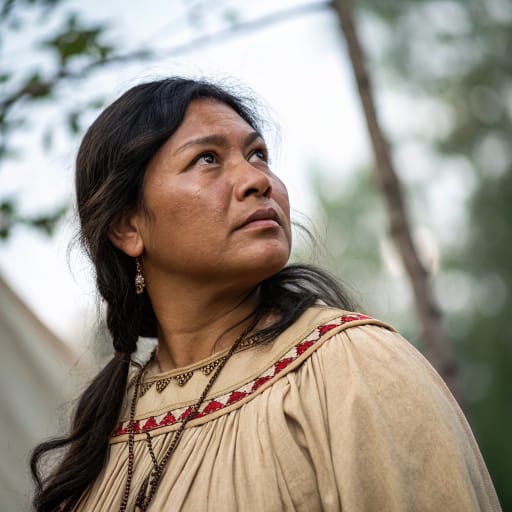
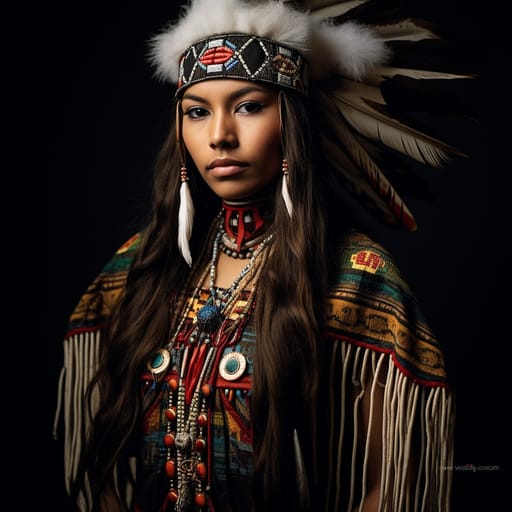
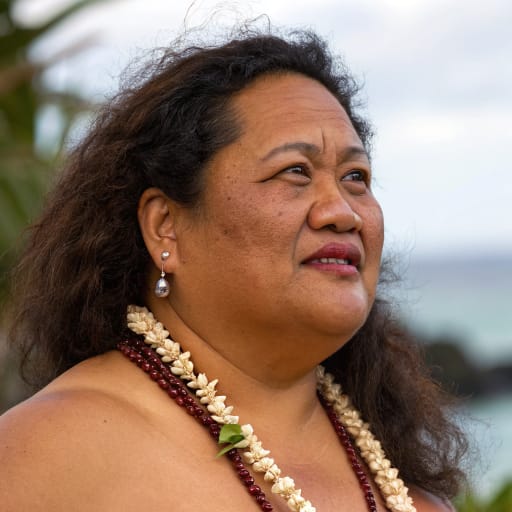
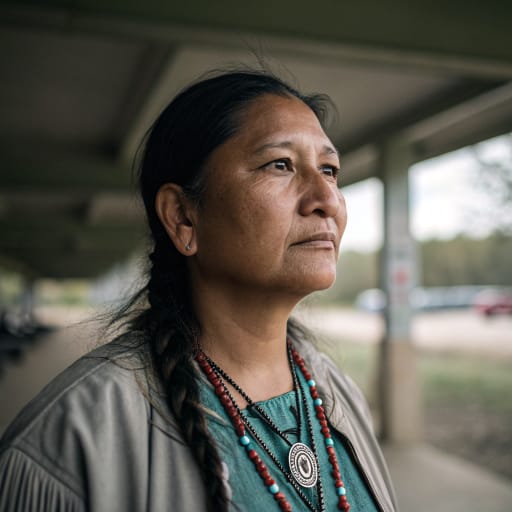
Typical Mattawoman Phenotypes
Reference for AI generation: hair, eyes, skin, facial structure, build
Mattawoman Body & Anatomy Reference
Per-feature anatomical profile for AI nude generation: Indigenous Northern American / Algonquian-Iroquoian phenotype
Mattawoman Boobs & Breasts
Bust reference for Mattawoman women: medium cup, moderate projection, which is typical of Indigenous Northern American / Algonquian-Iroquoian ancestry. Areolas measure about 30-44mm across, with medium-brown pigmentation. Body type (mesomorph, broader frame in northern Indigenous populations) shapes the bust as well, so Mattawoman tits are usually full and moderate projection. In AI imagery, keep the forward-set shape rather than drifting toward the smaller East Asian bust.
Mattawoman Ass & Hips
The Mattawoman ass is typically medium, moderate-to-full projection, which sets it apart from the slim East Asian narrow-hip profile. Underneath, the pelvis shows medium iliac crests, part of the Indigenous Northern American / Algonquian-Iroquoian skeletal pattern. For Mattawoman butt pics and AI renders, match that silhouette and the overall build (mesomorph, broader frame in northern Indigenous populations).
Mattawoman Vagina & Pussy
Mattawoman pussy and vulvar anatomy presents medium-brown labial pigmentation, consistent with the Indigenous Northern American / Algonquian-Iroquoian phenotype's pigmentation pattern. Mattawoman pubic hair is typically straight medium-coarse texture, in the inverted-triangle pattern. For anatomically accurate Mattawoman pussy renders the labial coloration should match the surrounding copper to medium-brown skin tone with a continuous gradient, and the hair should keep its straight medium-coarse texture.
Mattawoman Dicks & Penis
Mattawoman dicks follow the Indigenous Northern American / Algonquian-Iroquoian reference data: regional mean ~13cm erect; moderate girth; medium-brown shaft pigmentation. Shaft color should track the copper to medium-brown skin tone with a smooth change toward the glans, and Mattawoman pubic hair keeps its straight medium-coarse texture.
Mattawoman Body, Curves & Build
Mattawoman body type and overall build presents as mesomorph, broader frame in northern Indigenous populations, with mean adult female BMI 25-28: the characteristic Indigenous Northern American / Algonquian-Iroquoian habitus. Mattawoman curves and proportions should keep the regional skeletal frame (height, shoulder-to-hip ratio, limb proportions) rather than a generic mesomorph default.
Mattawoman Skin Tone & Hair Texture
Mattawoman skin sits in the copper to medium-brown (Fitzpatrick III-V) band. Hair is typically straight 1A, dark-brown to black, often thick and dense, in keeping with the Indigenous Northern American / Algonquian-Iroquoian phenotype. In nude renders the skin should stay one even tone from face to body, and body, pubic and head hair should match.
Explore phenotype categories
Structured taxonomy with peer-reviewed scales · 22 anatomical categories
Erotic Poses & Sex Positions
From the pose catalog: 219 named positions with reference skeletons
Frequently asked questions about Mattawoman people
Where is the Mattawoman homeland?
The Mattawoman homeland is Mattawoman Creek and the nearby Potomac shore in present-day Charles County, southern Maryland, United States. in North America.
What language do Mattawoman people speak?
Mattawoman people primarily speak Piscataway, also called Conoy (Eastern Algonquian, Algic family), closely related to Nanticoke; extinct..
What religion do Mattawoman people practice?
The predominant religion among Mattawoman people is Traditional Algonquian religion; Jesuit missions brought Catholicism to the Piscataway peoples from the 1640s, and most descendants today are Catholic..






Make your own Mattawoman images
Five a day, free, no credits to buy. The studio starts from this group's phenotype data, so you can set body type, pose and style and keep the traits accurate.
Start with Mattawoman