No portrait yet
Mansi Erotic
West bank of the Ob basin and eastern foothills of the Northern Urals, chiefly Khanty-Mansi Autonomous Okrug with smaller numbers in Sverdlovsk Oblast, Russia
Mansi (Uralic, Ugric branch, Ob-Ugric); Russian is the everyday language for most
Nominally Russian Orthodox, with a living animist and shamanic tradition centered on the bear cult and household spirits
Northern (Sosva, Lyapin, Upper Lozva), Eastern (Konda), Western (Pelym) and Southern (Tavda) Mansi; Ob-Ugric together with the Khanty; Ugric together with Hungarians
About Mansi People
The Mansi are the people whose name is on the map of one of Russia's richest regions and whose numbers there are among the smallest. Khanty-Mansi Autonomous Okrug, the oil heartland of western Siberia, takes half its name from them, yet the Mansi are well under one percent of its population: around twelve thousand people strung along the Sosva, Lozva, Konda and Pelym rivers on the west bank of the Ob and up into the eastern foothills of the Northern Urals. Older Russian sources call them Voguls. Their own name is usually traced to the same root as the Magy in Magyar, and that is no accident. With the Khanty and the Hungarians they form the Ugric branch of the Uralic family, so their closest linguistic cousin outside Siberia is Hungarian, separated by three millennia and half a continent. Mansi once had four dialect groups. Southern, western and eastern are gone; only the northern one, spoken around the Sosva and upper Lozva, still has fluent speakers, and they number in the hundreds. The language has co-official status in the okrug, a newspaper and a Cyrillic alphabet, but most Mansi live their days in Russian.
Formally the Mansi have been Orthodox since the mass baptisms of the early 1700s. The older religion never left. The sky god Numi-Torum and his son Mir-susne-khum, the rider who circles the world, preside over a crowd of local spirits kept in household shrines and sacred groves. The bear is a son of heaven who fell to earth, and killing one obliges the hunter's kin to hold a bear feast that can run several nights, with masked skits, long cycles of songs, and the animal's head seated as guest of honor. Society splits into two exogamous halves, Mos and Por. The Mos side claims descent from the sky family, the Por side from the bear, and a Mansi is expected to marry across that line. Northern Mansi took up reindeer herding from Nenets neighbors; the rest lived by hunting, fishing and later small livestock. The Pelym and Konda principalities raided Perm lands and fought Moscow through the 1400s and 1500s, and were broken after Yermak's campaign opened Siberia. Since the 1960s the oil boom has brought hundreds of thousands of newcomers, and the Mansi have gone from majority to footnote in their own basin. Their place names are still the ones the world repeats, including Kholat Syakhl, the Dead Mountain of the Dyatlov Pass story, and the boxer Ruslan Provodnikov, from Beryozovo, has carried the name Mansi into rings far from the Ob.
Related ethnic groups
Groups that share Mansi's homeland, region, language, or religious tradition. These are likely candidates for comparative phenotype reference.
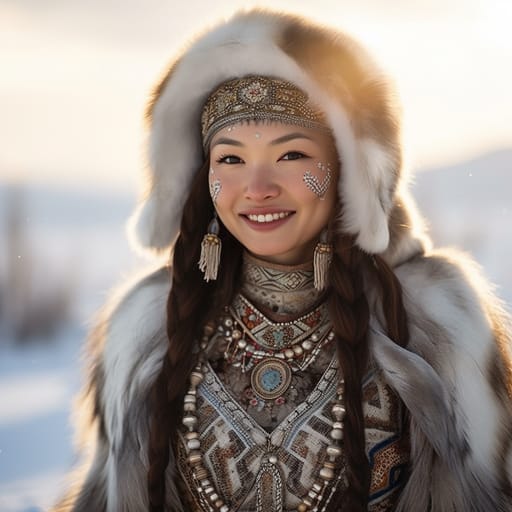
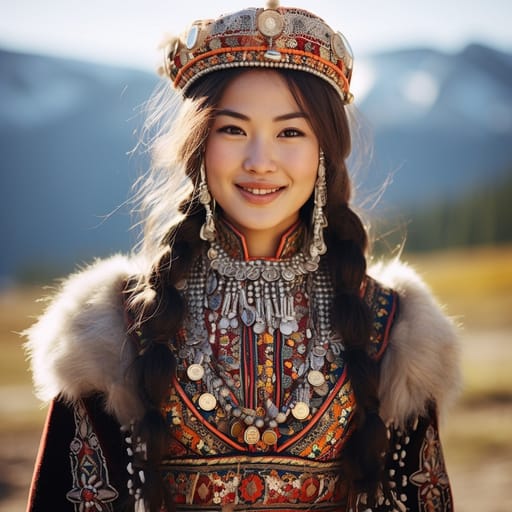
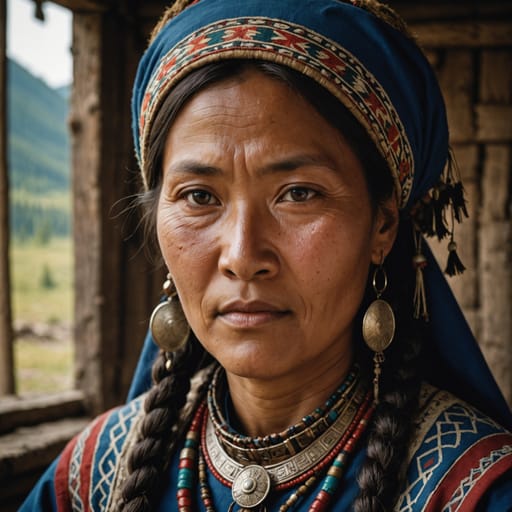
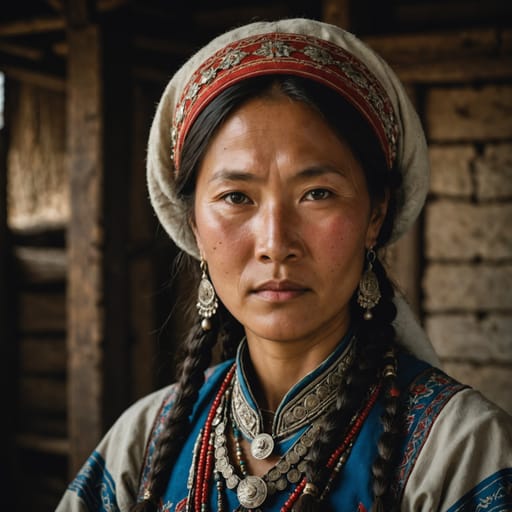
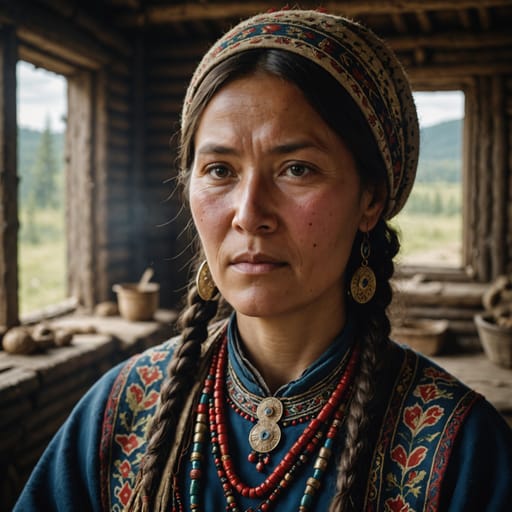
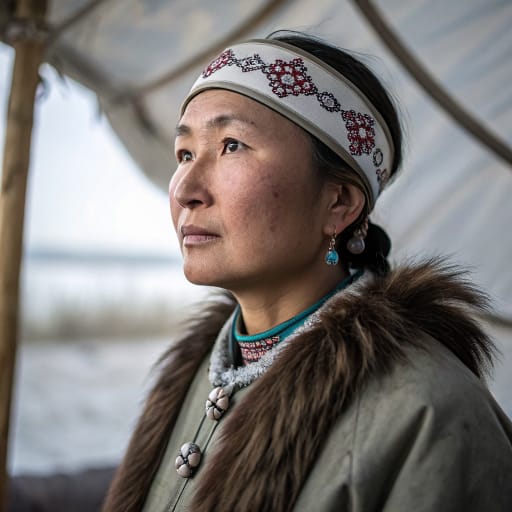
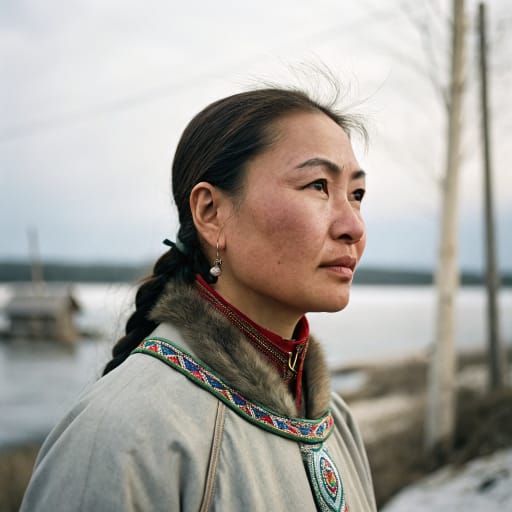
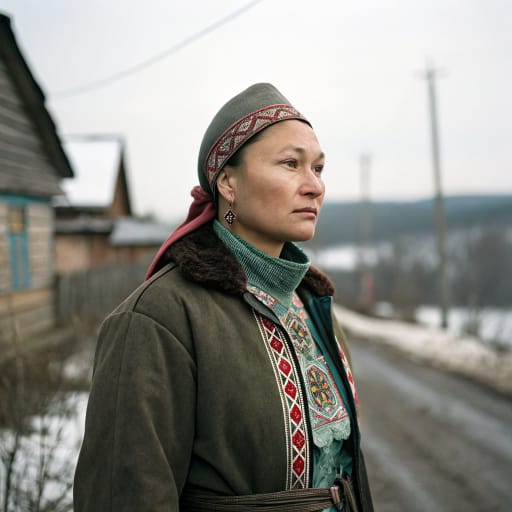
Typical Mansi Phenotypes
Reference for AI generation: hair, eyes, skin, facial structure, build
Mansi Body & Anatomy Reference
Per-feature anatomical profile for AI nude generation: Siberian Indigenous / Tungusic phenotype
Mansi Boobs & Breasts
Mansi tits and boobs run small-to-medium cup, modest projection, the classic Siberian Indigenous / Tungusic bust profile. Mansi nipples and areolas show medium-brown areolar pigmentation against the light-to-medium skin tone, with areolar diameter typically in the 26-38mm range and forward-set positioning rather than the fuller Central Asian or East Asian bust. Mansi breasts trend firm, modest projection, a function of the mesomorph, broader stocky frame adapted to cold climate body habitus and the mean adult female BMI 22-25. For anatomically accurate AI-generated Mansi nudes the render preserves the small-to-medium cup, modest projection shape, 26-38mm areolas with medium-brown pigmentation, and the torso proportions of the Siberian Indigenous / Tungusic phenotype.
Mansi Ass & Hips
Mansi hips and butt usually read as small-to-medium, modest projection. The skeletal base is narrow-to-medium iliac crests, the Siberian Indigenous / Tungusic pattern. Set against the broader Central Asian hip profile, the difference is easy to see, and the hip-to-waist ratio is often what identifies Mansi women in photos.
Mansi Vagina & Pussy
Expect medium-brown labial pigmentation on Mansi women, in keeping with Siberian Indigenous / Tungusic ancestry. The pubic hair is straight fine-to-medium texture, sparser distribution. Coloring should run evenly from the light to medium skin of the thighs to the labia, and Mansi nude imagery should keep the hair's straight fine-to-medium texture.
Mansi Dicks & Penis
Mansi dick and penile anatomy in adult AI generation should anchor on the regional reference data: regional mean ~12cm erect, moderate girth, and medium-brown shaft pigmentation. The Mansi cock profile reflects the Siberian Indigenous / Tungusic population's anthropometric measurements. The shaft pigmentation should track the surrounding light to medium skin tone, and the pubic hair should keep its straight fine-to-medium texture in the typical inverted-V escutcheon.
Mansi Body, Curves & Build
Mansi body type: mesomorph, broader stocky frame adapted to cold climate, with mean adult female BMI 22-25. This is the typical Siberian Indigenous / Tungusic build. Height range, shoulder-to-hip ratio and fat distribution all follow from it, which is what an accurate Mansi nude body should show.
Mansi Skin Tone & Hair Texture
Mansi skin tone falls in the light to medium (Fitzpatrick II-IV) band, the surface signal most often miscalibrated by generic AI nude generators. Mansi hair texture is typically straight 1A, dark-brown to black, characteristic of the Siberian Indigenous / Tungusic phenotype. In Mansi nude renders the skin should hold that band consistently across the body.
Explore phenotype categories
Structured taxonomy with peer-reviewed scales · 22 anatomical categories
Erotic Poses & Sex Positions
From the pose catalog: 219 named positions with reference skeletons
Frequently asked questions about Mansi people
Where is the Mansi homeland?
The Mansi homeland is West bank of the Ob basin and eastern foothills of the Northern Urals, chiefly Khanty-Mansi Autonomous Okrug with smaller numbers in Sverdlovsk Oblast, Russia in Northern Asia.
What language do Mansi people speak?
Mansi people primarily speak Mansi (Uralic, Ugric branch, Ob-Ugric); Russian is the everyday language for most.
What religion do Mansi people practice?
The predominant religion among Mansi people is Nominally Russian Orthodox, with a living animist and shamanic tradition centered on the bear cult and household spirits.






Make your own Mansi images
Five a day, free, no credits to buy. The studio starts from this group's phenotype data, so you can set body type, pose and style and keep the traits accurate.
Start with Mansi