Help us get this right
Does this portrait look right for Khanty?
Nobody has judged this one yet. You would be the first.
Khanty Erotic
Middle and lower Ob River basin in Western Siberia, Russia: Khanty-Mansi Autonomous Okrug (Yugra) and southern Yamalo-Nenets Autonomous Okrug, with small communities in Tomsk Oblast
Khanty (Uralic, Ob-Ugric branch, closest to Mansi), split into Northern and Eastern dialect groups that are not mutually intelligible, with Russian now dominant
Nominally Russian Orthodox since forced conversion in the 1710s, with indigenous animism, spirit offerings and the bear feast still widely practiced
Northern Khanty (Kazym, Shuryshkar, Obdorsk) and Eastern Khanty (Surgut, Vakh-Vasyugan); Southern (Irtysh) Khanty assimilated. Ob-Ugric people alongside the Mansi, divided into Por and Mos moieties
About Khanty People
The Khanty are the fishing and reindeer people of the middle and lower Ob, the river that drains Western Siberia into the Arctic. Their country is the taiga, bog and floodplain of the Khanty-Mansi Autonomous Okrug, a region still known as Yugra, plus the forest edge of the Yamalo-Nenets district. Their name for themselves means simply "people." Russians called them Ostyaks for four centuries. They number a little over thirty thousand, and in the district that carries their name they are a minority of about one percent, because the oil under their fishing grounds drew in millions of newcomers after the 1960s.
Khanty belongs to the Ob-Ugric branch of the Uralic family, alongside Mansi and, more distantly, Hungarian. The dialects sit so far apart that a Kazym speaker from the north and a Vakh speaker from the east cannot hold a conversation, and linguists often count them as separate languages. The southern Irtysh dialect died out in the twentieth century. Fewer than half of Khanty speak any variety today. Russian took over through Soviet boarding schools that pulled children from the fishing camps for most of the year.
On paper the Khanty have been Orthodox since forced baptisms in the 1710s. In practice the old religion never left. The sky god Torum presides, the river has its spirit master, and sacred groves and household spirit figures still receive offerings of cloth and coins. The bear is central. Khanty hold that the bear is Torum's son, lowered to earth, so a killed bear is not butchered but hosted. Its head is brought inside, set in the place of honor, and entertained over four or five nights of songs, masked comic skits and dances before it is sent back to the sky. The bear feast outlasted the missionaries and the Soviet state and is still held. Society divides into two intermarrying halves, Por and Mos, each with its own animal ancestry, shared with the neighboring Mansi.
Two moments of resistance frame their modern history. In the 1580s and 1590s some Khanty princedoms fought the Cossack advance while others made terms, and all ended up paying fur tribute. Between 1931 and 1934 the Kazym Khanty rose against collectivization, a state fishery on a sacred lake and the removal of their children to boarding schools. The uprising was crushed and its leaders shot. Since the 1990s the struggle has been over "family lands," recognized hunting and fishing territories that oil companies negotiate for, drill across and sometimes buy out. Northern Khanty still herd reindeer, a livelihood borrowed from the Nenets, and fish is the staple everywhere on the Ob.
Related ethnic groups
Groups that share Khanty's homeland, region, language, or religious tradition. These are likely candidates for comparative phenotype reference.
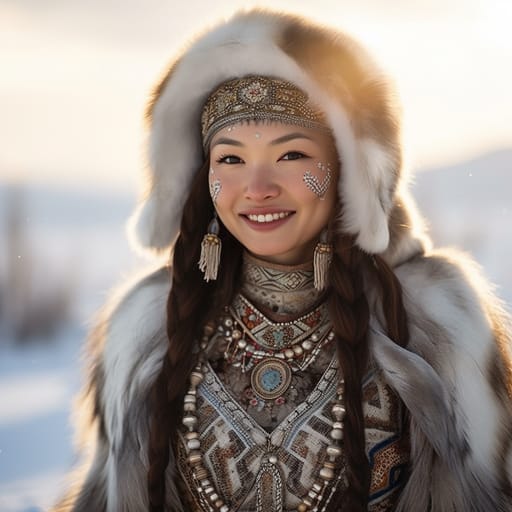
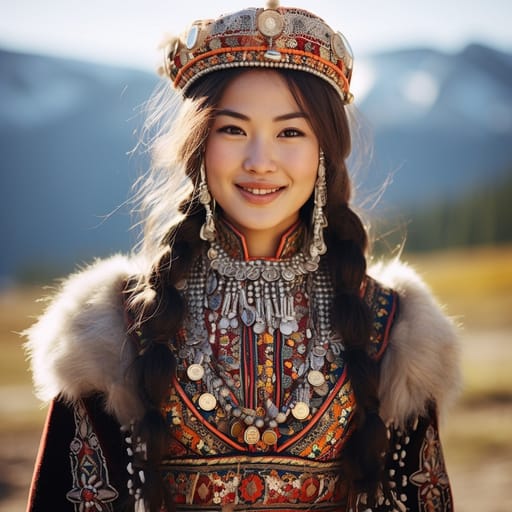
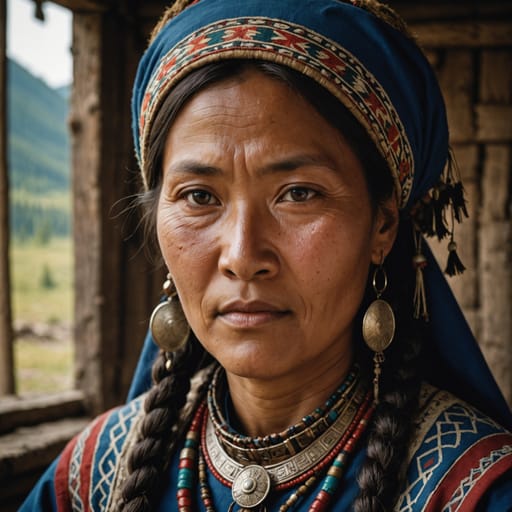
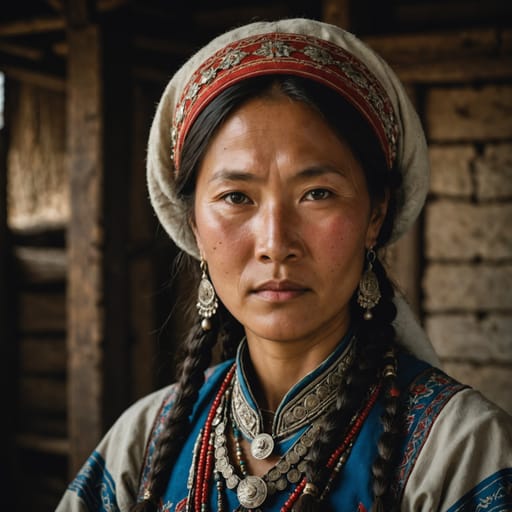
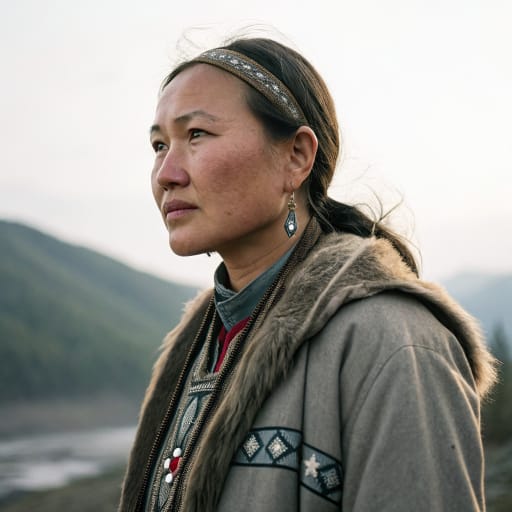
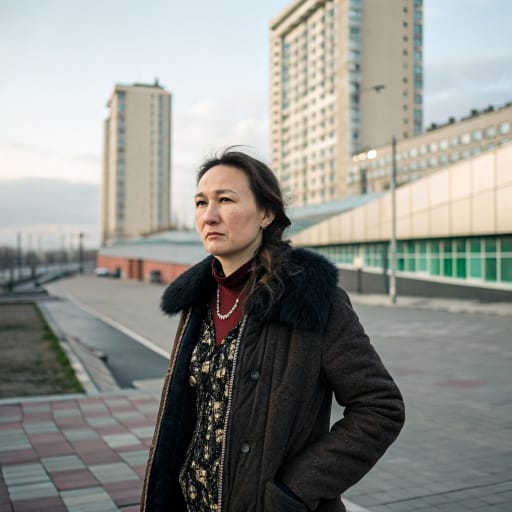
Typical Khanty Phenotypes
Reference for AI generation: hair, eyes, skin, facial structure, build
Khanty Body & Anatomy Reference
Per-feature anatomical profile for AI nude generation: Siberian Indigenous / Tungusic phenotype
Khanty Boobs & Breasts
The typical Khanty bust is small-to-medium cup, modest projection, in line with the wider Siberian Indigenous / Tungusic pattern. Areolas usually fall in the 26-38mm range, with medium-brown areolar pigmentation against the light-to-medium skin tone. Compared with the fuller Central Asian or East Asian bust, Khanty breasts sit forward and are generally firm, modest projection. A faithful AI render of Khanty tits keeps that shape and areola size.
Khanty Ass & Hips
Butt shape among Khanty women: small-to-medium, modest projection, over narrow-to-medium iliac crests. This follows Siberian Indigenous / Tungusic ancestry and looks quite unlike the broader Central Asian hip profile. An accurate Khanty ass in adult AI imagery keeps both the silhouette and the overall build (mesomorph, broader stocky frame adapted to cold climate) instead of a generic average.
Khanty Vagina & Pussy
Vulvar anatomy among Khanty women: medium-brown labial pigmentation. Pubic hair tends to be straight fine-to-medium texture, sparser distribution, in the usual inverted-triangle pattern. Both follow Siberian Indigenous / Tungusic pigmentation, which is why Khanty pussy renders should not fall back on a pale, sparse Western template.
Khanty Dicks & Penis
The Khanty cock profile, from Siberian Indigenous / Tungusic anthropometric data: regional mean ~12cm erect; moderate girth; medium-brown shaft pigmentation. Pubic hair has a straight fine-to-medium texture and forms the usual inverted-V pattern. Whether Khanty men are circumcised follows religious and cultural practice rather than phenotype.
Khanty Body, Curves & Build
Build and curves among Khanty women follow the Siberian Indigenous / Tungusic pattern: mesomorph, broader stocky frame adapted to cold climate, mean adult female BMI 22-25. Proportions matter as much as skin tone, so Khanty figures should keep their regional height and limb ratios.
Khanty Skin Tone & Hair Texture
The Khanty skin range is light to medium (Fitzpatrick II-IV), and hair tends to be straight 1A, dark-brown to black. That combination marks the Siberian Indigenous / Tungusic phenotype, and skin tone is the trait AI generators most often get wrong for Khanty women.
Explore phenotype categories
Structured taxonomy with peer-reviewed scales · 22 anatomical categories
Erotic Poses & Sex Positions
From the pose catalog: 219 named positions with reference skeletons
Frequently asked questions about Khanty people
Where is the Khanty homeland?
The Khanty homeland is Middle and lower Ob River basin in Western Siberia, Russia: Khanty-Mansi Autonomous Okrug (Yugra) and southern Yamalo-Nenets Autonomous Okrug, with small communities in Tomsk Oblast in Northern Asia.
What language do Khanty people speak?
Khanty people primarily speak Khanty (Uralic, Ob-Ugric branch, closest to Mansi), split into Northern and Eastern dialect groups that are not mutually intelligible, with Russian now dominant.
What religion do Khanty people practice?
The predominant religion among Khanty people is Nominally Russian Orthodox since forced conversion in the 1710s, with indigenous animism, spirit offerings and the bear feast still widely practiced.






Make your own Khanty images
Five a day, free, no credits to buy. The studio starts from this group's phenotype data, so you can set body type, pose and style and keep the traits accurate.
Start with Khanty