Help us get this right
Does this portrait look right for Udege people?
Nobody has judged this one yet. You would be the first.
Udege people Erotic
Sikhote-Alin mountains, Primorsky and Khabarovsk krais, Russia
Udege (Tungusic, Southern)
Shamanism and animism; some Orthodox Christianity
Amur Tungusic peoples; related to Nanai and Oroch
About Udege people People
The Udege people (also written Udihe or Udeghe) are a small Tungusic group of the Russian Far East, inhabiting the taiga of the Sikhote-Alin mountains and the river valleys of Primorsky and Khabarovsk krais. They number under two thousand, and the Udege language, of the Southern Tungusic branch, is critically endangered, spoken fluently by only a handful of elders.
Society and subsistence
The Udege were mobile hunters and gatherers of the mixed cedar and broadleaf forest, pursuing wild boar, red deer, sable, and other fur animals, and fishing the mountain rivers for salmon. Gathering of wild ginseng and forest plants supplemented the diet and supplied valuable trade goods. They lived in seasonal camps and gabled or conical dwellings, organized by clan, and revered the tiger and the bear as powerful forest beings. Shamanism structured healing and the relationship with animal spirits.
Appearance and adornment
Traditional Udege dress resembled that of neighboring Amur peoples: wrapped robes of tanned hide, cloth, or fish skin, worn with leggings and soft footwear suited to forest travel. Garments and aprons carried curvilinear appliqué and embroidery in scrolling motifs, and women wore metal and bead ornaments, with festive headwear and sashes for ceremony.
Heritage today
Soviet resettlement into permanent villages, wage work, and Russian schooling transformed Udege life in the twentieth century. The Udege of the Bikin River valley are known for a traditional forest economy of hunting and gathering, and the Bikin basin, part of a UNESCO World Heritage area of the Sikhote-Alin, has become a focus of indigenous land rights and conservation. The region and its peoples also entered Russian literature, through the explorer Vladimir Arsenyev's writings and Alexander Fadeyev's unfinished novel The Last of the Udege. Today most Udege live in modern dress, and language classes, folk ensembles, and craft revival sustain a fragile cultural heritage.
Related ethnic groups
Groups that share Udege people's homeland, region, language, or religious tradition. These are likely candidates for comparative phenotype reference.
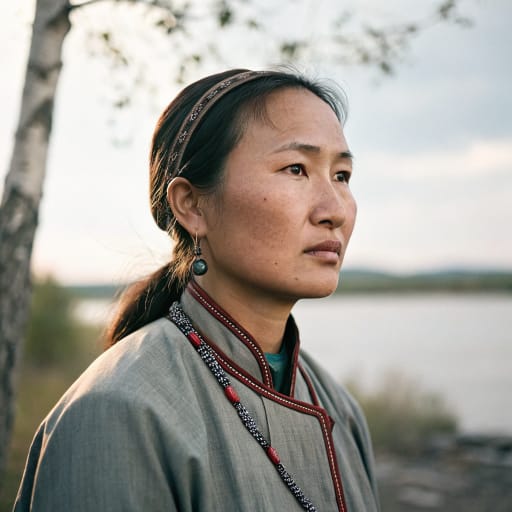
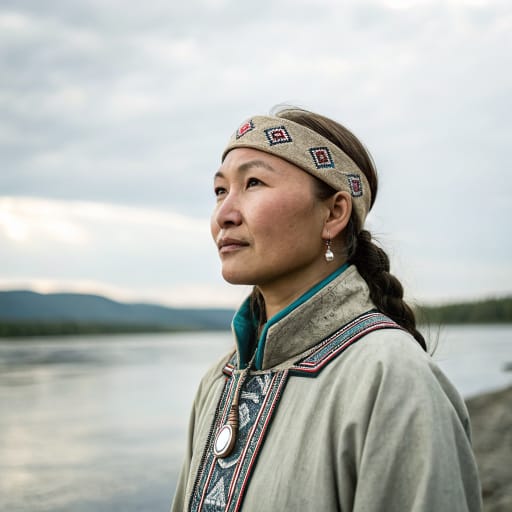
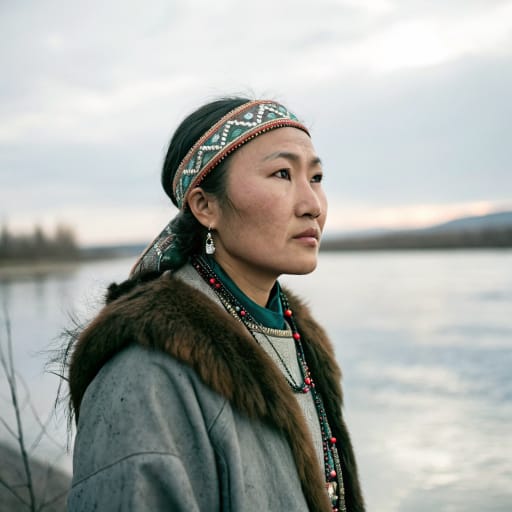

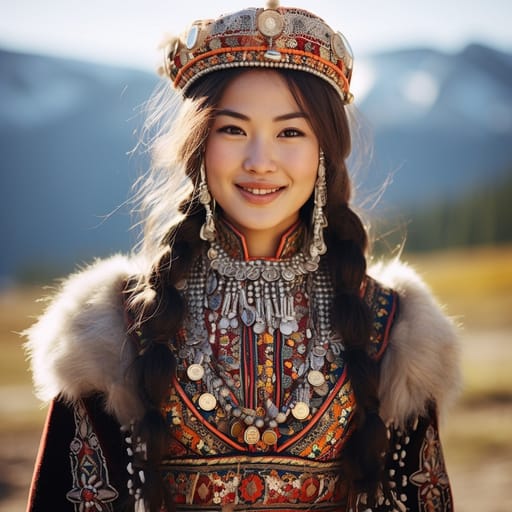
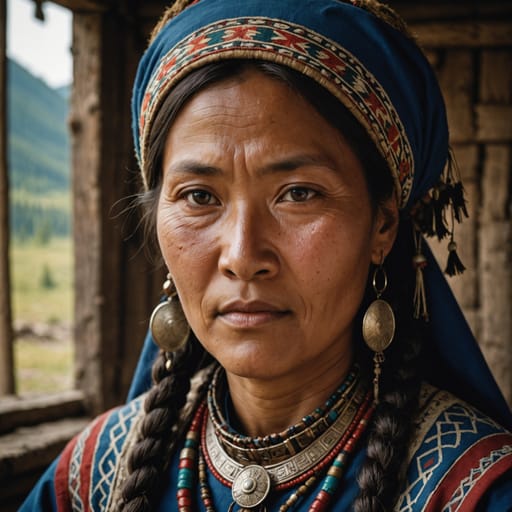
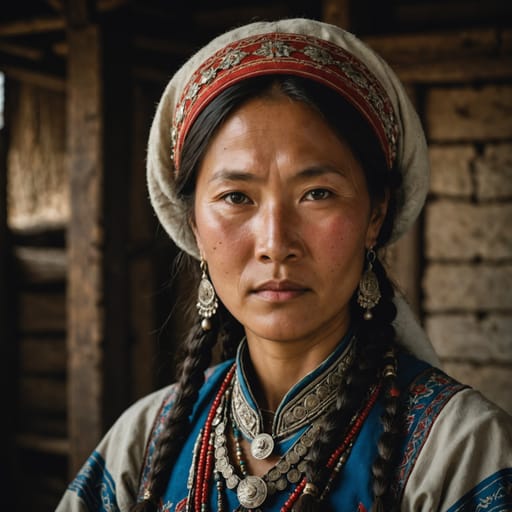
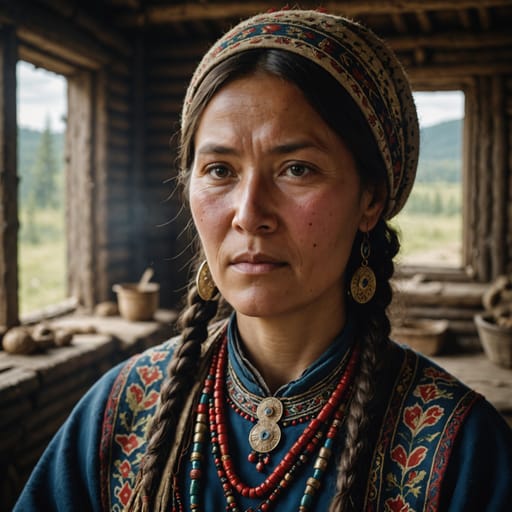
Typical Udege people Phenotypes
Reference for AI generation: hair, eyes, skin, facial structure, build
Udege people Body & Anatomy Reference
Anatomy by feature, Siberian Indigenous / Tungusic phenotype
Udege people Boobs & Breasts
The typical Udege people bust is small-to-medium cup, modest projection, in line with the wider Siberian Indigenous / Tungusic pattern. Areolas usually fall in the 26-38mm range, with medium-brown areolar pigmentation against the light-to-medium skin tone. Compared with the fuller Central Asian or East Asian bust, Udege people breasts sit forward and are generally firm, modest projection. A faithful AI render of Udege people tits keeps that shape and areola size.
Udege people Ass & Hips
Butt shape among Udege people women: small-to-medium, modest projection, over narrow-to-medium iliac crests. This follows Siberian Indigenous / Tungusic ancestry and looks quite unlike the broader Central Asian hip profile. An accurate Udege people ass in adult AI imagery keeps both the silhouette and the overall build (mesomorph, broader stocky frame adapted to cold climate) instead of a generic average.
Udege people Vagina & Pussy
Vulvar anatomy among Udege people women: medium-brown labial pigmentation. Pubic hair tends to be straight fine-to-medium texture, sparser distribution, in the usual inverted-triangle pattern. Both follow Siberian Indigenous / Tungusic pigmentation, which is why Udege people pussy renders should not fall back on a pale, sparse Western template.
Udege people Dicks & Penis
The Udege people cock profile, from Siberian Indigenous / Tungusic anthropometric data: regional mean ~12cm erect; moderate girth; medium-brown shaft pigmentation. Pubic hair has a straight fine-to-medium texture and forms the usual inverted-V pattern. Whether Udege people men are circumcised follows religious and cultural practice rather than phenotype.
Udege people Body, Curves & Build
Build and curves among Udege people women follow the Siberian Indigenous / Tungusic pattern: mesomorph, broader stocky frame adapted to cold climate, mean adult female BMI 22-25. Proportions matter as much as skin tone, so Udege people figures should keep their regional height and limb ratios.
Udege people Skin Tone & Hair Texture
The Udege people skin range is light to medium (Fitzpatrick II-IV), and hair tends to be straight 1A, dark-brown to black. That combination marks the Siberian Indigenous / Tungusic phenotype, and skin tone is the trait AI generators most often get wrong for Udege people women.
Explore phenotype categories
Structured taxonomy with peer-reviewed scales · 22 anatomical categories
Erotic Poses & Sex Positions
From the pose catalog: 219 named positions with reference skeletons
Frequently asked questions about Udege people people
Where is the Udege people homeland?
The Udege people homeland is Sikhote-Alin mountains, Primorsky and Khabarovsk krais, Russia in Northern Asia.
What language do Udege people people speak?
Udege people people primarily speak Udege (Tungusic, Southern).
What religion do Udege people people practice?
The predominant religion among Udege people people is Shamanism and animism; some Orthodox Christianity.






Make your own Udege people images
Five a day, free, no credits to buy. The studio starts from this group's phenotype data, so you can set body type, pose and style and keep the traits accurate.
Start with Udege people