No portrait yet
Siberian Yupik Erotic
Coast of the Chukchi Peninsula in Chukotka, Russia (New Chaplino, Sireniki, Provideniya and other coastal settlements), and St. Lawrence Island, Alaska, United States (Gambell and Savoonga).
Central Siberian Yupik, Naukan Yupik and the extinct Sirenik (Eskimo-Aleut); Russian widely used in Chukotka, English on St. Lawrence Island.
Christianity, largely Presbyterian and other Protestant churches on St. Lawrence Island; in Chukotka a mix of Christianity, Soviet-era secularism and traditional belief, with sea-mammal hunting observances on both sides.
Chaplino (Ungazighmiit), Naukan and Sirenik communities in Chukotka, and the St. Lawrence Island Yupik; part of the wider Yupik peoples alongside Alaska's Yup'ik and Alutiiq.
About Siberian Yupik People
The Siberian Yupik are a sea-hunting people divided by a border that barely existed for most of their history. Their villages sit on the Chukchi Peninsula at Russia's northeastern tip and on St. Lawrence Island, which belongs to Alaska but lies close enough that Siberia's mountains are visible from it on a clear day. Families on both shores married, traded and feasted with each other, and many islanders still trace their lines to the Chukotka coast. What binds them is a way of living off the Bering Sea: walrus, whales and seals hunted from skin boats and shared by long-settled rules. Their speech belongs to the Yupik branch of the Eskimo-Aleut family, making them kin to the Yup'ik of southwestern Alaska. Their Chukchi neighbors speak an unrelated language, though it has left plenty of loanwords in Yupik speech. Central Siberian Yupik is spoken on the island and around New Chaplino. Naukan Yupik survives among descendants of a cape village the Soviets shut in the late 1950s. Sirenik, a strikingly divergent tongue, lost its last fluent speaker in the late 1990s. The island has held on to its language far better than the mainland, where Russian now dominates.
Outside pressure hit both halves hard. On the island, famine and disease in the late 1870s killed a large share of the people and emptied whole villages. Presbyterian missionaries arrived in the 1890s, and Christianity now coexists with hunting observances that never fully disappeared. In Chukotka, Soviet planners folded small settlements into collective enterprises and discouraged older rituals. Meanwhile the Cold War sealed the strait. Relatives went four decades without contact until a 1988 flight from Nome to Provideniya reopened the route. A few details set the Yupik apart even within the Arctic. Island society is organized in patrilineal clans that traditionally made up boat crews. When Alaska's land claims were settled in 1971, Gambell and Savoonga took full title to the island itself. That means islanders own ground layered with Old Bering Sea and Punuk sites, and digging old ivory there is both a livelihood and a controversy. Women's facial tattoos, lines on the chin and cheeks, were nearly abandoned in the last century and are now coming back as a deliberate claim on identity.
Related ethnic groups
Groups that share Siberian Yupik's homeland, region, language, or religious tradition. These are likely candidates for comparative phenotype reference.
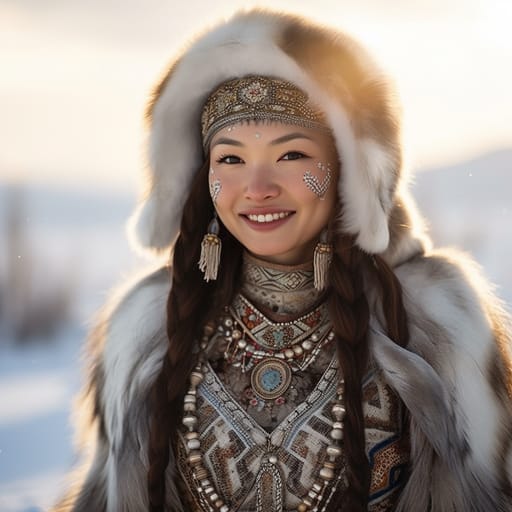
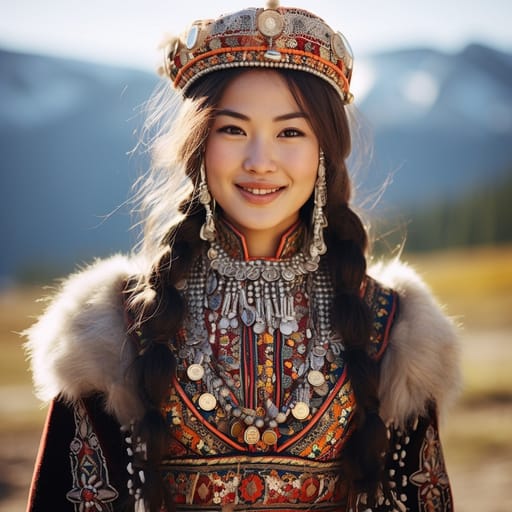
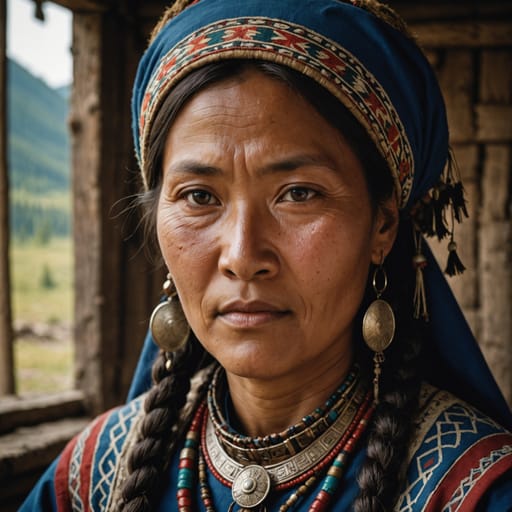
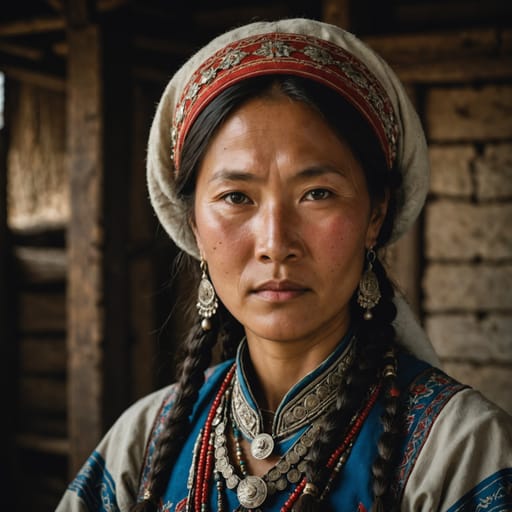
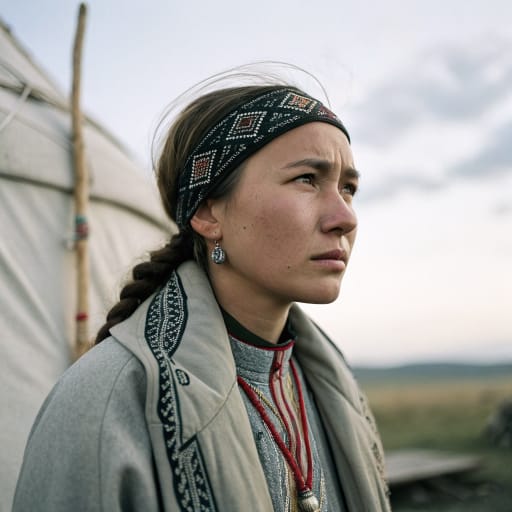
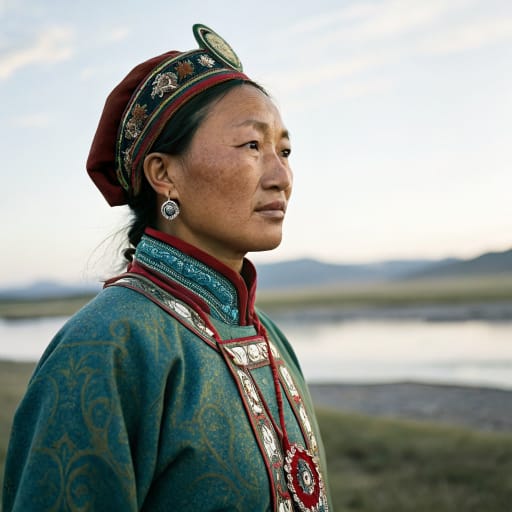
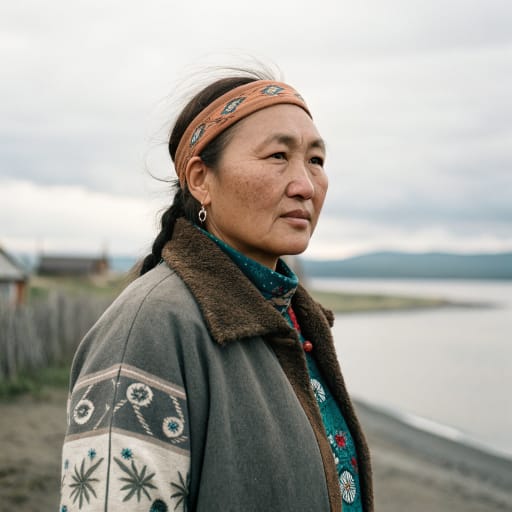
Typical Siberian Yupik Phenotypes
Reference for AI generation: hair, eyes, skin, facial structure, build
Siberian Yupik Body & Anatomy Reference
Anatomy by feature, Siberian Indigenous / Tungusic phenotype
Siberian Yupik Boobs & Breasts
Bust reference for Siberian Yupik women: small-to-medium cup, modest projection, which is typical of Siberian Indigenous / Tungusic ancestry. Areolas measure about 26-38mm across, with medium-brown pigmentation. Body type (mesomorph, broader stocky frame adapted to cold climate) shapes the bust as well, so Siberian Yupik tits are usually firm, modest projection. In AI imagery, keep the forward-set shape rather than drifting toward the fuller Central Asian or East Asian bust.
Siberian Yupik Ass & Hips
The Siberian Yupik ass is typically small-to-medium, modest projection, which sets it apart from the broader Central Asian hip profile. Underneath, the pelvis shows narrow-to-medium iliac crests, part of the Siberian Indigenous / Tungusic skeletal pattern. For Siberian Yupik butt pics and AI renders, match that silhouette and the overall build (mesomorph, broader stocky frame adapted to cold climate).
Siberian Yupik Vagina & Pussy
Siberian Yupik pussy and vulvar anatomy presents medium-brown labial pigmentation, consistent with the Siberian Indigenous / Tungusic phenotype's pigmentation pattern. Siberian Yupik pubic hair is typically straight fine-to-medium texture, sparser distribution, in the inverted-triangle pattern. For anatomically accurate Siberian Yupik pussy renders the labial coloration should match the surrounding light to medium skin tone with a continuous gradient, and the hair should keep its straight fine-to-medium texture.
Siberian Yupik Dicks & Penis
Siberian Yupik dicks follow the Siberian Indigenous / Tungusic reference data: regional mean ~12cm erect; moderate girth; medium-brown shaft pigmentation. Shaft color should track the light to medium skin tone with a smooth change toward the glans, and Siberian Yupik pubic hair keeps its straight fine-to-medium texture.
Siberian Yupik Body, Curves & Build
Siberian Yupik body type and overall build presents as mesomorph, broader stocky frame adapted to cold climate, with mean adult female BMI 22-25: the characteristic Siberian Indigenous / Tungusic habitus. Siberian Yupik curves and proportions should keep the regional skeletal frame (height, shoulder-to-hip ratio, limb proportions) rather than a generic mesomorph default.
Siberian Yupik Skin Tone & Hair Texture
Siberian Yupik skin sits in the light to medium (Fitzpatrick II-IV) band. Hair is typically straight 1A, dark-brown to black, in keeping with the Siberian Indigenous / Tungusic phenotype. In nude renders the skin should stay one even tone from face to body, and body, pubic and head hair should match.
Explore phenotype categories
Structured taxonomy with peer-reviewed scales · 22 anatomical categories
Erotic Poses & Sex Positions
From the pose catalog: 219 named positions with reference skeletons
Frequently asked questions about Siberian Yupik people
Where is the Siberian Yupik homeland?
The Siberian Yupik homeland is Coast of the Chukchi Peninsula in Chukotka, Russia (New Chaplino, Sireniki, Provideniya and other coastal settlements), and St. Lawrence Island, Alaska, United States (Gambell and Savoonga). in Northern Asia.
What language do Siberian Yupik people speak?
Siberian Yupik people primarily speak Central Siberian Yupik, Naukan Yupik and the extinct Sirenik (Eskimo-Aleut); Russian widely used in Chukotka, English on St. Lawrence Island..
What religion do Siberian Yupik people practice?
The predominant religion among Siberian Yupik people is Christianity, largely Presbyterian and other Protestant churches on St. Lawrence Island; in Chukotka a mix of Christianity, Soviet-era secularism and traditional belief, with sea-mammal hunting observances on both sides..






Make your own Siberian Yupik images
Five a day, free, no credits to buy. The studio starts from this group's phenotype data, so you can set body type, pose and style and keep the traits accurate.
Start with Siberian Yupik