No portrait yet
Kamchadals Erotic
The Kamchatka Peninsula, chiefly the Kamchatka River valley around Milkovo, with communities along the Okhotsk coast into Magadan Oblast, Russia
Russian, in a distinctive Kamchadal dialect (Indo-European, Slavic); historically Itelmen (Chukotko-Kamchatkan), now nearly extinct
Russian Orthodox Christianity, alongside surviving pre-Christian seasonal observances
A creole people of Itelmen and Russian Cossack descent, closely tied to the Itelmens and counted separately among Russia's indigenous small-numbered peoples of the North
About Kamchadals People
A Kamchadal is what you get when three centuries of Cossack settlement meet the salmon rivers of Kamchatka and neither side entirely wins. The name once covered all the indigenous inhabitants of the peninsula, the people now called Itelmen. By the nineteenth century it had narrowed to something more specific: the riverine, Orthodox, Russian-speaking population descended from Cossack men and Itelmen women, fishing the same reaches their maternal grandmothers had fished and doing it in a dialect nobody in Moscow could follow. That dialect, old Russian softened and salted with Itelmen words for fish, weather and plants, is the clearest marker they have. The Itelmen language itself belongs to the small Chukotko-Kamchatkan family and is down to a handful of elderly speakers on the western coast. Most Kamchadals never spoke it.
The homeland is the Kamchatka River valley and the villages strung along it, Milkovo above all, plus a scattering along the Sea of Okhotsk coast into Magadan Oblast. Life is organized around the salmon run. Fish are split and hung to dry as yukola, some for people and a great deal for dogs, because until snowmobiles arrived the dog team was the only way to move in winter, and Kamchatka's sled-dog culture is older than any of its roads. What the rivers do not provide, the forest does: sarana lily bulbs, fireweed, wild garlic, crowberries, the sweet inner stalk of cow parsnip. Itelmen clothing was made from what the region actually had, which meant dog fur, fish skin and sea-mammal gut for rain gear rather than the reindeer hide of the tundra peoples further north.
Orthodoxy arrived with the mass baptisms of the 1740s, after smallpox and the failed risings of the previous decade had already broken the old order, and it settled in properly: icons in the corner, saints' days kept, an easy coexistence with older seasonal observances. The autumn thanksgiving festival Alkhalalalai, Itelmen in origin, has been revived and is now a fixture of the Kamchatkan year. In 2000 the Russian state listed Kamchadals among the indigenous small-numbered peoples of the North, a status that carries real fishing and hunting rights, and the number of people willing to be counted as Kamchadal promptly went up. Around two thousand claim the name today.
Related ethnic groups
Groups that share Kamchadals's homeland, region, language, or religious tradition. These are likely candidates for comparative phenotype reference.
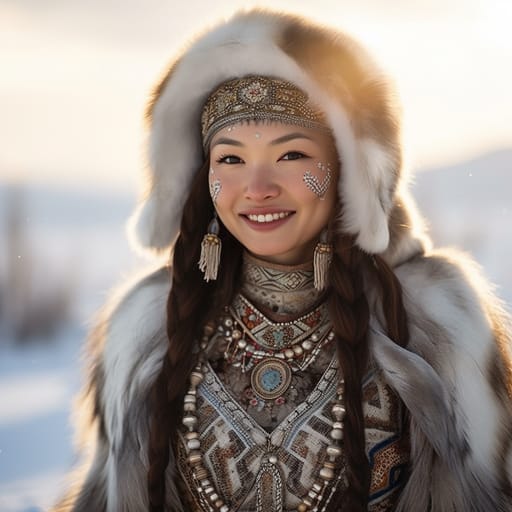
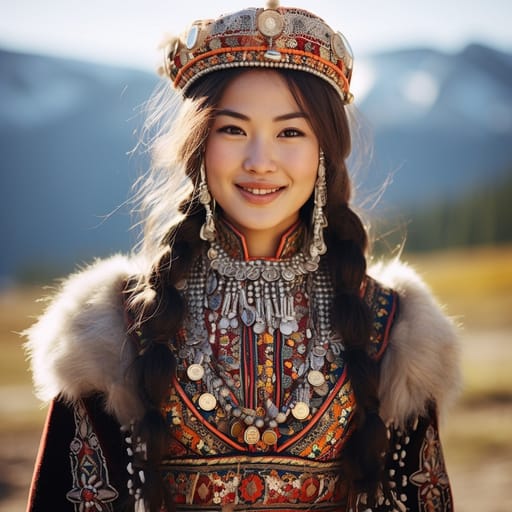
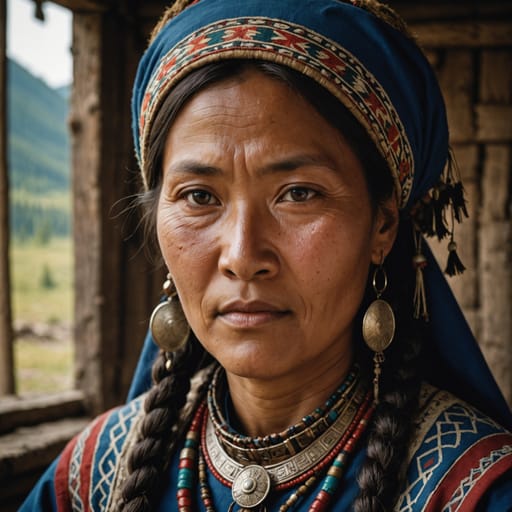
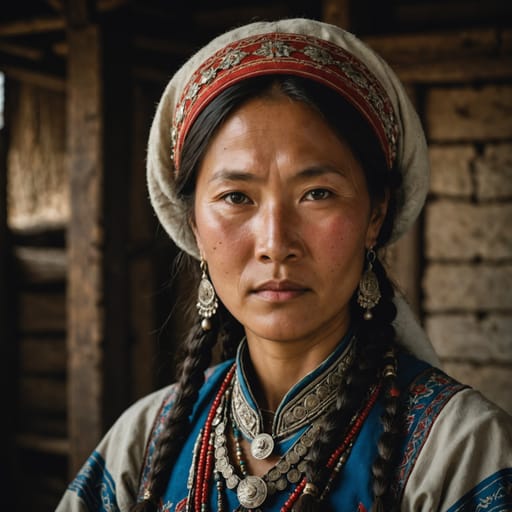
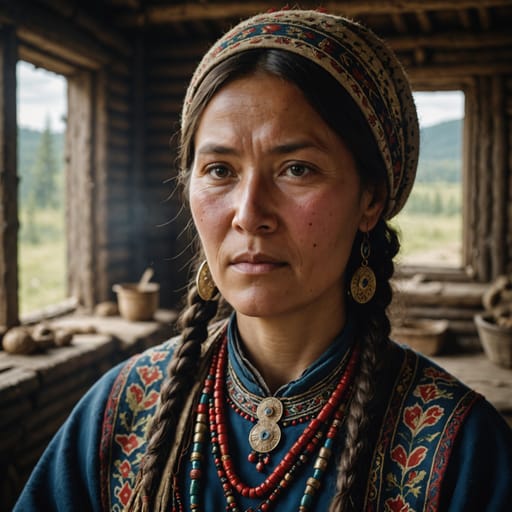
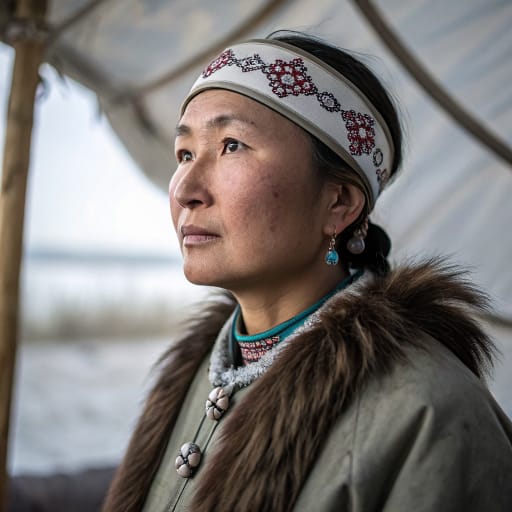
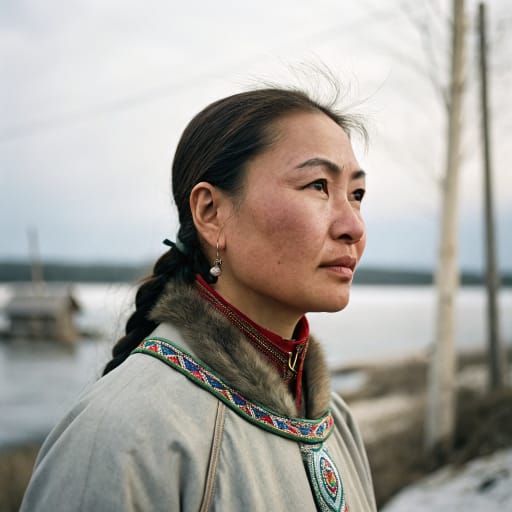
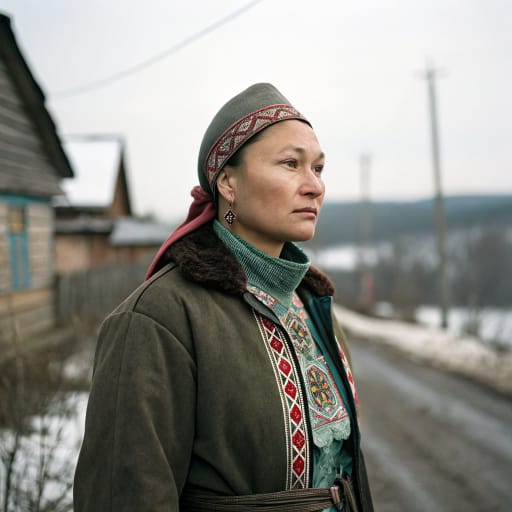
Typical Kamchadals Phenotypes
Reference for AI generation: hair, eyes, skin, facial structure, build
Kamchadals Body & Anatomy Reference
Anatomy by feature, Siberian Indigenous / Tungusic phenotype
Kamchadals Boobs & Breasts
Bust reference for Kamchadals women: small-to-medium cup, modest projection, which is typical of Siberian Indigenous / Tungusic ancestry. Areolas measure about 26-38mm across, with medium-brown pigmentation. Body type (mesomorph, broader stocky frame adapted to cold climate) shapes the bust as well, so Kamchadals tits are usually firm, modest projection. In AI imagery, keep the forward-set shape rather than drifting toward the fuller Central Asian or East Asian bust.
Kamchadals Ass & Hips
The Kamchadals ass is typically small-to-medium, modest projection, which sets it apart from the broader Central Asian hip profile. Underneath, the pelvis shows narrow-to-medium iliac crests, part of the Siberian Indigenous / Tungusic skeletal pattern. For Kamchadals butt pics and AI renders, match that silhouette and the overall build (mesomorph, broader stocky frame adapted to cold climate).
Kamchadals Vagina & Pussy
Kamchadals pussy and vulvar anatomy presents medium-brown labial pigmentation, consistent with the Siberian Indigenous / Tungusic phenotype's pigmentation pattern. Kamchadals pubic hair is typically straight fine-to-medium texture, sparser distribution, in the inverted-triangle pattern. For anatomically accurate Kamchadals pussy renders the labial coloration should match the surrounding light to medium skin tone with a continuous gradient, and the hair should keep its straight fine-to-medium texture.
Kamchadals Dicks & Penis
Kamchadals dicks follow the Siberian Indigenous / Tungusic reference data: regional mean ~12cm erect; moderate girth; medium-brown shaft pigmentation. Shaft color should track the light to medium skin tone with a smooth change toward the glans, and Kamchadals pubic hair keeps its straight fine-to-medium texture.
Kamchadals Body, Curves & Build
Kamchadals body type and overall build presents as mesomorph, broader stocky frame adapted to cold climate, with mean adult female BMI 22-25: the characteristic Siberian Indigenous / Tungusic habitus. Kamchadals curves and proportions should keep the regional skeletal frame (height, shoulder-to-hip ratio, limb proportions) rather than a generic mesomorph default.
Kamchadals Skin Tone & Hair Texture
Kamchadals skin sits in the light to medium (Fitzpatrick II-IV) band. Hair is typically straight 1A, dark-brown to black, in keeping with the Siberian Indigenous / Tungusic phenotype. In nude renders the skin should stay one even tone from face to body, and body, pubic and head hair should match.
Explore phenotype categories
Structured taxonomy with peer-reviewed scales · 22 anatomical categories
Erotic Poses & Sex Positions
From the pose catalog: 219 named positions with reference skeletons
Frequently asked questions about Kamchadals people
Where is the Kamchadals homeland?
The Kamchadals homeland is The Kamchatka Peninsula, chiefly the Kamchatka River valley around Milkovo, with communities along the Okhotsk coast into Magadan Oblast, Russia in Northern Asia.
What language do Kamchadals people speak?
Kamchadals people primarily speak Russian, in a distinctive Kamchadal dialect (Indo-European, Slavic); historically Itelmen (Chukotko-Kamchatkan), now nearly extinct.
What religion do Kamchadals people practice?
The predominant religion among Kamchadals people is Russian Orthodox Christianity, alongside surviving pre-Christian seasonal observances.






Make your own Kamchadals images
Five a day, free, no credits to buy. The studio starts from this group's phenotype data, so you can set body type, pose and style and keep the traits accurate.
Start with Kamchadals