No portrait yet
Tubalar Erotic
Northeastern Altai Republic, Russia: the Biya river basin and the northwestern end of Lake Teletskoye, chiefly the Turochak and Choya districts.
Tubalar, also called Tuba (Turkic, Northern Altai group), with Russian in everyday use.
Russian Orthodox Christianity, layered over shamanic and animist practice directed at the master spirits of mountains, forest and water.
One of the three Northern Altai peoples alongside the Chelkans and Kumandins; long counted administratively as Altaians; internally organized into exogamous patrilineal clans (seok).
About Tubalar People
The Tubalar are a people of the dark taiga, and that is a matter of record, not just atmosphere: Russian officials filed them for two centuries as the Chern Tatars, from chern, the black fir and Siberian pine forest that covers the low mountains of the northeastern Altai. Where the southern Altaians were horsemen on open high country, the Tubalar hunted, trapped, fished, gathered, and hoe farmed small clearings of barley long before Russian settlers arrived. Their homeland is the Biya basin and the northwestern end of Lake Teletskoye, in the Turochak and Choya districts of the Altai Republic. Before the Dzungar state fell in the 1750s they paid fur tribute twice over, to Russian collectors and to Dzungar overlords. Fewer than two thousand people now claim the name.
They call themselves Tuba, or Tuba-kizhi, a name that recurs across the Sayan and Altai country and is shared in some form with the Tuvans and the Tofalar. Their language belongs to the Northern Altai branch of Turkic, close to Chelkan, Kumandin and Shor, and far enough from Southern Altai that calling it a dialect is a political decision rather than a linguistic one. It carries what came before it: the northern Altai peoples descend in part from Samoyedic and Yeniseian speaking forest hunters who took up Turkic and kept the hunting. It is spoken now mainly by the old, with Russian doing the daily work. The Altai Spiritual Mission, based at Ulala from 1830, pressed hardest here, so Orthodoxy sits more heavily on the Tubalar than on the southern Altaians, who went their own way with Burkhanism after 1904. Underneath runs a working relationship with place: mountains, passes and springs have masters who are addressed with care and left offerings of ribbon, and the shaman's drum is within living memory. Kinship still runs through the seok, literally the bone, the patrilineal clan a person marries outside of. In 2000 the state added the Tubalar to its register of indigenous small-numbered peoples, less a compliment than a tool: it carries priority rights to hunt, fish and gather on ancestral ground. Those rights are what the argument is about now, with the same forest wanted for timber and the same lake for visitors. The autumn cedar nut harvest, whole families camped in the taiga knocking cones down with a wooden beater, is still the fixed point of the year.
Related ethnic groups
Groups that share Tubalar's homeland, region, language, or religious tradition. These are likely candidates for comparative phenotype reference.

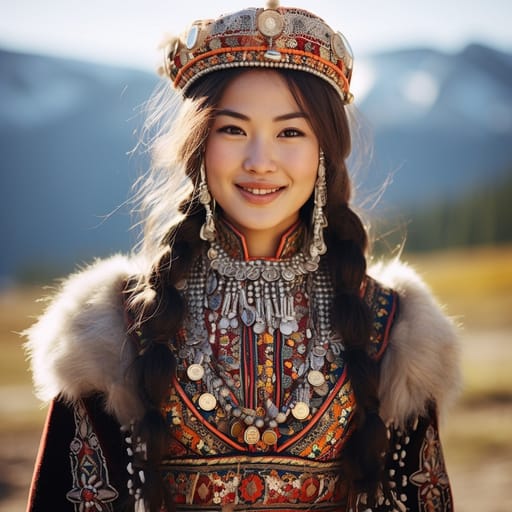
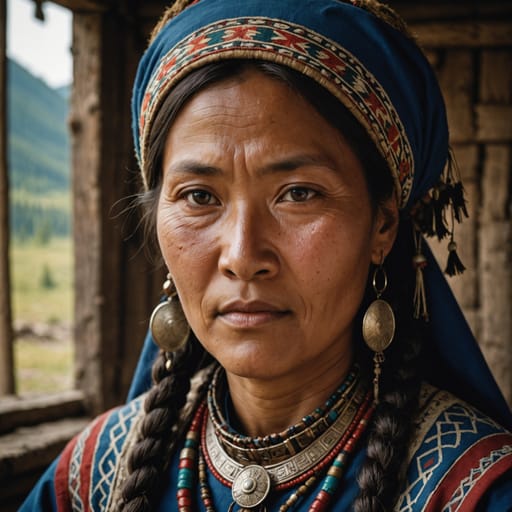
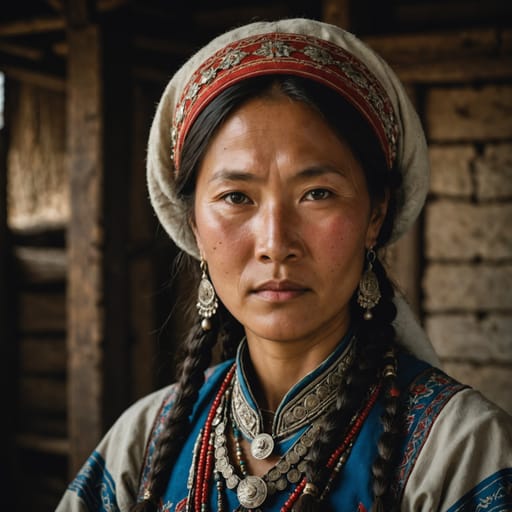
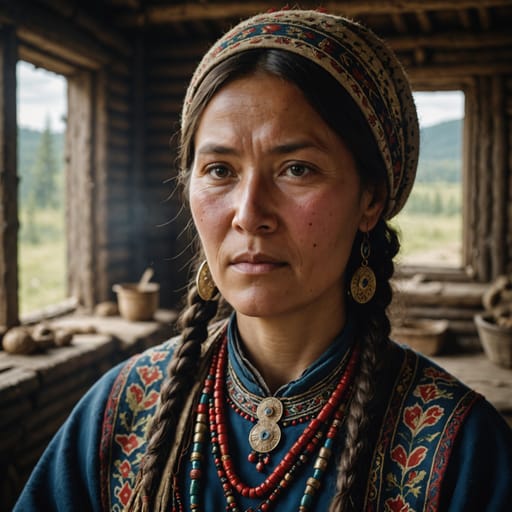
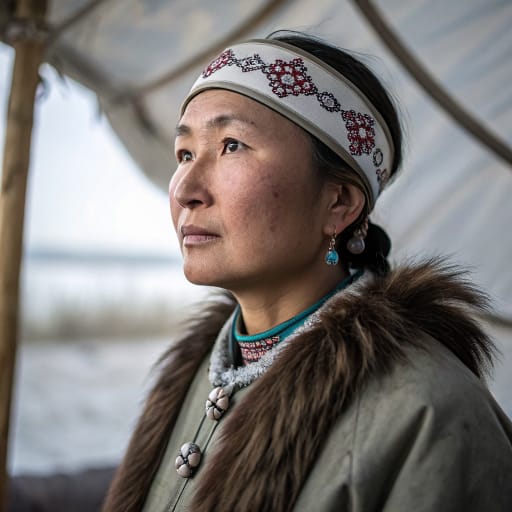
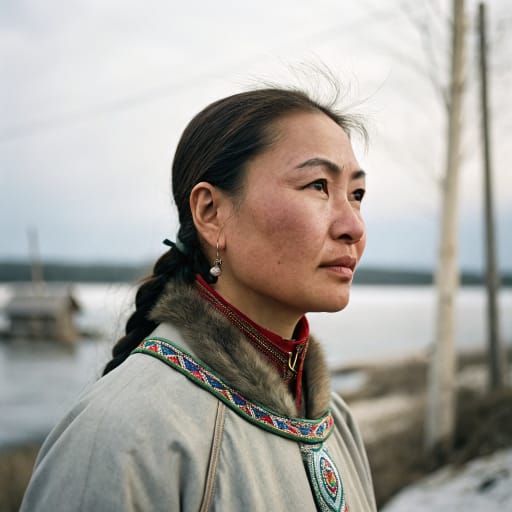
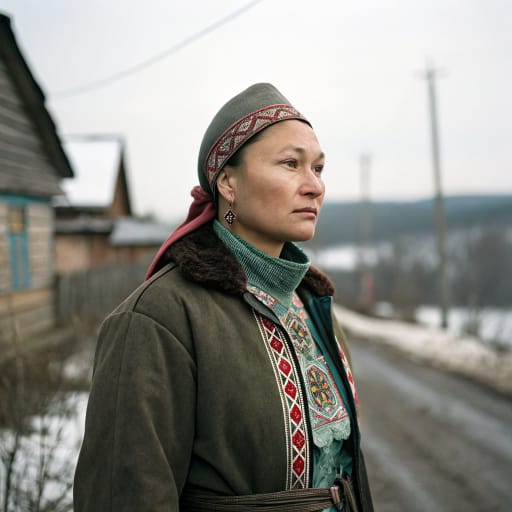
Typical Tubalar Phenotypes
Reference for AI generation: hair, eyes, skin, facial structure, build
Tubalar Body & Anatomy Reference
Per-feature anatomical profile for AI nude generation: Siberian Indigenous / Tungusic phenotype
Tubalar Boobs & Breasts
The typical Tubalar bust is small-to-medium cup, modest projection, in line with the wider Siberian Indigenous / Tungusic pattern. Areolas usually fall in the 26-38mm range, with medium-brown areolar pigmentation against the light-to-medium skin tone. Compared with the fuller Central Asian or East Asian bust, Tubalar breasts sit forward and are generally firm, modest projection. A faithful AI render of Tubalar tits keeps that shape and areola size.
Tubalar Ass & Hips
Butt shape among Tubalar women: small-to-medium, modest projection, over narrow-to-medium iliac crests. This follows Siberian Indigenous / Tungusic ancestry and looks quite unlike the broader Central Asian hip profile. An accurate Tubalar ass in adult AI imagery keeps both the silhouette and the overall build (mesomorph, broader stocky frame adapted to cold climate) instead of a generic average.
Tubalar Vagina & Pussy
Vulvar anatomy among Tubalar women: medium-brown labial pigmentation. Pubic hair tends to be straight fine-to-medium texture, sparser distribution, in the usual inverted-triangle pattern. Both follow Siberian Indigenous / Tungusic pigmentation, which is why Tubalar pussy renders should not fall back on a pale, sparse Western template.
Tubalar Dicks & Penis
The Tubalar cock profile, from Siberian Indigenous / Tungusic anthropometric data: regional mean ~12cm erect; moderate girth; medium-brown shaft pigmentation. Pubic hair has a straight fine-to-medium texture and forms the usual inverted-V pattern. Whether Tubalar men are circumcised follows religious and cultural practice rather than phenotype.
Tubalar Body, Curves & Build
Build and curves among Tubalar women follow the Siberian Indigenous / Tungusic pattern: mesomorph, broader stocky frame adapted to cold climate, mean adult female BMI 22-25. Proportions matter as much as skin tone, so Tubalar figures should keep their regional height and limb ratios.
Tubalar Skin Tone & Hair Texture
The Tubalar skin range is light to medium (Fitzpatrick II-IV), and hair tends to be straight 1A, dark-brown to black. That combination marks the Siberian Indigenous / Tungusic phenotype, and skin tone is the trait AI generators most often get wrong for Tubalar women.
Explore phenotype categories
Structured taxonomy with peer-reviewed scales · 22 anatomical categories
Erotic Poses & Sex Positions
From the pose catalog: 219 named positions with reference skeletons
Frequently asked questions about Tubalar people
Where is the Tubalar homeland?
The Tubalar homeland is Northeastern Altai Republic, Russia: the Biya river basin and the northwestern end of Lake Teletskoye, chiefly the Turochak and Choya districts. in Northern Asia.
What language do Tubalar people speak?
Tubalar people primarily speak Tubalar, also called Tuba (Turkic, Northern Altai group), with Russian in everyday use..
What religion do Tubalar people practice?
The predominant religion among Tubalar people is Russian Orthodox Christianity, layered over shamanic and animist practice directed at the master spirits of mountains, forest and water..






Make your own Tubalar images
Five a day, free, no credits to buy. The studio starts from this group's phenotype data, so you can set body type, pose and style and keep the traits accurate.
Start with Tubalar