No portrait yet
Koryaks Erotic
Northern Kamchatka Peninsula and the adjoining Bering Sea and Sea of Okhotsk coasts, Kamchatka Krai, with smaller communities in Magadan Oblast and Chukotka, Russia.
Koryak (Chukotko-Kamchatkan), with Alutor variously treated as a dialect or a sister language; Russian is now the first language of most.
Traditional shamanism and household animism with Russian Orthodox overlay; largely syncretic or secular today.
Two main divisions, the coastal Nymylans (sedentary sea hunters and fishers) and the inland Chavchuvens (nomadic reindeer herders); closely related to the Chukchi, Alutor and Kerek peoples.
About Koryaks People
The Koryaks are a people split down the middle by two ways of living, and the split shows in what they call themselves. The Chavchuvens, the reindeer-rich, move with their herds across the tundra and mountains of northern Kamchatka. The Nymylans, the village people, stay put on the shores of the Bering Sea and the Sea of Okhotsk, hunting seals and whales and netting salmon. Outsiders lumped both under one label, probably from the Koryak word for reindeer, and the label stuck. Around 7,000 to 8,000 Koryaks remain, most of them in Kamchatka Krai, with the small town of Palana on the west coast serving as the administrative and cultural hub. Their language belongs to the Chukotko-Kamchatkan family, sharing a good deal with Chukchi to the north and much less with Itelmen to the south. Alutor, spoken around the base of the peninsula, is close enough that linguists argue over whether it is a dialect or a sister language. Russian is now the first language of nearly everyone, and fluent Koryak is mostly heard from the older generation.
Religion here was never a building or a book. It was the household: a carved fire-board kept as a family guardian, worn through with fire drilling, and small wooden figures fed with fat at the hearth. Big Raven, creator and trickster, presides over a mythology the Koryaks share with the Chukchi and Itelmen. Coastal villages still hold Hololo in the autumn, a festival that thanks the seals and whales taken during the year and sends their souls home so they will return. Cremation on a pyre was the traditional burial, and a person's funeral clothing was sewn in advance but deliberately left unfinished, since completing it was thought to hasten death. Dried fly agaric mushrooms, eaten as an intoxicant, were documented in detail among the Koryaks by Waldemar Jochelson during the Jesup expedition of 1900 to 1901. Russian Cossacks pushed into Koryak country in the late 17th century demanding fur tribute, and the Koryaks fought them for decades, burning forts and losing whole settlements to reprisals and smallpox. Soviet collectivization in the 1930s put the herds under state farms and the children in boarding schools. The herds have shrunk badly since the 1990s, and the Koryak Autonomous Okrug itself was folded into Kamchatka Krai in 2007. What has held is craft: the fur-mosaic trim on a reindeer-skin kukhlyanka, the knives forged in the village of Paren, and the drum-and-dance tradition that the Mengo ensemble has carried to stages far beyond Palana since the 1960s.
Related ethnic groups
Groups that share Koryaks's homeland, region, language, or religious tradition. These are likely candidates for comparative phenotype reference.
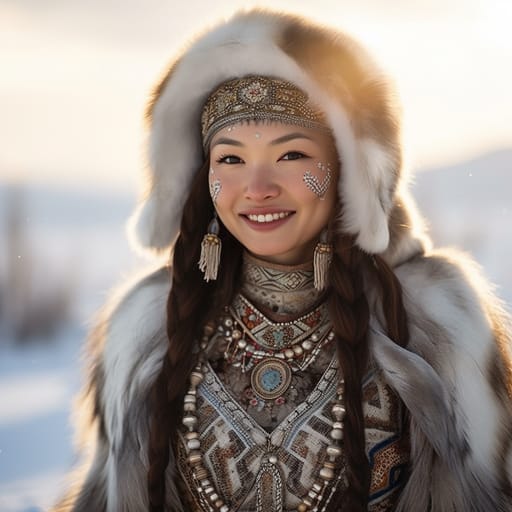
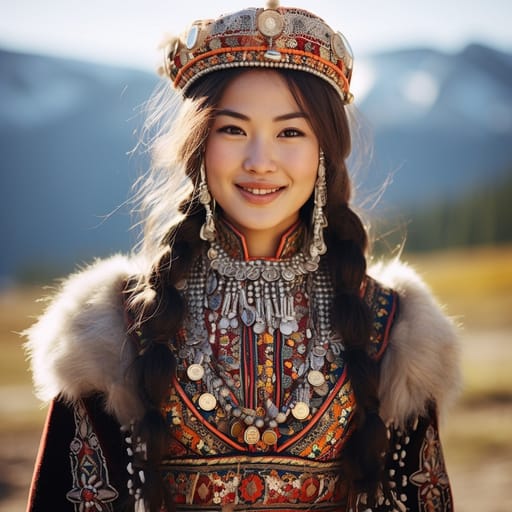
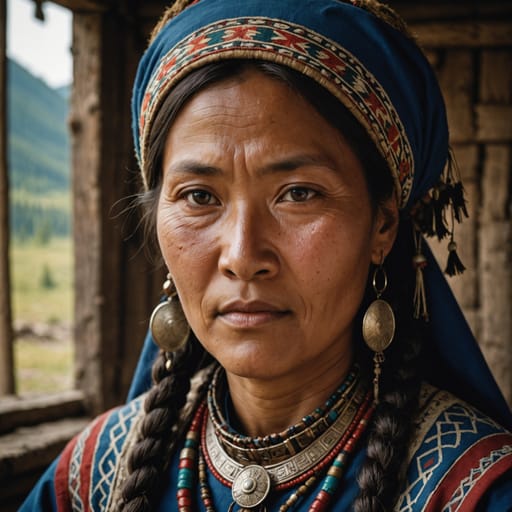
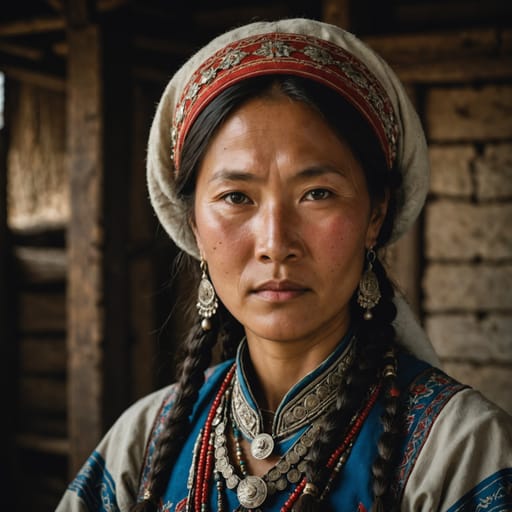
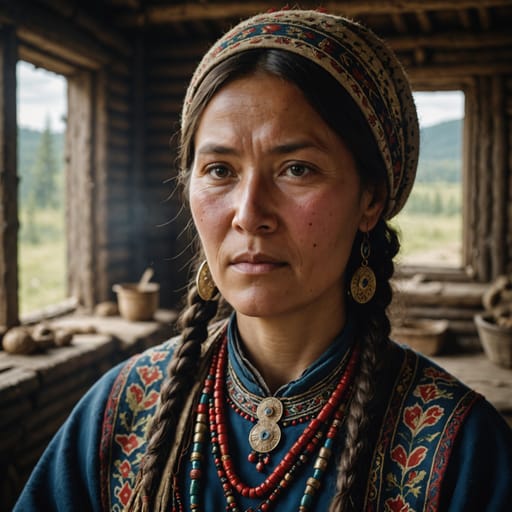
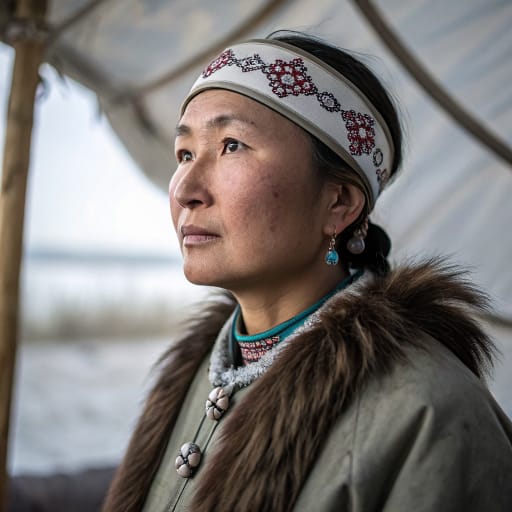
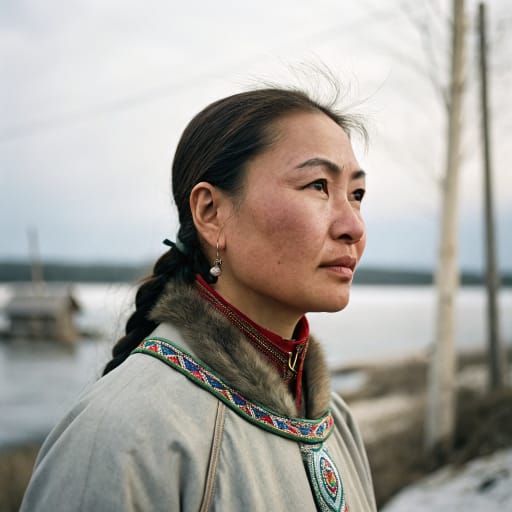
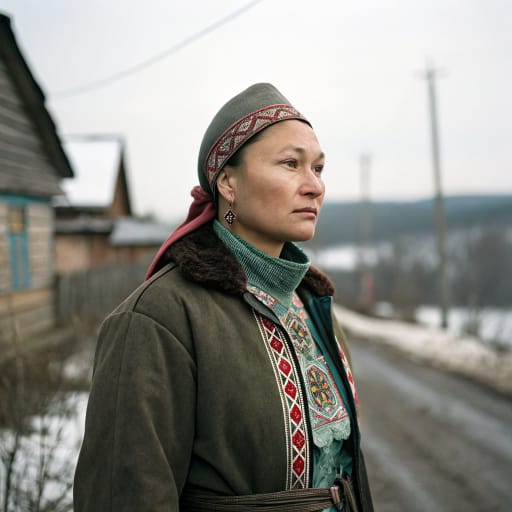
Typical Koryaks Phenotypes
Reference for AI generation: hair, eyes, skin, facial structure, build
Koryaks Body & Anatomy Reference
Per-feature anatomical profile for AI nude generation: Siberian Indigenous / Tungusic phenotype
Koryaks Boobs & Breasts
Koryaks tits and boobs run small-to-medium cup, modest projection, the classic Siberian Indigenous / Tungusic bust profile. Koryaks nipples and areolas show medium-brown areolar pigmentation against the light-to-medium skin tone, with areolar diameter typically in the 26-38mm range and forward-set positioning rather than the fuller Central Asian or East Asian bust. Koryaks breasts trend firm, modest projection, a function of the mesomorph, broader stocky frame adapted to cold climate body habitus and the mean adult female BMI 22-25. For anatomically accurate AI-generated Koryaks nudes the render preserves the small-to-medium cup, modest projection shape, 26-38mm areolas with medium-brown pigmentation, and the torso proportions of the Siberian Indigenous / Tungusic phenotype.
Koryaks Ass & Hips
Koryaks hips and butt usually read as small-to-medium, modest projection. The skeletal base is narrow-to-medium iliac crests, the Siberian Indigenous / Tungusic pattern. Set against the broader Central Asian hip profile, the difference is easy to see, and the hip-to-waist ratio is often what identifies Koryaks women in photos.
Koryaks Vagina & Pussy
Expect medium-brown labial pigmentation on Koryaks women, in keeping with Siberian Indigenous / Tungusic ancestry. The pubic hair is straight fine-to-medium texture, sparser distribution. Coloring should run evenly from the light to medium skin of the thighs to the labia, and Koryaks nude imagery should keep the hair's straight fine-to-medium texture.
Koryaks Dicks & Penis
Koryaks dick and penile anatomy in adult AI generation should anchor on the regional reference data: regional mean ~12cm erect, moderate girth, and medium-brown shaft pigmentation. The Koryaks cock profile reflects the Siberian Indigenous / Tungusic population's anthropometric measurements. The shaft pigmentation should track the surrounding light to medium skin tone, and the pubic hair should keep its straight fine-to-medium texture in the typical inverted-V escutcheon.
Koryaks Body, Curves & Build
Koryaks body type: mesomorph, broader stocky frame adapted to cold climate, with mean adult female BMI 22-25. This is the typical Siberian Indigenous / Tungusic build. Height range, shoulder-to-hip ratio and fat distribution all follow from it, which is what an accurate Koryaks nude body should show.
Koryaks Skin Tone & Hair Texture
Koryaks skin tone falls in the light to medium (Fitzpatrick II-IV) band, the surface signal most often miscalibrated by generic AI nude generators. Koryaks hair texture is typically straight 1A, dark-brown to black, characteristic of the Siberian Indigenous / Tungusic phenotype. In Koryaks nude renders the skin should hold that band consistently across the body.
Explore phenotype categories
Structured taxonomy with peer-reviewed scales · 22 anatomical categories
Erotic Poses & Sex Positions
From the pose catalog: 219 named positions with reference skeletons
Frequently asked questions about Koryaks people
Where is the Koryaks homeland?
The Koryaks homeland is Northern Kamchatka Peninsula and the adjoining Bering Sea and Sea of Okhotsk coasts, Kamchatka Krai, with smaller communities in Magadan Oblast and Chukotka, Russia. in Northern Asia.
What language do Koryaks people speak?
Koryaks people primarily speak Koryak (Chukotko-Kamchatkan), with Alutor variously treated as a dialect or a sister language; Russian is now the first language of most..
What religion do Koryaks people practice?
The predominant religion among Koryaks people is Traditional shamanism and household animism with Russian Orthodox overlay; largely syncretic or secular today..






Make your own Koryaks images
Five a day, free, no credits to buy. The studio starts from this group's phenotype data, so you can set body type, pose and style and keep the traits accurate.
Start with Koryaks