Help us get this right
Does this portrait look right for Khamnigan?
One tap. It takes a second and it is recorded.
1 says it looks right, 0 say it looks off.
Khamnigan Erotic
Onon and Argun basin, Transbaikalia (Zabaykalsky Krai and Buryatia), Russia; also Mongolia and Inner Mongolia, China
Khamnigan Mongol (Mongolic); some also Khamnigan Evenki (Tungusic)
Tibetan Buddhism and shamanism
linked to Buryats and Evenks; Mongol-Evenki bilingual heritage
About Khamnigan People
The Khamnigan are a Mongolic-speaking pastoral people of the Transbaikal region straddling the borders of Russia, Mongolia and China, centered historically on the Onon and Argun river country and the Aginskoye area of Zabaykalsky Krai and Buryatia in Russia, with related communities in northeastern Mongolia and Hulunbuir in Inner Mongolia. The Khamnigan are notable for a dual linguistic heritage: many spoke both Khamnigan Mongol, an archaic and conservative Mongolic tongue, and Khamnigan Evenki, a Tungusic language, reflecting long intermarriage and cultural blending between Mongol and Evenki groups. The name Khamnigan derives from a Mongolic term for the Evenki, reflecting the group's forest-hunting origins before they took up steppe pastoralism.
Society and subsistence
The Khamnigan were mobile herders who combined the reindeer and taiga traditions of their Evenki ancestry with the horse, cattle, sheep and camel pastoralism of the Mongol steppe, moving with the seasons across forest and grassland. Under the Russian Empire and the Qing they served as border cossacks and frontier subjects, and the twentieth-century closing of borders divided their communities among three states. In China many Khamnigan are officially classified within the Evenki nationality, while in Russia they are generally counted among the Buryats. Religious life blends Tibetan Buddhism, widespread among Buryats and Mongols, with older shamanism and reverence for the land, rivers and ancestral spirits.
Appearance and adornment
Khamnigan people show the North Asian phenotype of the Baikal and Transbaikal region, with straight black hair, dark eyes and broad, high-cheekboned faces, of medium and sturdy build suited to a cold continental climate. Traditional dress resembles that of their Buryat and Mongol neighbors: long belted robes (deel), fur-lined coats, sashes, boots and fur or brimmed hats, with festival garments trimmed in silk, braid and silver ornaments. Reindeer-hide and sheepskin garments long suited both forest and steppe travel, and everyday clothing today is modern Russian, Mongolian or Chinese.
Related ethnic groups
Groups that share Khamnigan's homeland, region, language, or religious tradition. These are likely candidates for comparative phenotype reference.
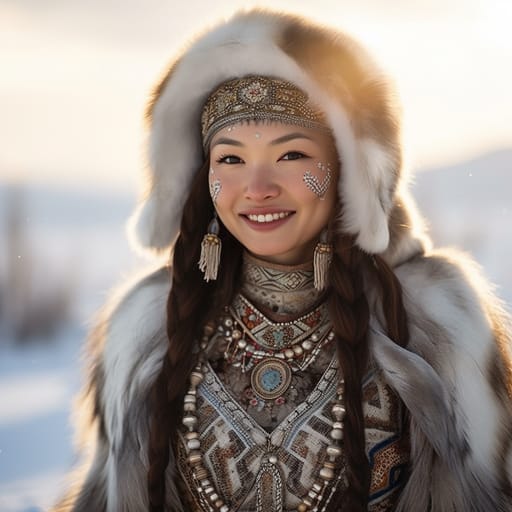
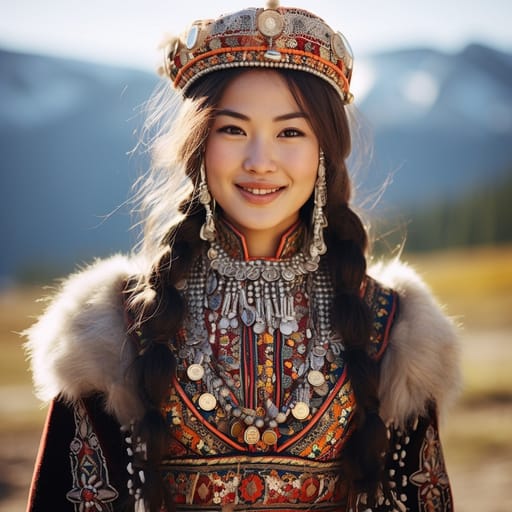
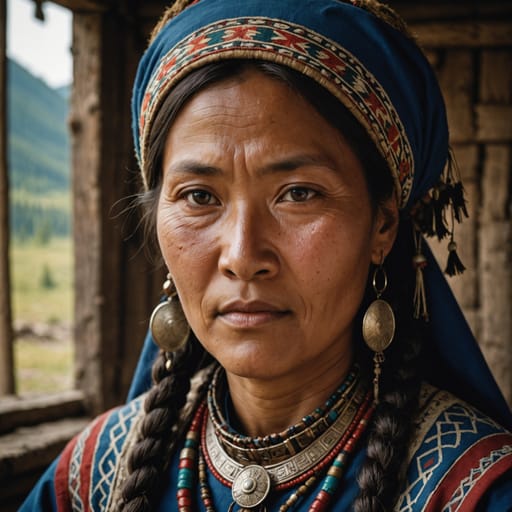
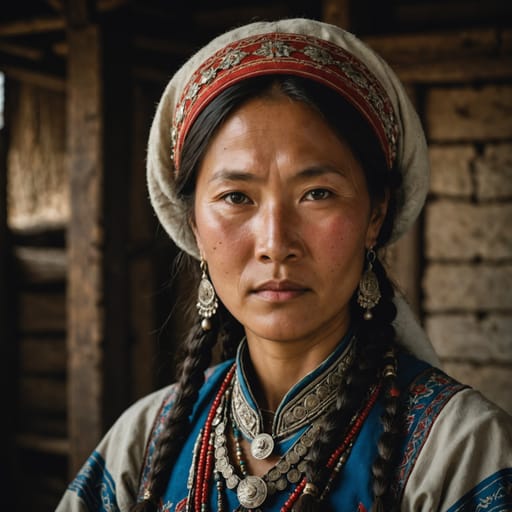
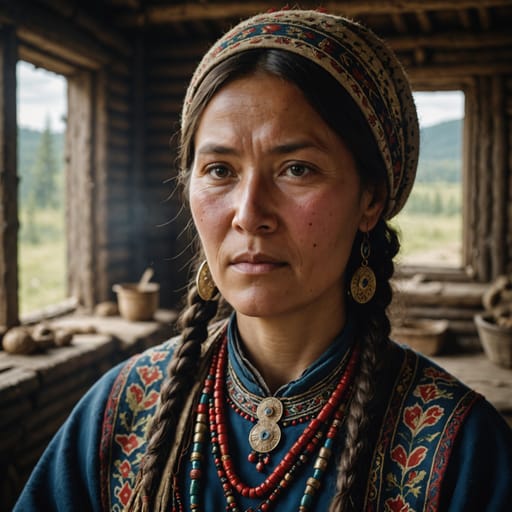
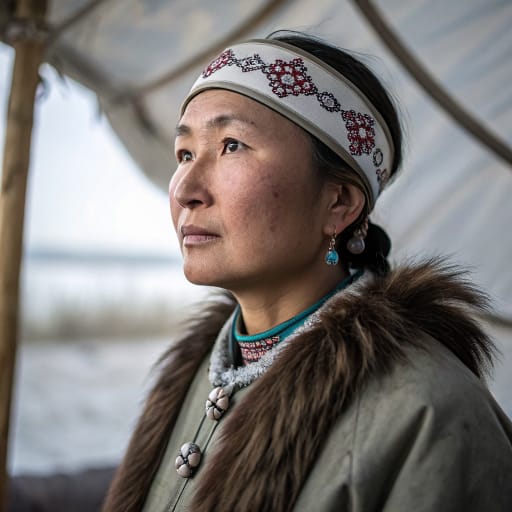
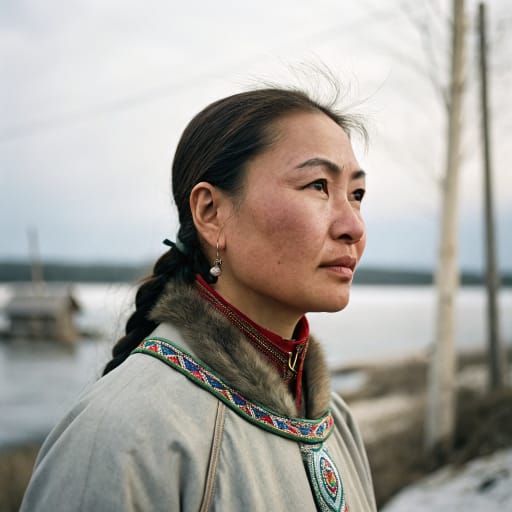
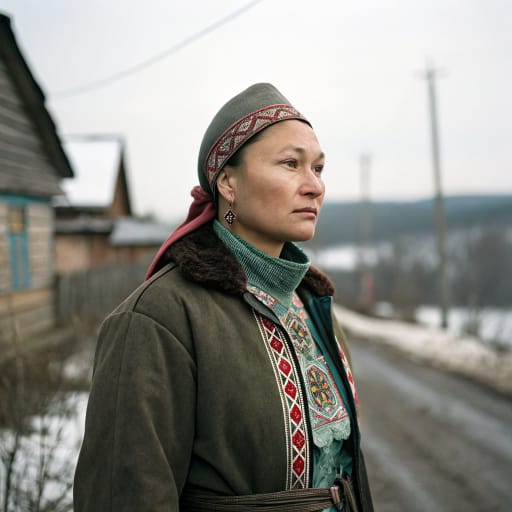
Typical Khamnigan Phenotypes
Reference for AI generation: hair, eyes, skin, facial structure, build
Khamnigan Body & Anatomy Reference
Siberian Indigenous / Tungusic phenotype: anatomy reference for AI nude generation
Khamnigan Boobs & Breasts
Khamnigan boobs follow the Siberian Indigenous / Tungusic profile: small-to-medium cup, modest projection. Areolar diameter is usually 26-38mm, and the coloring is medium-brown areolar pigmentation against the light-to-medium skin tone. Breast shape tracks body composition (mesomorph, broader stocky frame adapted to cold climate, mean adult female BMI 22-25), so Khamnigan breasts tend to be firm, modest projection. Expect a forward-set shape, not the fuller Central Asian or East Asian bust.
Khamnigan Ass & Hips
Khamnigan ass and hip morphology presents as small-to-medium, modest projection, distinctly different from the broader Central Asian hip profile. The Khamnigan pelvic profile shows narrow-to-medium iliac crests, anchored in the Siberian Indigenous / Tungusic skeletal pattern. Khamnigan butt shots in adult AI imagery should render the small-to-medium, modest projection silhouette with the overall build (mesomorph, broader stocky frame adapted to cold climate) and the fat distribution typical of the Siberian Indigenous / Tungusic phenotype.
Khamnigan Vagina & Pussy
Khamnigan pussy anatomy typically shows medium-brown labial pigmentation. Pubic hair is usually straight fine-to-medium texture, sparser distribution. In AI-generated Khamnigan nudes, labial color should blend into the light to medium skin with a gradual transition, and the hair should keep its straight fine-to-medium texture.
Khamnigan Dicks & Penis
Penis reference for Khamnigan men: regional mean ~12cm erect, moderate girth. Coloring: medium-brown shaft pigmentation. An accurate Khamnigan cock in AI imagery matches the surrounding light to medium skin rather than a generic porn default. Circumcision depends on religion and custom, not ancestry.
Khamnigan Body, Curves & Build
The Khamnigan figure is generally mesomorph, broader stocky frame adapted to cold climate, with mean adult female BMI 22-25, characteristic of Siberian Indigenous / Tungusic ancestry. AI image tools tend to flatten regional body types into a few stock shapes; here the Khamnigan build is kept as its own reference.
Khamnigan Skin Tone & Hair Texture
Skin: light to medium (Fitzpatrick II-IV). Hair: straight 1A, dark-brown to black. Both are typical of Siberian Indigenous / Tungusic ancestry. The most common mistake in AI nudes of Khamnigan women is a body rendered lighter than the face.
Explore phenotype categories
Structured taxonomy with peer-reviewed scales · 22 anatomical categories
Erotic Poses & Sex Positions
From the pose catalog: 219 named positions with reference skeletons
Frequently asked questions about Khamnigan people
Where is the Khamnigan homeland?
The Khamnigan homeland is Onon and Argun basin, Transbaikalia (Zabaykalsky Krai and Buryatia), Russia; also Mongolia and Inner Mongolia, China in Northern Asia.
What language do Khamnigan people speak?
Khamnigan people primarily speak Khamnigan Mongol (Mongolic); some also Khamnigan Evenki (Tungusic).
What religion do Khamnigan people practice?
The predominant religion among Khamnigan people is Tibetan Buddhism and shamanism.






Make your own Khamnigan images
Five a day, free, no credits to buy. The studio starts from this group's phenotype data, so you can set body type, pose and style and keep the traits accurate.
Start with Khamnigan