Help us get this right
Does this portrait look right for Kotts?
Nobody has judged this one yet. You would be the first.
Kotts Erotic
The Kan River basin and tributaries such as the Agul, east of Krasnoyarsk, in present-day Krasnoyarsk Krai, Russia (southern Siberia)
Kott (Yeniseian), extinct by the mid-nineteenth century; speakers shifted to Russian
Indigenous Siberian beliefs, later Russian Orthodox Christianity under Russian rule
Yeniseian peoples; closely tied to the Assan, whose speech is often classed as a Kott dialect; related to the Arin, Pumpokol, Yugh and the surviving Ket
About Kotts People
The Kotts were a small Yeniseian-speaking people of southern Siberia. They lived along the Kan River and its tributaries, east of present-day Krasnoyarsk, until the nineteenth century. By then they had been absorbed into the Russian and other peoples around them, and their language had fallen out of use. No community calls itself Kott today. What remains is their language, written down in detail just before it disappeared, and that record still matters.
Language was what set the Kotts apart. Theirs belonged to the Yeniseian family, which has no accepted relatives among the Turkic, Samoyedic and Tungusic languages spoken around it. Those neighboring languages build words by adding endings. Yeniseian languages build their verbs from the front instead, stacking prefixes ahead of the root. Assan, spoken nearby, was so close to Kott that it is often treated as a dialect of it. Other members of the family, such as Arin and Pumpokol, are known only from short word lists. Ket, spoken far to the north along the Yenisei, is the only one still alive. River names with Yeniseian roots are scattered across southern Siberia, which suggests these languages once covered far more ground than the few pockets Russian explorers found.
The Kotts hunted and fished in the forested country below the Eastern Sayan mountains. In the seventeenth century Russian forts pushed up the Kan, and the Kotts were made to pay yasak, the fur tax the tsars collected from Siberia's native peoples. Over the next two centuries came Orthodox baptism, marriage with Russian settlers and a slow switch to Russian, until the Kotts no longer existed as a separate people.
Most of what is known about Kott comes from the Finnish scholar Matthias Alexander Castrén, who worked with the last speakers in the 1840s. His grammar and word list were published in 1858, after his death. They added to shorter word lists gathered by eighteenth-century expeditions. As a result, Kott is far better documented than its close relatives, and that gives the Kotts a real place in a live scholarly debate. The Dene-Yeniseian hypothesis, which links the Yeniseian family to the Na-Dene languages of North America, relies on Kott words alongside Ket. Linguists still argue over the connection. Even so, a people who faded from view in the nineteenth century now sit at the center of one of the boldest ideas in historical linguistics.
Related ethnic groups
Groups that share Kotts's homeland, region, language, or religious tradition. These are likely candidates for comparative phenotype reference.

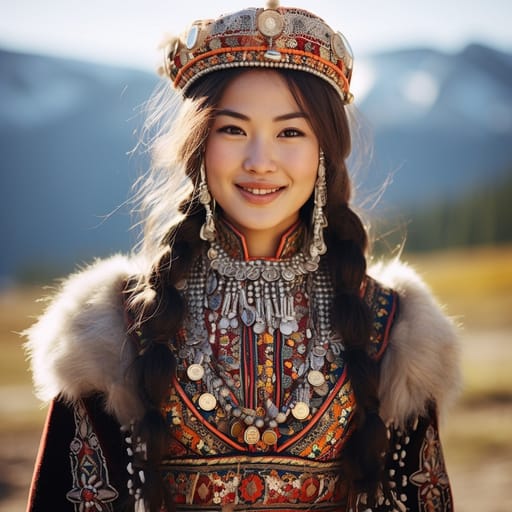
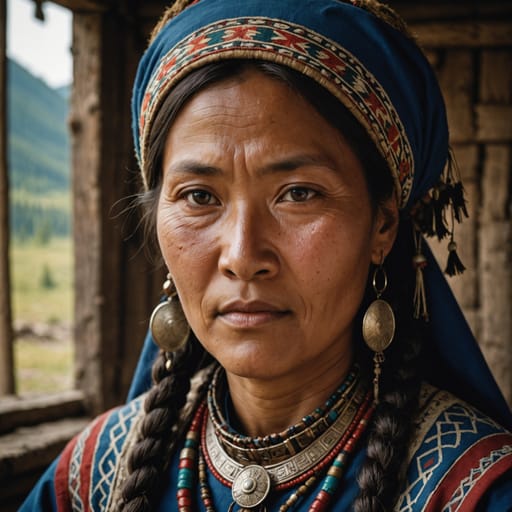
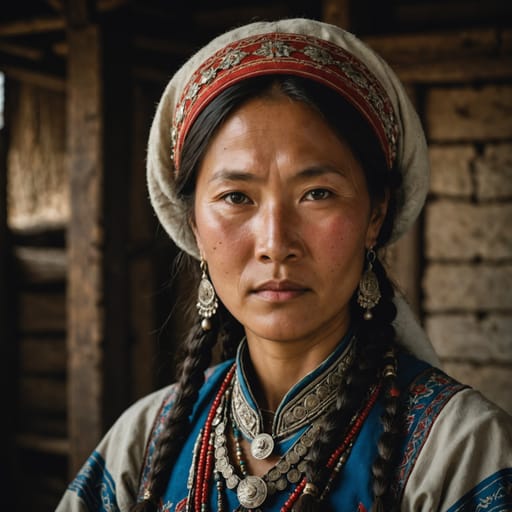
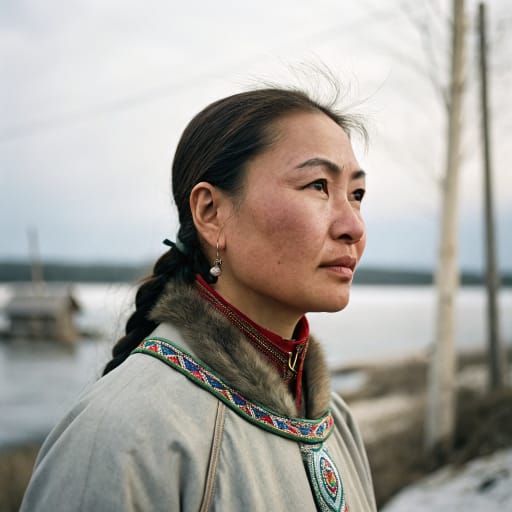

Typical Kotts Phenotypes
Reference for AI generation: hair, eyes, skin, facial structure, build
Kotts Body & Anatomy Reference
Siberian Indigenous / Tungusic phenotype: anatomy reference for AI nude generation
Kotts Boobs & Breasts
Bust reference for Kotts women: small-to-medium cup, modest projection, which is typical of Siberian Indigenous / Tungusic ancestry. Areolas measure about 26-38mm across, with medium-brown pigmentation. Body type (mesomorph, broader stocky frame adapted to cold climate) shapes the bust as well, so Kotts tits are usually firm, modest projection. In AI imagery, keep the forward-set shape rather than drifting toward the fuller Central Asian or East Asian bust.
Kotts Ass & Hips
The Kotts ass is typically small-to-medium, modest projection, which sets it apart from the broader Central Asian hip profile. Underneath, the pelvis shows narrow-to-medium iliac crests, part of the Siberian Indigenous / Tungusic skeletal pattern. For Kotts butt pics and AI renders, match that silhouette and the overall build (mesomorph, broader stocky frame adapted to cold climate).
Kotts Vagina & Pussy
Kotts pussy and vulvar anatomy presents medium-brown labial pigmentation, consistent with the Siberian Indigenous / Tungusic phenotype's pigmentation pattern. Kotts pubic hair is typically straight fine-to-medium texture, sparser distribution, in the inverted-triangle pattern. For anatomically accurate Kotts pussy renders the labial coloration should match the surrounding light to medium skin tone with a continuous gradient, and the hair should keep its straight fine-to-medium texture.
Kotts Dicks & Penis
Kotts dicks follow the Siberian Indigenous / Tungusic reference data: regional mean ~12cm erect; moderate girth; medium-brown shaft pigmentation. Shaft color should track the light to medium skin tone with a smooth change toward the glans, and Kotts pubic hair keeps its straight fine-to-medium texture.
Kotts Body, Curves & Build
Kotts body type and overall build presents as mesomorph, broader stocky frame adapted to cold climate, with mean adult female BMI 22-25: the characteristic Siberian Indigenous / Tungusic habitus. Kotts curves and proportions should keep the regional skeletal frame (height, shoulder-to-hip ratio, limb proportions) rather than a generic mesomorph default.
Kotts Skin Tone & Hair Texture
Kotts skin sits in the light to medium (Fitzpatrick II-IV) band. Hair is typically straight 1A, dark-brown to black, in keeping with the Siberian Indigenous / Tungusic phenotype. In nude renders the skin should stay one even tone from face to body, and body, pubic and head hair should match.
Explore phenotype categories
Structured taxonomy with peer-reviewed scales · 22 anatomical categories
Erotic Poses & Sex Positions
From the pose catalog: 219 named positions with reference skeletons
Frequently asked questions about Kotts people
Where is the Kotts homeland?
The Kotts homeland is The Kan River basin and tributaries such as the Agul, east of Krasnoyarsk, in present-day Krasnoyarsk Krai, Russia (southern Siberia) in Northern Asia.
What language do Kotts people speak?
Kotts people primarily speak Kott (Yeniseian), extinct by the mid-nineteenth century; speakers shifted to Russian.
What religion do Kotts people practice?
The predominant religion among Kotts people is Indigenous Siberian beliefs, later Russian Orthodox Christianity under Russian rule.






Make your own Kotts images
Five a day, free, no credits to buy. The studio starts from this group's phenotype data, so you can set body type, pose and style and keep the traits accurate.
Start with Kotts