No portrait yet
Sagai Erotic
Abakan River valley from the Uybat River to its upper tributaries, mainly Askiz and Tashtyp districts of Khakassia, Russia
Sagai dialect of Khakas (Turkic, Siberian branch); Russian (Slavic) widely spoken
Russian Orthodox Christianity mixed with shamanism and offerings to mountain, water and hearth spirits; some follow a revived traditional faith
Ethnographic group of the Khakas, alongside the Kachins, Kyzyls, Koibals and Beltirs; traditionally organized in patrilineal clans (seok)
About Sagai People
The Sagai are the Khakas of the Abakan River valley, along the stretch that runs from the Uybat River up into the foothills of the Western Sayan. What sets them apart from other Khakas is mostly their speech and history, not a separate sense of nationhood. They speak the Sagai dialect and, like their neighbors, call themselves tadar. The name still means something. In the villages around Askiz and Tashtyp, being Sagai is a real way of placing a family, and their dialect is one of the two that written Khakas was built on. The other is Kachin.
Khakas is a Turkic language of southern Siberia, and its closest relatives are Shor and Chulym, spoken by small neighboring peoples. Russian dominates school, work and government, and many younger Sagai speak it better than the dialect their grandparents spoke. Russian power reached the valley in the seventeenth and early eighteenth centuries, when these steppes were still tied to the Yenisei Kyrgyz. Imperial officials called the people there Abakan or Minusinsk Tatars. Reforms in the 1820s gave the Sagai their own steppe duma, a native administrative council, which turned a clan and territorial name into an official category. The name Khakas for the whole people was adopted in the early Soviet years. Later, collectivization moved the last semi-nomadic herders into fixed villages.
Life was built around herds of horses, cattle and sheep moved between winter and summer grounds. Hunting in the taiga and digging wild lily bulbs filled out the year. Society was organized by the seok, the patrilineal clan, a word that literally means bone, and marrying someone from your own seok was forbidden. Most Khakas were baptized into the Orthodox Church in the eighteenth and nineteenth centuries, but the new faith did not push out the old one. The kham, or shaman, kept working, and families went on making offerings to the spirits of mountains, water and the hearth. Since the 1990s these older practices have become public again, most visibly at Tun Payram, the summer festival of the first ayran.
The Sagai also share in a Khakas oral tradition that deserves more attention. Heroic epics were performed in khai, a deep throat-sung chant, often to the plucked strings of the chatkhan, a long zither, and one epic could take several evenings to finish. Married women's dress was marked by the pogo, a crescent-shaped breastpiece sewn with mother-of-pearl buttons and beads. It is still worn at festivals.
Related ethnic groups
Groups that share Sagai's homeland, region, language, or religious tradition. These are likely candidates for comparative phenotype reference.

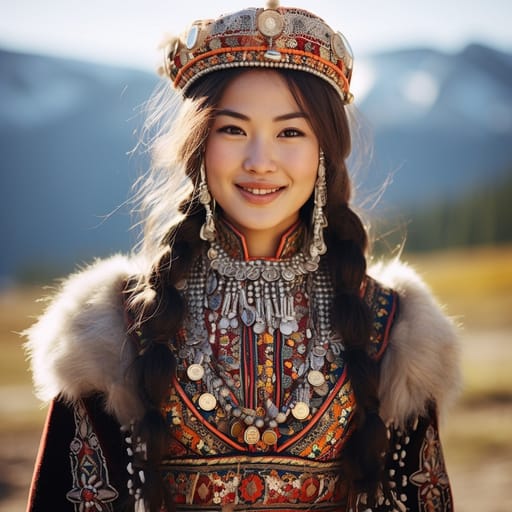
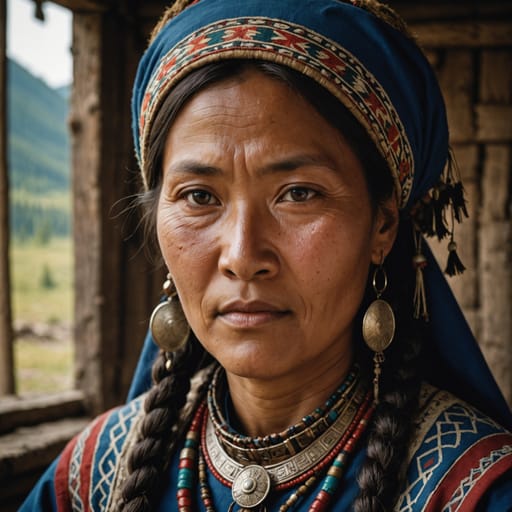
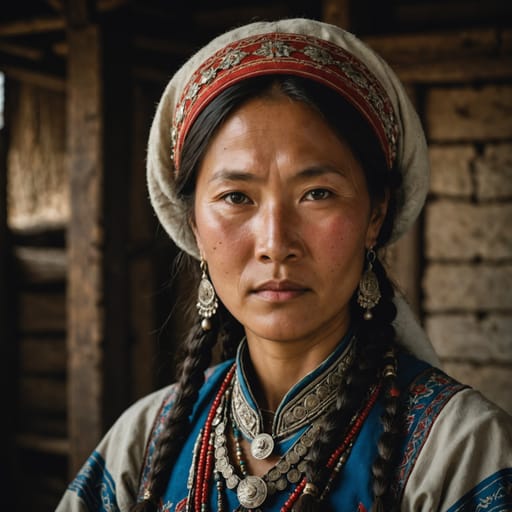
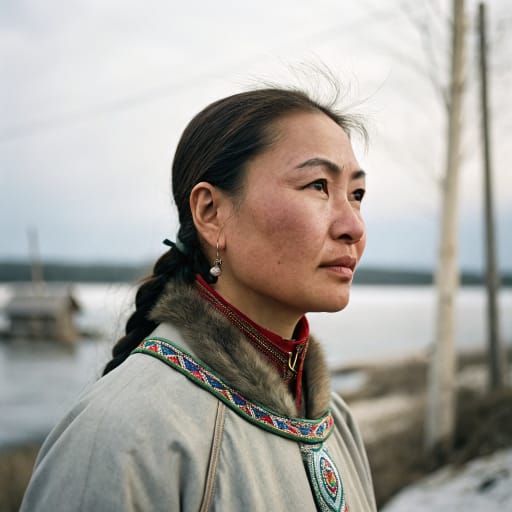
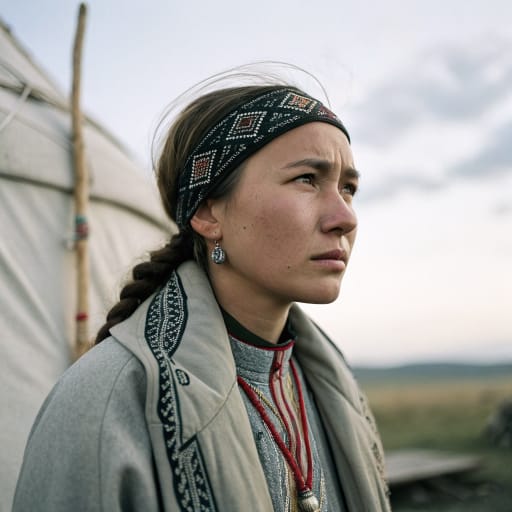
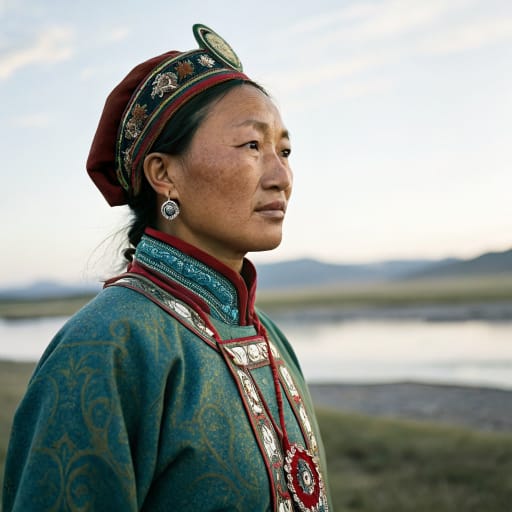
Typical Sagai Phenotypes
Reference for AI generation: hair, eyes, skin, facial structure, build
Sagai Body & Anatomy Reference
Anatomy by feature, Siberian Indigenous / Tungusic phenotype
Sagai Boobs & Breasts
Bust reference for Sagai women: small-to-medium cup, modest projection, which is typical of Siberian Indigenous / Tungusic ancestry. Areolas measure about 26-38mm across, with medium-brown pigmentation. Body type (mesomorph, broader stocky frame adapted to cold climate) shapes the bust as well, so Sagai tits are usually firm, modest projection. In AI imagery, keep the forward-set shape rather than drifting toward the fuller Central Asian or East Asian bust.
Sagai Ass & Hips
The Sagai ass is typically small-to-medium, modest projection, which sets it apart from the broader Central Asian hip profile. Underneath, the pelvis shows narrow-to-medium iliac crests, part of the Siberian Indigenous / Tungusic skeletal pattern. For Sagai butt pics and AI renders, match that silhouette and the overall build (mesomorph, broader stocky frame adapted to cold climate).
Sagai Vagina & Pussy
Sagai pussy and vulvar anatomy presents medium-brown labial pigmentation, consistent with the Siberian Indigenous / Tungusic phenotype's pigmentation pattern. Sagai pubic hair is typically straight fine-to-medium texture, sparser distribution, in the inverted-triangle pattern. For anatomically accurate Sagai pussy renders the labial coloration should match the surrounding light to medium skin tone with a continuous gradient, and the hair should keep its straight fine-to-medium texture.
Sagai Dicks & Penis
Sagai dicks follow the Siberian Indigenous / Tungusic reference data: regional mean ~12cm erect; moderate girth; medium-brown shaft pigmentation. Shaft color should track the light to medium skin tone with a smooth change toward the glans, and Sagai pubic hair keeps its straight fine-to-medium texture.
Sagai Body, Curves & Build
Sagai body type and overall build presents as mesomorph, broader stocky frame adapted to cold climate, with mean adult female BMI 22-25: the characteristic Siberian Indigenous / Tungusic habitus. Sagai curves and proportions should keep the regional skeletal frame (height, shoulder-to-hip ratio, limb proportions) rather than a generic mesomorph default.
Sagai Skin Tone & Hair Texture
Sagai skin sits in the light to medium (Fitzpatrick II-IV) band. Hair is typically straight 1A, dark-brown to black, in keeping with the Siberian Indigenous / Tungusic phenotype. In nude renders the skin should stay one even tone from face to body, and body, pubic and head hair should match.
Explore phenotype categories
Structured taxonomy with peer-reviewed scales · 22 anatomical categories
Erotic Poses & Sex Positions
From the pose catalog: 219 named positions with reference skeletons
Frequently asked questions about Sagai people
Where is the Sagai homeland?
The Sagai homeland is Abakan River valley from the Uybat River to its upper tributaries, mainly Askiz and Tashtyp districts of Khakassia, Russia in Northern Asia.
What language do Sagai people speak?
Sagai people primarily speak Sagai dialect of Khakas (Turkic, Siberian branch); Russian (Slavic) widely spoken.
What religion do Sagai people practice?
The predominant religion among Sagai people is Russian Orthodox Christianity mixed with shamanism and offerings to mountain, water and hearth spirits; some follow a revived traditional faith.






Make your own Sagai images
Five a day, free, no credits to buy. The studio starts from this group's phenotype data, so you can set body type, pose and style and keep the traits accurate.
Start with Sagai