Help us get this right
Does this portrait look right for Oroch?
Nobody has judged this one yet. You would be the first.
Oroch Erotic
The Tumnin River basin and the Strait of Tartary coast of Khabarovsk Krai, in the Russian Far East, with a few families historically in Primorsky Krai and on Sakhalin.
Oroch (Southern or Amur branch of Tungusic, closest to Udege), now moribund; Russian in daily use.
Russian Orthodoxy layered over clan animism and shamanism, including bear ceremonialism.
One of the southern Amur Tungusic peoples alongside the Udege, Nanai and Ulch; organized internally by exogamous clans rather than branches.
About Oroch People
The Oroch are a small people of the Russian Far East, several hundred in all, whose center of gravity is the Tumnin River and the stretch of Tatar Strait coast it empties into, on the northern flank of the Sikhote-Alin. Their name has caused a century of confusion: they are not the Orok of Sakhalin, who call themselves Uilta, and not the Oirat of Inner Asia, and not quite the Udege, though the Udege are their closest kin. Their own older self-designation was nani, roughly "people of this place," the same word the Nanai use downriver. That tangle says more about how nineteenth century outsiders sorted the Amur peoples than it does about the Oroch. What held them together was never a state or a chiefdom but a set of exogamous clans and a seasonal round: salmon runs in summer, sable and elk in the winter forest, seals and fish along the coast, dog teams and bark boats to move between them.
The Oroch language sits in the southern, Amur branch of Tungusic, near enough to Udege that some linguists treat the two as ends of one chain rather than separate tongues. It is now barely spoken. Russian has been the everyday language for two or three generations and the remaining fluent speakers are elderly, which makes the recorded texts and the scattered teaching efforts more than sentimental. Religion runs on two tracks. Orthodox baptism came with Russian administration after the border settlements of 1858 and 1860 pulled the region out of the Qing orbit, and it sat on top of an older order of clan spirits, masters of the taiga and the water, and shamans who negotiated with them. The bear was the pivot of that older order: a cub raised in the village and killed under strict ceremony, a rite the Oroch shared with the Nivkh and with the Ainu across the water. Soviet collectivization in the 1930s pulled scattered winter camps into consolidated villages, above all Uska-Orochskaya on the Tumnin, and put fishing under a state plan. Russia now counts the Oroch among the Indigenous Small-Numbered Peoples of the North, a status that carries subsistence fishing and hunting rights and, in practice, an annual argument over quotas.
Related ethnic groups
Groups that share Oroch's homeland, region, language, or religious tradition. These are likely candidates for comparative phenotype reference.
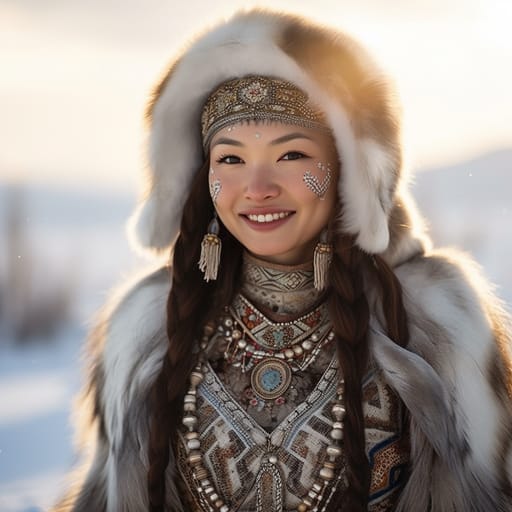
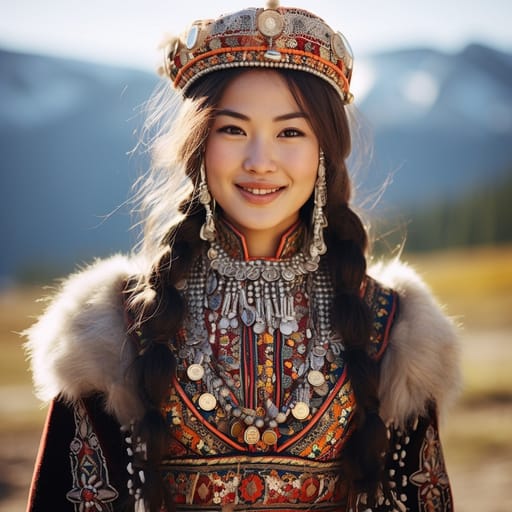
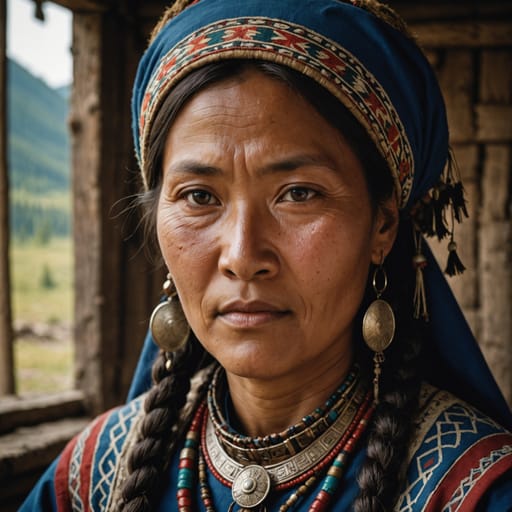
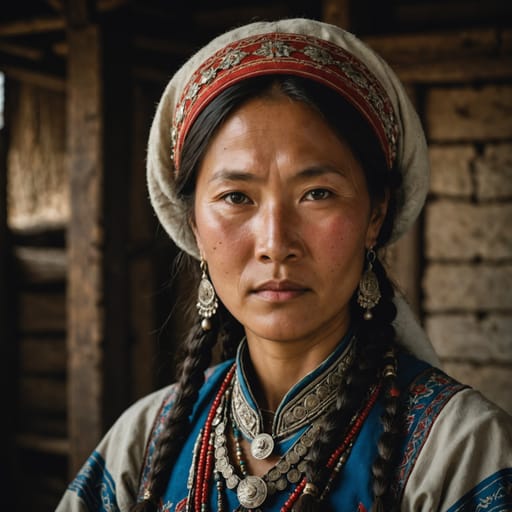
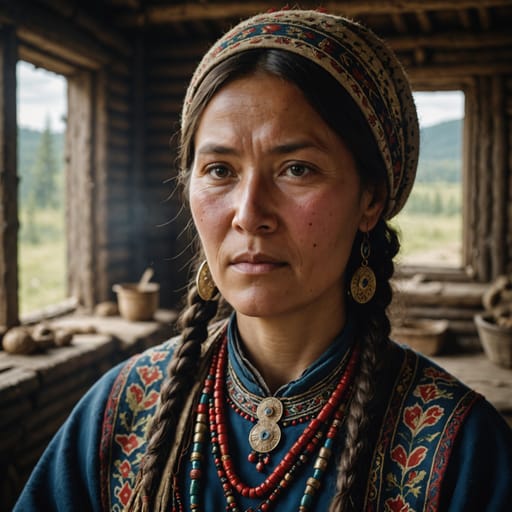
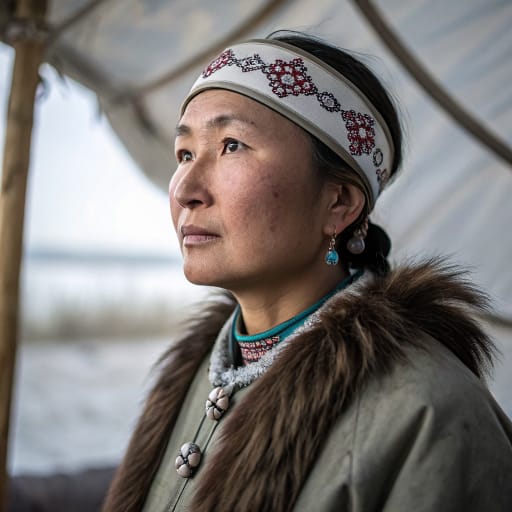
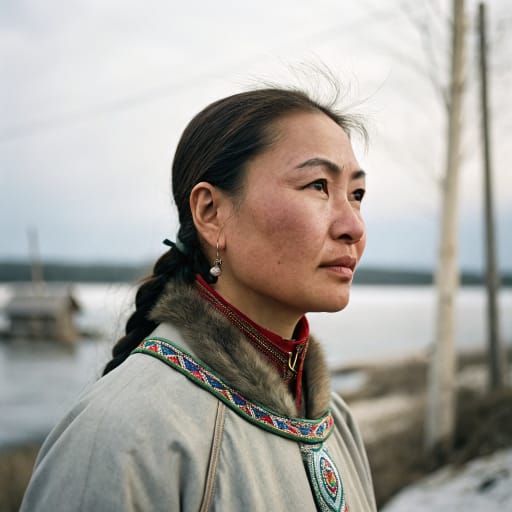
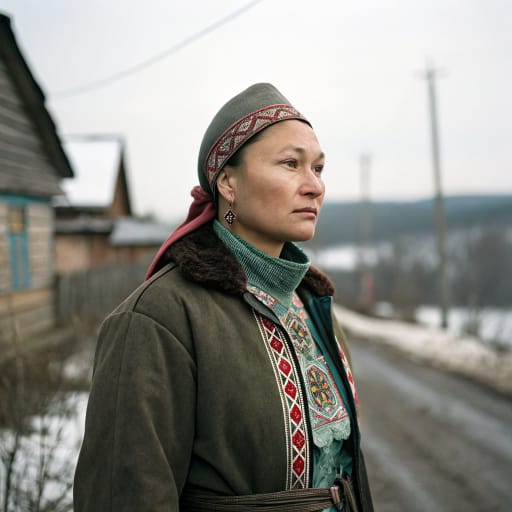
Typical Oroch Phenotypes
Reference for AI generation: hair, eyes, skin, facial structure, build
Oroch Body & Anatomy Reference
Per-feature anatomical profile for AI nude generation: Siberian Indigenous / Tungusic phenotype
Oroch Boobs & Breasts
The typical Oroch bust is small-to-medium cup, modest projection, in line with the wider Siberian Indigenous / Tungusic pattern. Areolas usually fall in the 26-38mm range, with medium-brown areolar pigmentation against the light-to-medium skin tone. Compared with the fuller Central Asian or East Asian bust, Oroch breasts sit forward and are generally firm, modest projection. A faithful AI render of Oroch tits keeps that shape and areola size.
Oroch Ass & Hips
Butt shape among Oroch women: small-to-medium, modest projection, over narrow-to-medium iliac crests. This follows Siberian Indigenous / Tungusic ancestry and looks quite unlike the broader Central Asian hip profile. An accurate Oroch ass in adult AI imagery keeps both the silhouette and the overall build (mesomorph, broader stocky frame adapted to cold climate) instead of a generic average.
Oroch Vagina & Pussy
Vulvar anatomy among Oroch women: medium-brown labial pigmentation. Pubic hair tends to be straight fine-to-medium texture, sparser distribution, in the usual inverted-triangle pattern. Both follow Siberian Indigenous / Tungusic pigmentation, which is why Oroch pussy renders should not fall back on a pale, sparse Western template.
Oroch Dicks & Penis
The Oroch cock profile, from Siberian Indigenous / Tungusic anthropometric data: regional mean ~12cm erect; moderate girth; medium-brown shaft pigmentation. Pubic hair has a straight fine-to-medium texture and forms the usual inverted-V pattern. Whether Oroch men are circumcised follows religious and cultural practice rather than phenotype.
Oroch Body, Curves & Build
Build and curves among Oroch women follow the Siberian Indigenous / Tungusic pattern: mesomorph, broader stocky frame adapted to cold climate, mean adult female BMI 22-25. Proportions matter as much as skin tone, so Oroch figures should keep their regional height and limb ratios.
Oroch Skin Tone & Hair Texture
The Oroch skin range is light to medium (Fitzpatrick II-IV), and hair tends to be straight 1A, dark-brown to black. That combination marks the Siberian Indigenous / Tungusic phenotype, and skin tone is the trait AI generators most often get wrong for Oroch women.
Explore phenotype categories
Structured taxonomy with peer-reviewed scales · 22 anatomical categories
Erotic Poses & Sex Positions
From the pose catalog: 219 named positions with reference skeletons
Frequently asked questions about Oroch people
Where is the Oroch homeland?
The Oroch homeland is The Tumnin River basin and the Strait of Tartary coast of Khabarovsk Krai, in the Russian Far East, with a few families historically in Primorsky Krai and on Sakhalin. in Northern Asia.
What language do Oroch people speak?
Oroch people primarily speak Oroch (Southern or Amur branch of Tungusic, closest to Udege), now moribund; Russian in daily use..
What religion do Oroch people practice?
The predominant religion among Oroch people is Russian Orthodoxy layered over clan animism and shamanism, including bear ceremonialism..






Make your own Oroch images
Five a day, free, no credits to buy. The studio starts from this group's phenotype data, so you can set body type, pose and style and keep the traits accurate.
Start with Oroch