Help us get this right
Does this portrait look right for Khakass?
Nobody has judged this one yet. You would be the first.
Khakass Erotic
Republic of Khakassia in southern Siberia, Russia, in the Minusinsk Basin on the upper Yenisei between the Kuznetsk Alatau and the Sayan mountains; smaller communities in neighboring Krasnoyarsk Krai and Tuva.
Khakas (Turkic, Siberian branch, close to Shor and Chulym), written in Cyrillic; Russian is now the first language of many, especially the young.
Nominally Russian Orthodox since nineteenth-century baptisms, layered over living shamanic and Tengrist practice: fire and hearth spirits, sacred mountains and springs, revived seasonal festivals.
Five historical groups: Kacha (Khaas), Sagai, Kyzyl, Koibal and Beltir, further divided into exogamous clans (seok); descendants in part of the Yenisei Kyrgyz, related to the Shor and Chulym.
About Khakass People
The Khakass are the Turkic people of the Minusinsk Basin, the bowl of steppe on the upper Yenisei where southern Siberia opens out between the Kuznetsk Alatau and the Sayan ranges. The basin is studded with thousands of Bronze and Iron Age burial mounds and standing stones, and the Khakass are the people who still treat those stones as living: the stele called Ulug Khurtuyakh Tas, the Great Stone Old Woman, draws women asking for children to this day. Their republic is Khakassia, with its capital at Abakan, but after two centuries of Russian settlement they are barely one in eight of its residents. Even the name is recent, a Soviet-era coinage lifted from a Chinese rendering of the Yenisei Kyrgyz. Before 1917 Russians called them Minusinsk or Abakan Tatars, and among themselves many still say Tadar.
That single label covers several older groups. The Kacha and Sagai are the largest, alongside the Kyzyl, Koibal and Beltir, each once tied to its own stretch of river and organized into exogamous clans called seok, literally bone. Khakas belongs to the Siberian branch of Turkic, closest to Shor and Chulym to the west and north, more distant from Tuvan to the south. It has been written since the 1920s, yet many younger Khakass now speak Russian more readily. The people descend in part from the Yenisei Kyrgyz, whose khaganate broke the Uyghurs in 840 and held the basin until the Mongols. The Dzungars carried off much of the Kyrgyz elite in 1703, Russia built its first fort at Abakan in 1707, mass Orthodox baptisms followed in the nineteenth century, and collectivization ended the seasonal herding cycle.
What survived is a religious life that never settled into one confession. Families feed the fire spirit Ot Ine at the hearth, tie cloth ribbons called chalama at springs and birches, and hold the sacred mountains in mind alongside the Orthodox calendar. Shamans work openly again since the 1990s, and a revived festival cycle anchors the year: Tun Payram in early summer marks the herds' first milk and has become the national holiday, with horse races, wrestling and rows of felt and timber yurts. Heroic epics, alyptyg nymakh, are still performed in the low throat-singing style called khai to the chatkhan, a long box zither that has become the emblem of Khakass music. Horses, cattle and sheep are still kept in the villages, called aals, while coal mines and the Sayano-Shushenskaya dam have turned the republic into one of Siberia's industrial corners. Khakass identity today lives in the aal and on the festival ground, held together by a language under pressure and the stones in the steppe.
Related ethnic groups
Groups that share Khakass's homeland, region, language, or religious tradition. These are likely candidates for comparative phenotype reference.
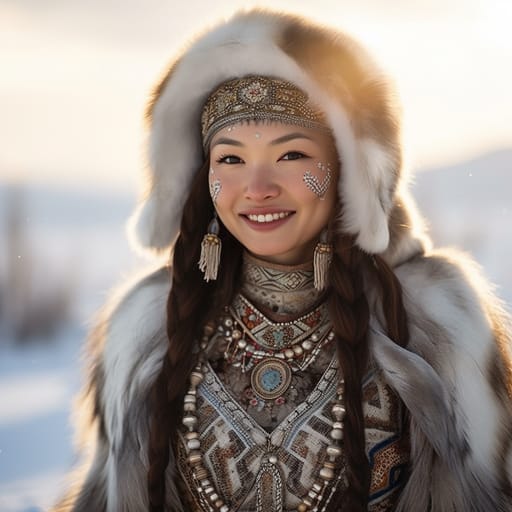
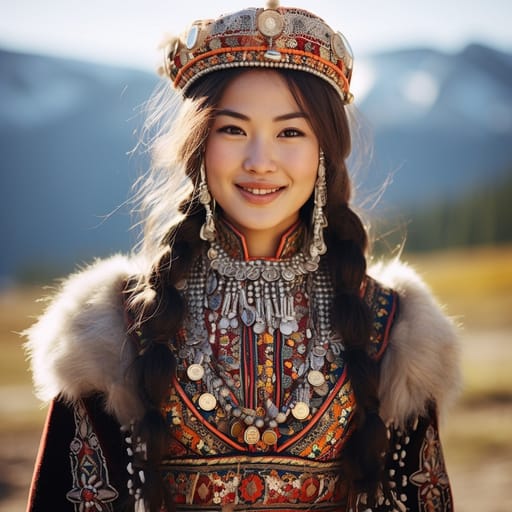
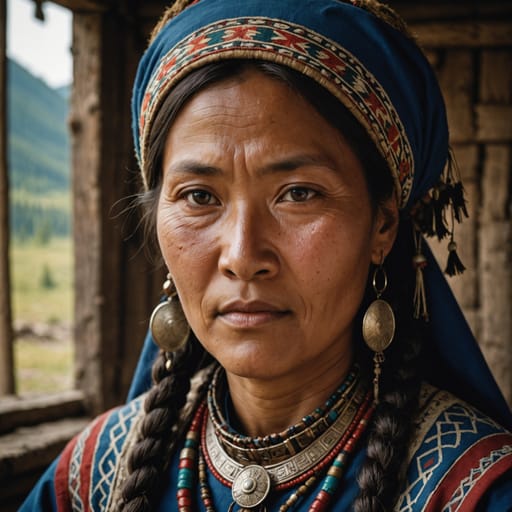
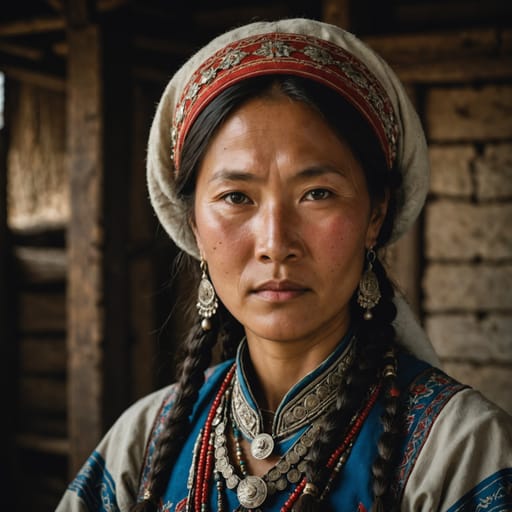
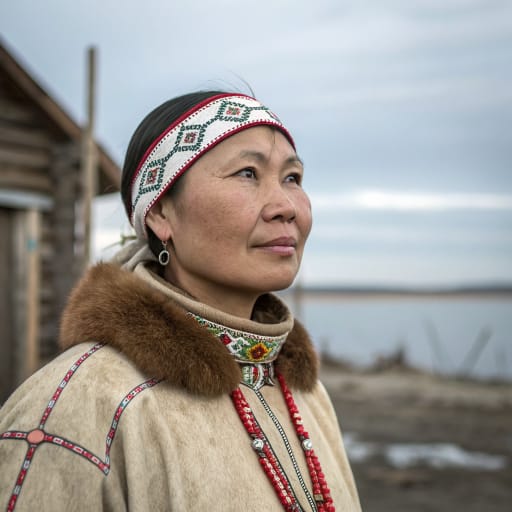
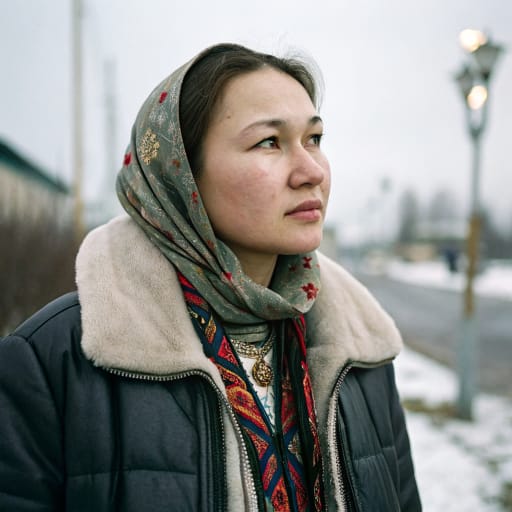
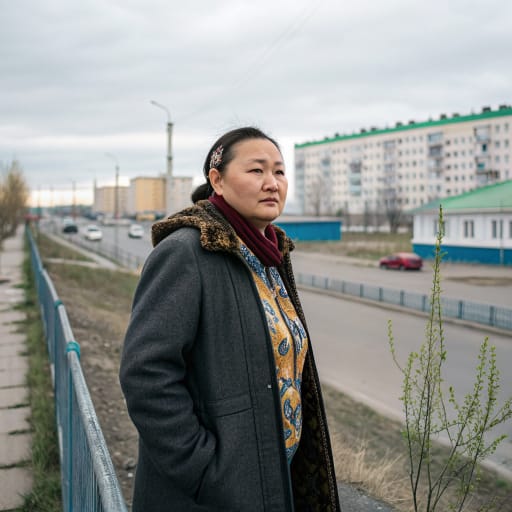
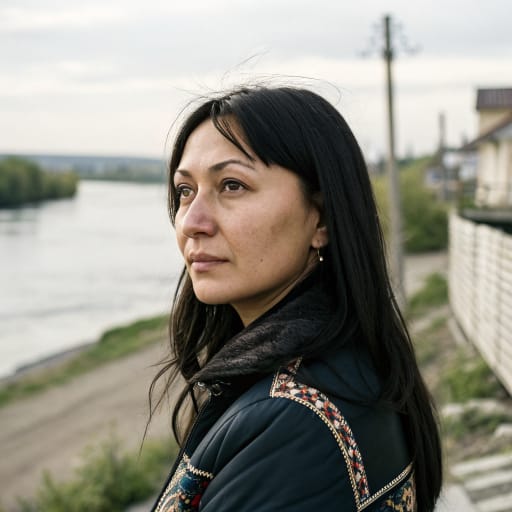
Typical Khakass Phenotypes
Reference for AI generation: hair, eyes, skin, facial structure, build
Khakass Body & Anatomy Reference
Anatomy by feature, Siberian Indigenous / Tungusic phenotype
Khakass Boobs & Breasts
Khakass tits and boobs run small-to-medium cup, modest projection, the classic Siberian Indigenous / Tungusic bust profile. Khakass nipples and areolas show medium-brown areolar pigmentation against the light-to-medium skin tone, with areolar diameter typically in the 26-38mm range and forward-set positioning rather than the fuller Central Asian or East Asian bust. Khakass breasts trend firm, modest projection, a function of the mesomorph, broader stocky frame adapted to cold climate body habitus and the mean adult female BMI 22-25. For anatomically accurate AI-generated Khakass nudes the render preserves the small-to-medium cup, modest projection shape, 26-38mm areolas with medium-brown pigmentation, and the torso proportions of the Siberian Indigenous / Tungusic phenotype.
Khakass Ass & Hips
Khakass hips and butt usually read as small-to-medium, modest projection. The skeletal base is narrow-to-medium iliac crests, the Siberian Indigenous / Tungusic pattern. Set against the broader Central Asian hip profile, the difference is easy to see, and the hip-to-waist ratio is often what identifies Khakass women in photos.
Khakass Vagina & Pussy
Expect medium-brown labial pigmentation on Khakass women, in keeping with Siberian Indigenous / Tungusic ancestry. The pubic hair is straight fine-to-medium texture, sparser distribution. Coloring should run evenly from the light to medium skin of the thighs to the labia, and Khakass nude imagery should keep the hair's straight fine-to-medium texture.
Khakass Dicks & Penis
Khakass dick and penile anatomy in adult AI generation should anchor on the regional reference data: regional mean ~12cm erect, moderate girth, and medium-brown shaft pigmentation. The Khakass cock profile reflects the Siberian Indigenous / Tungusic population's anthropometric measurements. The shaft pigmentation should track the surrounding light to medium skin tone, and the pubic hair should keep its straight fine-to-medium texture in the typical inverted-V escutcheon.
Khakass Body, Curves & Build
Khakass body type: mesomorph, broader stocky frame adapted to cold climate, with mean adult female BMI 22-25. This is the typical Siberian Indigenous / Tungusic build. Height range, shoulder-to-hip ratio and fat distribution all follow from it, which is what an accurate Khakass nude body should show.
Khakass Skin Tone & Hair Texture
Khakass skin tone falls in the light to medium (Fitzpatrick II-IV) band, the surface signal most often miscalibrated by generic AI nude generators. Khakass hair texture is typically straight 1A, dark-brown to black, characteristic of the Siberian Indigenous / Tungusic phenotype. In Khakass nude renders the skin should hold that band consistently across the body.
Explore phenotype categories
Structured taxonomy with peer-reviewed scales · 22 anatomical categories
Erotic Poses & Sex Positions
From the pose catalog: 219 named positions with reference skeletons
Frequently asked questions about Khakass people
Where is the Khakass homeland?
The Khakass homeland is Republic of Khakassia in southern Siberia, Russia, in the Minusinsk Basin on the upper Yenisei between the Kuznetsk Alatau and the Sayan mountains; smaller communities in neighboring Krasnoyarsk Krai and Tuva. in Northern Asia.
What language do Khakass people speak?
Khakass people primarily speak Khakas (Turkic, Siberian branch, close to Shor and Chulym), written in Cyrillic; Russian is now the first language of many, especially the young..
What religion do Khakass people practice?
The predominant religion among Khakass people is Nominally Russian Orthodox since nineteenth-century baptisms, layered over living shamanic and Tengrist practice: fire and hearth spirits, sacred mountains and springs, revived seasonal festivals..






Make your own Khakass images
Five a day, free, no credits to buy. The studio starts from this group's phenotype data, so you can set body type, pose and style and keep the traits accurate.
Start with Khakass