Help us get this right
Does this portrait look right for Kalmaks?
Nobody has judged this one yet. You would be the first.
Kalmaks Erotic
Tom River valley around Tomsk, in Tomsk Oblast and neighboring Kemerovo Oblast, western Siberia, Russia
Siberian Tatar, Kalmak dialect of the Tomsk group (Turkic, Kipchak branch); Russian (Indo-European, Slavic)
Sunni Islam
A branch of the Tomsk Tatars, alongside the Eushta and Chat Tatars, within the Siberian Tatars; of Teleut origin
About Kalmaks People
The Kalmaks are a Muslim Tatar community of the Tom River valley around Tomsk, and their name points to a past very different from their present. Kalmak is an old Turkic name for the Oirats, the western Mongols. Russians in Siberia extended it to the Teleuts, a Turkic people of the Altai foothills and the upper Ob who lived in the orbit of the Oirat Dzungar state. The Kalmaks descend from Teleut groups who moved north and settled under Russian authority near Tomsk in the 17th and 18th centuries, while Russia and the Dzungars fought for control of southern Siberia. They are a separate people from the Kalmyks of the lower Volga, who speak a Mongolic language and are Buddhists, though the near-identical names cause steady confusion.
Religion and neighbors turned Teleut settlers into Tatars. Around Tomsk they lived beside the Eushta and Chat Tatars and Muslim settlers from Central Asia. Over generations they adopted Sunni Islam and merged into the Muslim population of the region. Ethnographers now class them as one of the branches of the Tomsk Tatars. Their speech is a dialect of Siberian Tatar, a Kipchak Turkic language, and it keeps Teleut traces that set it apart from other Siberian Tatar dialects. Russian dominates daily life, as it does for most Siberian Tatars, and the dialect is under steady pressure from it.
Islam now sets the rhythm of the year and of a person's life. Kurban Bayram, Uraza Bayram and Muslim burial customs mark community life as they do for other Siberian Tatars. The summer Sabantuy festival, with its wrestling and games, links the Kalmaks to Tatar communities across Russia. Their numbers are small, and official statistics usually fold them into the broader Tatar total. What stays distinctive is harder to count: ancestors who herded livestock in the Altai foothills and switched loyalty between steppe rulers and Russian forts, a history the community now carries mostly in its name. The Kalmaks are a clear case of how Siberian Tatar identity was built from several peoples rather than inherited whole.
Related ethnic groups
Groups that share Kalmaks's homeland, region, language, or religious tradition. These are likely candidates for comparative phenotype reference.
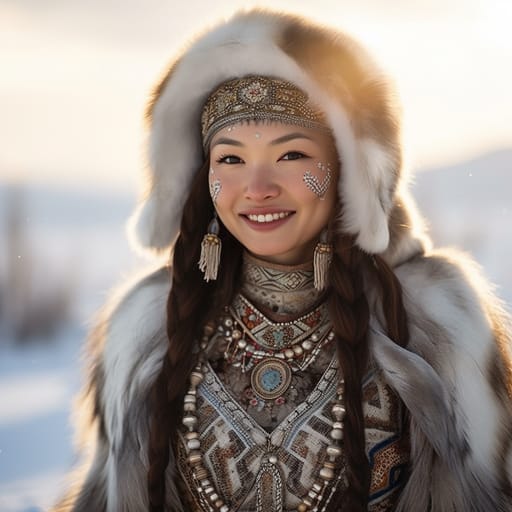
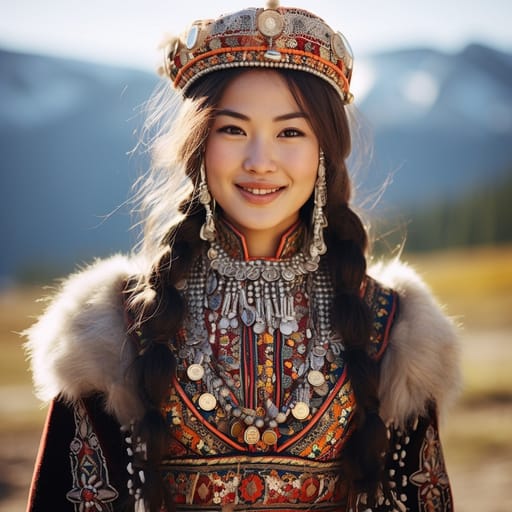
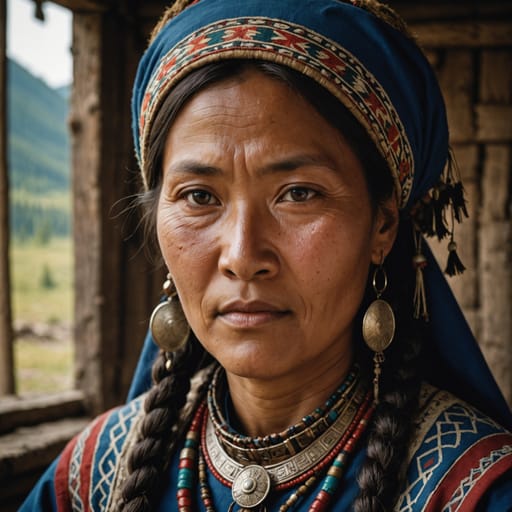
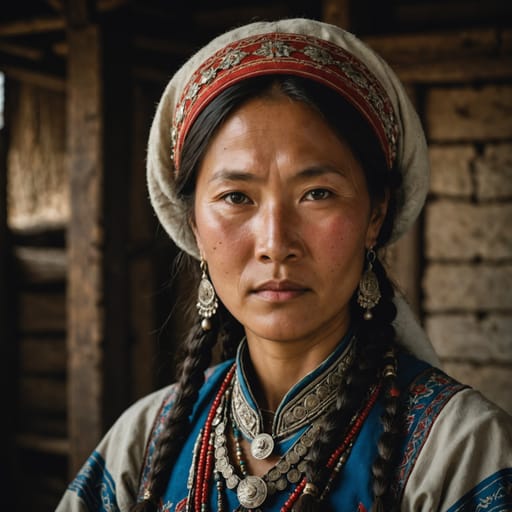
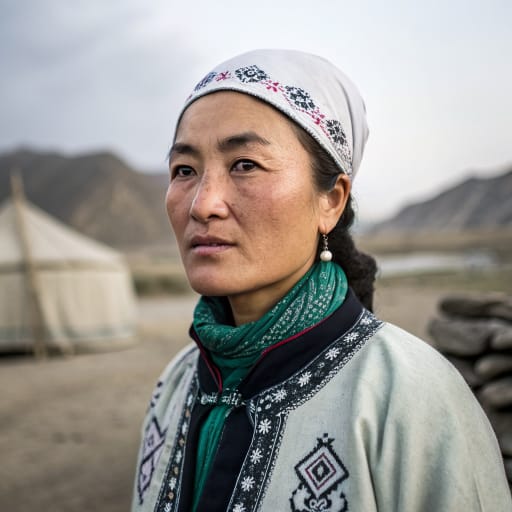
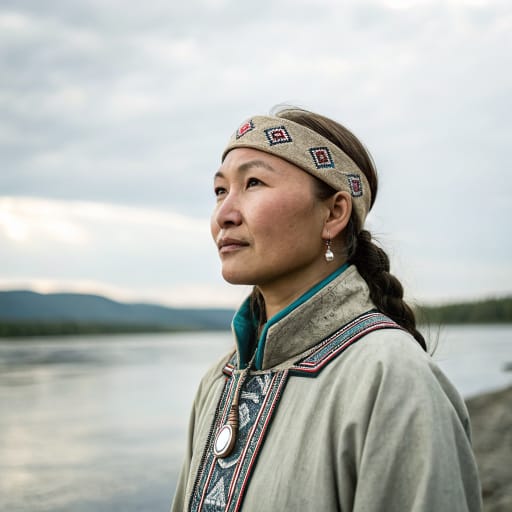
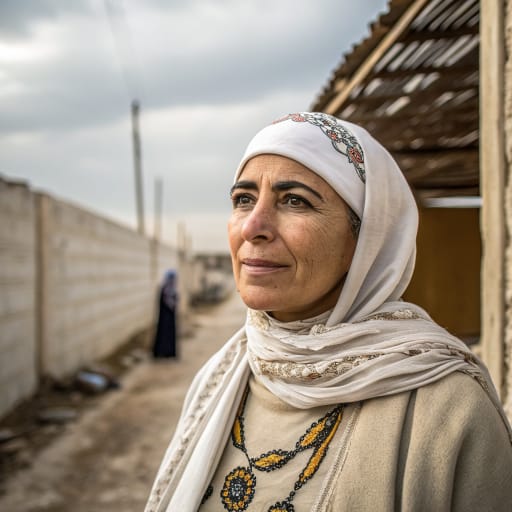
Typical Kalmaks Phenotypes
Reference for AI generation: hair, eyes, skin, facial structure, build
Kalmaks Body & Anatomy Reference
Per-feature anatomical profile for AI nude generation: Siberian Indigenous / Tungusic phenotype
Kalmaks Boobs & Breasts
Kalmaks tits and boobs run small-to-medium cup, modest projection, the classic Siberian Indigenous / Tungusic bust profile. Kalmaks nipples and areolas show medium-brown areolar pigmentation against the light-to-medium skin tone, with areolar diameter typically in the 26-38mm range and forward-set positioning rather than the fuller Central Asian or East Asian bust. Kalmaks breasts trend firm, modest projection, a function of the mesomorph, broader stocky frame adapted to cold climate body habitus and the mean adult female BMI 22-25. For anatomically accurate AI-generated Kalmaks nudes the render preserves the small-to-medium cup, modest projection shape, 26-38mm areolas with medium-brown pigmentation, and the torso proportions of the Siberian Indigenous / Tungusic phenotype.
Kalmaks Ass & Hips
Kalmaks hips and butt usually read as small-to-medium, modest projection. The skeletal base is narrow-to-medium iliac crests, the Siberian Indigenous / Tungusic pattern. Set against the broader Central Asian hip profile, the difference is easy to see, and the hip-to-waist ratio is often what identifies Kalmaks women in photos.
Kalmaks Vagina & Pussy
Expect medium-brown labial pigmentation on Kalmaks women, in keeping with Siberian Indigenous / Tungusic ancestry. The pubic hair is straight fine-to-medium texture, sparser distribution. Coloring should run evenly from the light to medium skin of the thighs to the labia, and Kalmaks nude imagery should keep the hair's straight fine-to-medium texture.
Kalmaks Dicks & Penis
Kalmaks dick and penile anatomy in adult AI generation should anchor on the regional reference data: regional mean ~12cm erect, moderate girth, and medium-brown shaft pigmentation. The Kalmaks cock profile reflects the Siberian Indigenous / Tungusic population's anthropometric measurements. The shaft pigmentation should track the surrounding light to medium skin tone, and the pubic hair should keep its straight fine-to-medium texture in the typical inverted-V escutcheon.
Kalmaks Body, Curves & Build
Kalmaks body type: mesomorph, broader stocky frame adapted to cold climate, with mean adult female BMI 22-25. This is the typical Siberian Indigenous / Tungusic build. Height range, shoulder-to-hip ratio and fat distribution all follow from it, which is what an accurate Kalmaks nude body should show.
Kalmaks Skin Tone & Hair Texture
Kalmaks skin tone falls in the light to medium (Fitzpatrick II-IV) band, the surface signal most often miscalibrated by generic AI nude generators. Kalmaks hair texture is typically straight 1A, dark-brown to black, characteristic of the Siberian Indigenous / Tungusic phenotype. In Kalmaks nude renders the skin should hold that band consistently across the body.
Explore phenotype categories
Structured taxonomy with peer-reviewed scales · 22 anatomical categories
Erotic Poses & Sex Positions
From the pose catalog: 219 named positions with reference skeletons
Frequently asked questions about Kalmaks people
Where is the Kalmaks homeland?
The Kalmaks homeland is Tom River valley around Tomsk, in Tomsk Oblast and neighboring Kemerovo Oblast, western Siberia, Russia in Northern Asia.
What language do Kalmaks people speak?
Kalmaks people primarily speak Siberian Tatar, Kalmak dialect of the Tomsk group (Turkic, Kipchak branch); Russian (Indo-European, Slavic).
What religion do Kalmaks people practice?
The predominant religion among Kalmaks people is Sunni Islam.






Make your own Kalmaks images
Five a day, free, no credits to buy. The studio starts from this group's phenotype data, so you can set body type, pose and style and keep the traits accurate.
Start with Kalmaks