Help us get this right
Does this portrait look right for Mambila?
One tap. It takes a second and it is recorded.
0 say it looks right, 1 says it looks off.
Mambila Erotic
Mambilla Plateau (Nigeria, Cameroon)
Traditional African religions
Somyev
About Mambila People
The Mambila live on a high grassland plateau that straddles the Nigeria–Cameroon border at around 1,600 metres, a cool, mist-prone country of rolling pasture and gallery forest that feels nothing like the lowland tropics most outsiders associate with this latitude. The plateau itself takes its name from them, and that geographic isolation — bounded by escarpments, reachable historically only by foot trails — is the single most important fact about Mambila identity. It explains why their language sits a little awkwardly within Niger–Congo classifications (specialists place it in the Bantoid branch, but it sits at the family's northern fringe, neighbour to languages it does not closely resemble), and why what is called "Mambila" is in practice a cluster of dialects, some of them mutually difficult, spread across dozens of villages on both sides of the border.
Cattle and farming structure ordinary life. The Mambila keep a small humpless breed unusual in the region, and the agricultural year — maize, guinea corn, cocoyam, increasingly coffee — runs alongside a ritual calendar still tied to traditional religious practice. Christian and Muslim missions have been present for generations and have made real inroads, but the older religious framework, organised around ancestors, masquerades and a class of diviners and ritual specialists, has not been displaced so much as layered with the newer faiths. The Sũã masquerade tradition and the practice of nggwun divination — interpreting the movements of a particular ground-dwelling spider as a way of resolving disputes and diagnosing misfortune — are the kind of distinctive institutions that anthropologists working in the area have written about at length, and which villagers themselves still take seriously.
The Somyev are a small associated group, historically the blacksmiths of the plateau, speaking a related but separate language and traditionally living in a client relationship with Mambila farming communities — a division of labour familiar from other parts of the West African savanna but worth noting because the Somyev's language is now seriously endangered, spoken by only a few hundred people. The Mambila themselves number somewhere in the low hundreds of thousands and remain politically decentralised: there is no historical Mambila kingdom or paramount chief, and authority traditionally rested with village heads, lineage elders, and the ritual specialists who mediate between them.
Related ethnic groups
Groups that share Mambila's homeland, region, language, or religious tradition. These are likely candidates for comparative phenotype reference.
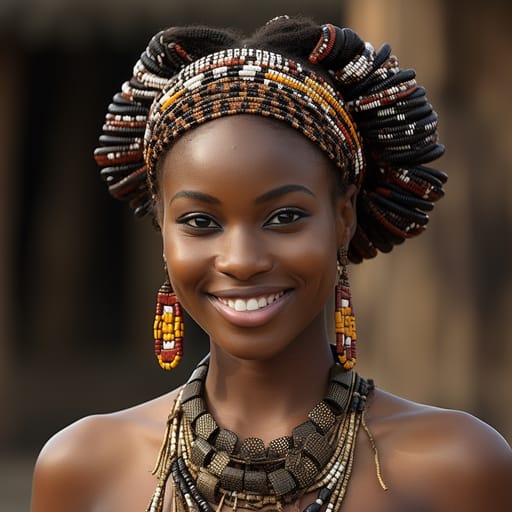
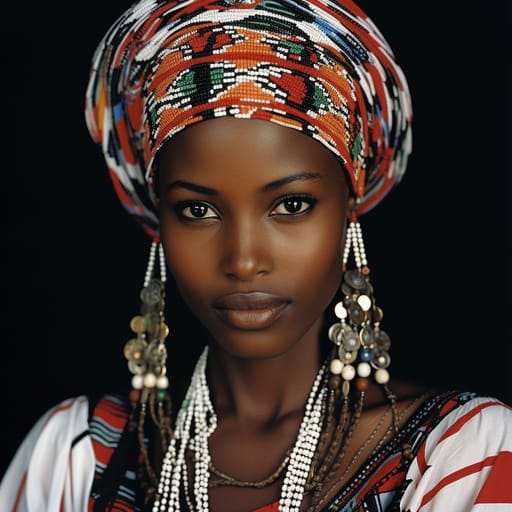
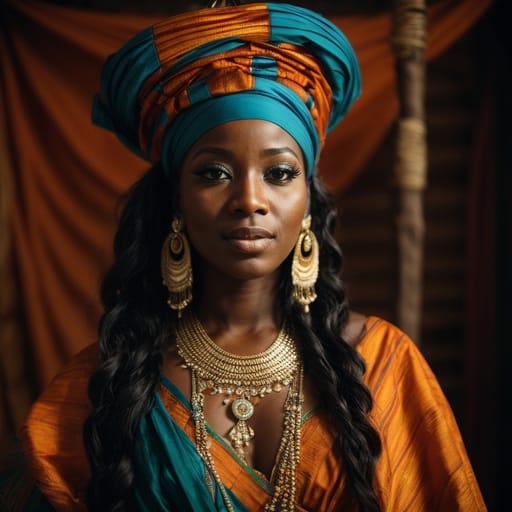
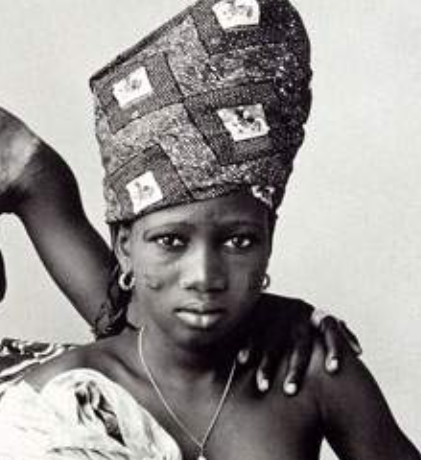
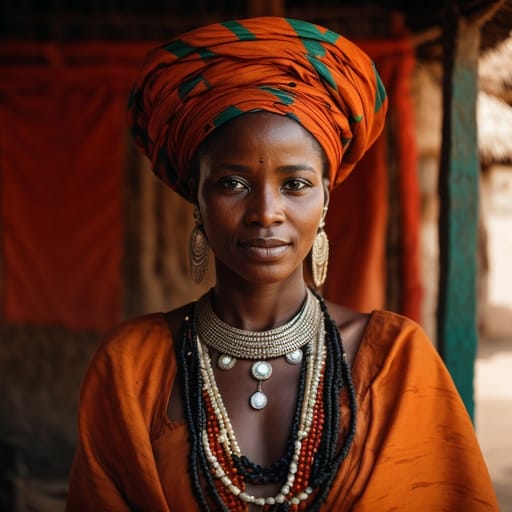
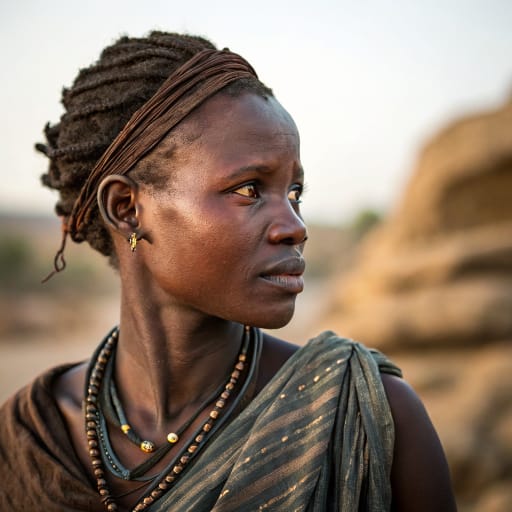
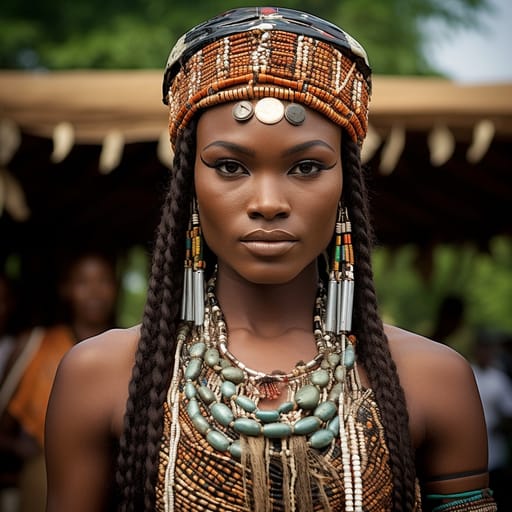
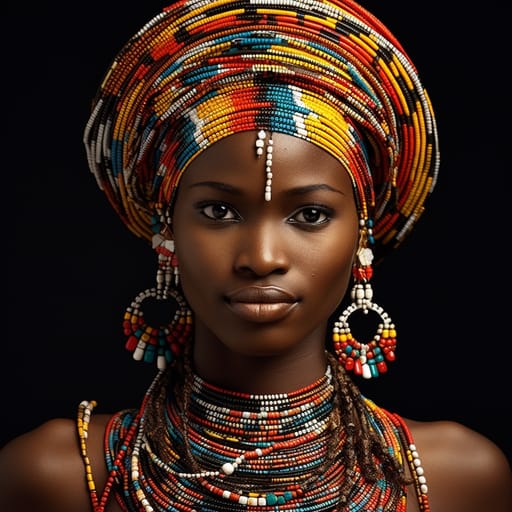
Typical Mambila Phenotypes
Reference for AI generation: hair, eyes, skin, facial structure, build
The Mambila are a small highland population of the Mambilla Plateau, straddling the Nigeria–Cameroon border at elevations above 1,500 metres, and their phenotype carries the imprint of long isolation in cool, high-altitude grassland. Skin tone sits in a relatively narrow band — Fitzpatrick V to VI, deep brown to near-black, usually with warm reddish-brown rather than blue-black undertones, distinct from the cooler, darker tones common in lowland Cameroonian groups to the south. Plateau sun exposure is intense but tempered by cloud cover, and skin tends to read as matte and even-toned rather than highly burnished.
Hair is uniformly Type 4 — tightly coiled, dense, with the springy "zz" pattern typical of the Cameroonian Grassfields cluster; colour stays in true black through life, greying late. Eyes are dark brown to near-black, set under a moderately heavy supraorbital ridge, with no epicanthic fold and a wide interocular distance that gives the face an open, frontal cast.
Facial structure is the group's most distinctive feature. Mambila faces tend toward a short, broad cranial proportion with prominent zygomatic arches, full rounded cheeks, and a relatively flat midface — the nose is short with a low bridge and a notably wide alar base, often described in regional ethnographies as "platyrrhine." Lips are full top and bottom, with a well-defined philtrum; the jaw is square but soft, the chin compact. Foreheads are broad and slightly receding.
Build is compact and powerfully proportioned rather than tall — adult men typically run 165–172 cm, women 155–162 cm, with short limbs relative to torso, dense musculature, and broad shoulders shaped by generations of mountain farming. The Somyev sub-group, historically the blacksmith caste living among the Mambila, are phenotypically near-identical — slightly leaner on average, but otherwise indistinguishable in skin, hair, and facial morphology, reflecting centuries of intermarriage and shared plateau environment.
Mambila Body & Anatomy Reference
West African Niger-Congo phenotype: anatomy reference for AI nude generation
Mambila Boobs & Breasts
Bust reference for Mambila women: medium-to-large cup, full, projecting, which is typical of West African Niger-Congo ancestry. Areolas measure about 35-50mm across, with deep-brown to near-black pigmentation. Body type (mesomorph with strong gluteal-femoral fat distribution) shapes the bust as well, so Mambila tits are usually fuller and more projecting than the East African norm. In AI imagery, keep the forward-set shape rather than drifting toward the smaller conical Cushitic East African profile.
Mambila Ass & Hips
The Mambila ass is typically wide-set, full, heavily projected glutes, which sets it apart from the slim narrow-hip Cushitic East African profile. Underneath, the pelvis shows wide iliac crests, broad gynoid pelvic pattern, high glute-to-waist ratio, part of the West African Niger-Congo skeletal pattern. For Mambila butt pics and AI renders, match that silhouette and the overall build (mesomorph with strong gluteal-femoral fat distribution).
Mambila Vagina & Pussy
Mambila pussy and vulvar anatomy presents deep-brown to near-black labial pigmentation, fuller labia minora, consistent with the West African Niger-Congo phenotype's pigmentation pattern. Mambila pubic hair is typically tightly-coiled coarse texture, densely distributed, in the inverted-triangle pattern. For anatomically accurate Mambila pussy renders the labial coloration should match the surrounding medium-brown to deep-brown skin tone with a continuous gradient, and the hair should keep its tightly-coiled coarse texture.
Mambila Dicks & Penis
Mambila dicks follow the West African Niger-Congo reference data: regional mean ~14-15cm erect; above-average girth, ~13cm circumference; deep-brown-to-near-black shaft pigmentation. Shaft color should track the medium-brown to deep-brown skin tone with a smooth change toward the glans, and Mambila pubic hair keeps its tightly-coiled coarse texture.
Mambila Body, Curves & Build
Mambila body type and overall build presents as mesomorph with strong gluteal-femoral fat distribution, with mean adult female BMI 24-27: the characteristic West African Niger-Congo habitus. Mambila curves and proportions should keep the regional skeletal frame (height, shoulder-to-hip ratio, limb proportions) rather than a generic mesomorph default.
Mambila Skin Tone & Hair Texture
Mambila skin sits in the medium-brown to deep-brown (Fitzpatrick V-VI) band. Hair is typically tight 4A-4C coil, often worn natural, braided, or relaxed, in keeping with the West African Niger-Congo phenotype. In nude renders the skin should stay one even tone from face to body, and body, pubic and head hair should match.
Data depth
0/100Coverage of image-grounded phenotype observations · drives AI generation diversity
- Sample size
- 0/40· 0 images
- Image quality
- 0/30· 0% high
- Confidence
- 0/20
- Source diversity
- 0/10
- ·No image observations yet
Explore phenotype categories
Structured taxonomy with peer-reviewed scales · 22 anatomical categories
Erotic Poses & Sex Positions
From the pose catalog: 219 named positions with reference skeletons
Frequently asked questions about Mambila people
Where is the Mambila homeland?
The Mambila homeland is Mambilla Plateau (Nigeria, Cameroon) in Western Africa.
What language do Mambila people speak?
Mambila people primarily speak Niger-Congo / Mambila.
What religion do Mambila people practice?
The predominant religion among Mambila people is Traditional African religions.






Make your own Mambila images
Five a day, free, no credits to buy. The studio starts from this group's phenotype data, so you can set body type, pose and style and keep the traits accurate.
Start with Mambila