Help us get this right
Does this portrait look right for Lobedu?
Nobody has judged this one yet. You would be the first.
Lobedu Erotic
Bolobedu, around Modjadjiskloof and Kgapane in Mopani District, Limpopo Province, South Africa
Khilobedu, often classed as a dialect of Northern Sotho (Niger-Congo, Bantu, Sotho-Tswana)
Christianity, alongside ancestor veneration and the rain rites of the Modjadji queenship
Sotho-Tswana peoples, closely linked to the Northern Sotho; oral tradition traces the royal line to Shona-speaking ancestors in Zimbabwe
About Lobedu People
The Lobedu, who call themselves Balobedu, are known across southern Africa as the people of the Rain Queen. For about two centuries their rulers have been women holding the title Modjadji. The queen is known as the keeper of the rain medicines, and that reputation reaches well beyond Bolobedu, the hilly country the Lobedu call home in the northeast of Limpopo Province, around Modjadjiskloof and Kgapane. In the past, neighboring chiefdoms sent gifts to ask for rain, and colonial writers turned the queen into a legend. H. Rider Haggard is often said to have had her in mind when he wrote She.
Oral tradition traces the royal house north to a Shona-speaking kingdom in present-day Zimbabwe. A princess is said to have fled south from there, carrying the rain charms with her. Kings ruled until around 1800. Then the throne passed to Maselekwane, the first Modjadji, and women have held it ever since. The queen rules less by display than by alliance. By tradition she lives out of public view, and district heads send her wives. Men chosen by the court father these wives' children, and those children bind each district to the royal village. It is marriage used as a way of running a state. Eileen and J. D. Krige wrote about it in their 1943 study, spelling the name Lovedu, and the system became a standard case in the study of kinship.
Khilobedu, the language, belongs to the Sotho-Tswana group of Bantu languages. It is usually classed as a dialect of Northern Sotho, though its speakers treat it as a language of their own. Under apartheid, Bolobedu was placed inside the Lebowa homeland and run as Northern Sotho territory. Tsonga communities live close by to the east, and Venda communities to the north. Most Balobedu today are Christian, but honoring the ancestors and the queen's rain rites still matter in community life.
The queens have long guarded the Modjadji cycads, a dense stand of Encephalartos transvenosus on the slopes near the royal village that is now a nature reserve. The line of succession has been unsettled since Modjadji V died in 2001 and her granddaughter, Modjadji VI, died in 2005. That left a young heir and a regency, and it has tested how a dynasty built on female rule handles a gap on the throne.
Related ethnic groups
Groups that share Lobedu's homeland, region, language, or religious tradition. These are likely candidates for comparative phenotype reference.
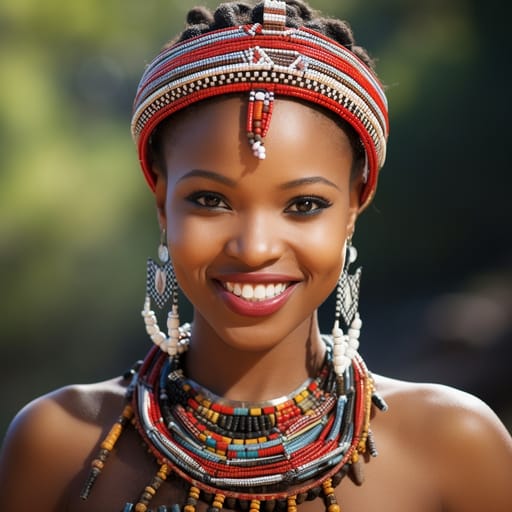
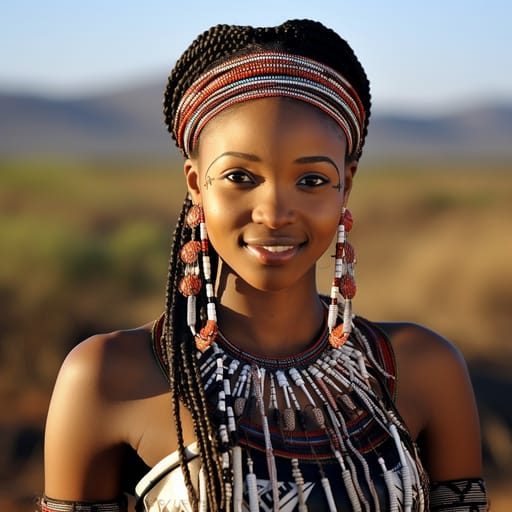
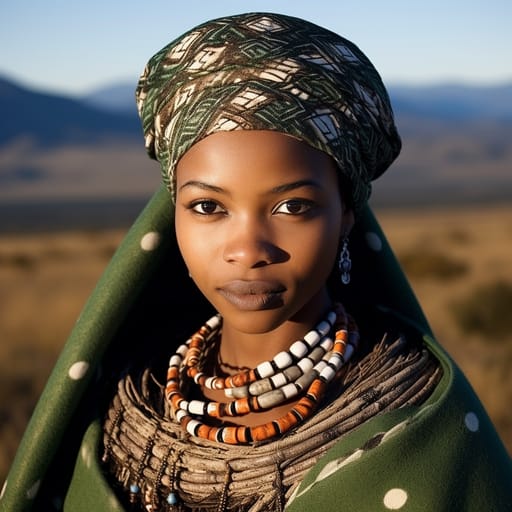
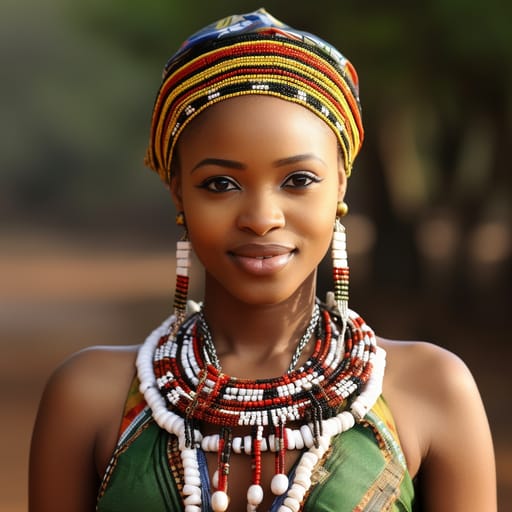
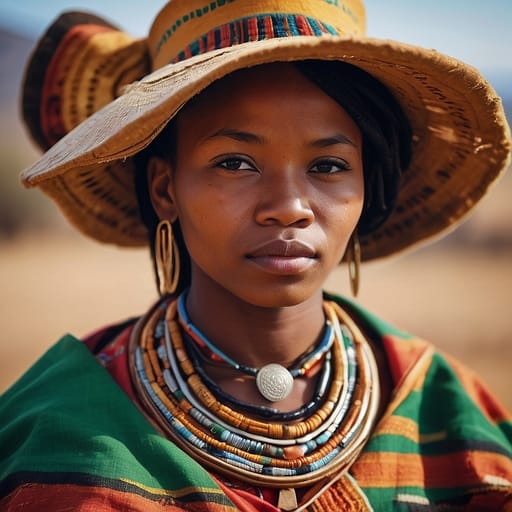
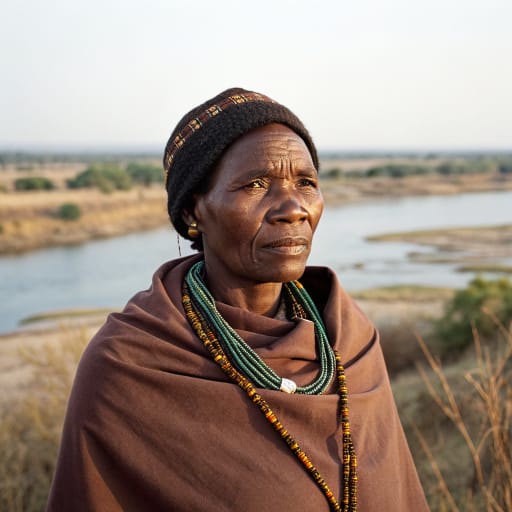
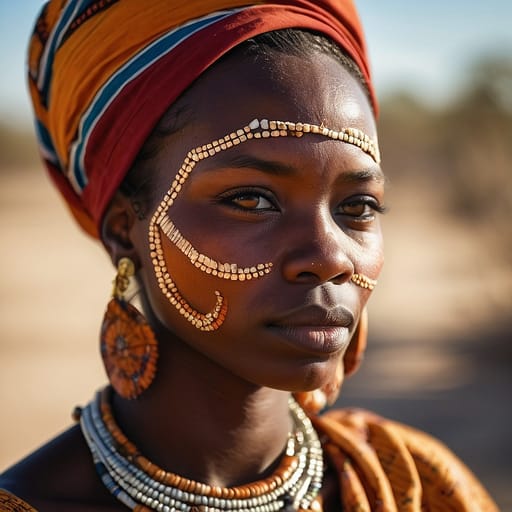
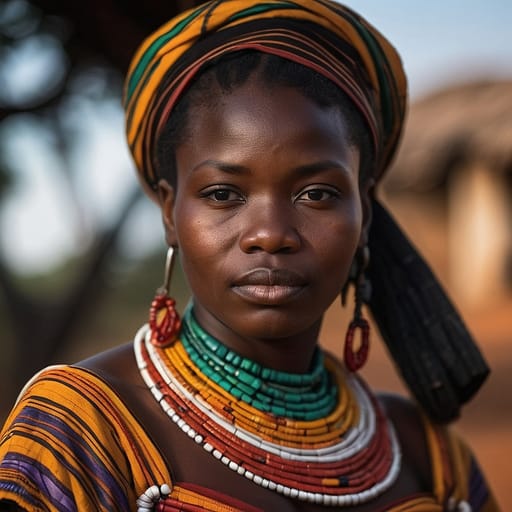
Typical Lobedu Phenotypes
Reference for AI generation: hair, eyes, skin, facial structure, build
Lobedu Body & Anatomy Reference
Per-feature anatomical profile for AI nude generation: Bantu / Khoisan Southern African phenotype
Lobedu Boobs & Breasts
The typical Lobedu bust is medium cup, full but moderate projection, in line with the wider Bantu / Khoisan Southern African pattern. Areolas usually fall in the 30-44mm range, with medium-brown to deep-brown areolar pigmentation. Compared with the heavier West African bust, Lobedu breasts sit forward and are generally moderately full; less projecting than West African norm. A faithful AI render of Lobedu tits keeps that shape and areola size.
Lobedu Ass & Hips
Butt shape among Lobedu women: the distinctive Khoisan-influenced steatopygic profile in some sub-populations (San, Khoekhoe); broader gluteal projection in Bantu-speaking groups, over wide iliac crests with notable lordosis in Khoisan-descended sub-populations. This follows Bantu / Khoisan Southern African ancestry and looks quite unlike the slim Cushitic East African profile. An accurate Lobedu ass in adult AI imagery keeps both the silhouette and the overall build (mesomorph; Khoisan-descended sub-populations show distinctive steatopygic fat deposition) instead of a generic average.
Lobedu Vagina & Pussy
Vulvar anatomy among Lobedu women: deep-brown labial pigmentation; the elongated labia minora documented in some Khoisan-descended populations. Pubic hair tends to be tightly-coiled coarse texture, in the usual inverted-triangle pattern. Both follow Bantu / Khoisan Southern African pigmentation, which is why Lobedu pussy renders should not fall back on a pale, sparse Western template.
Lobedu Dicks & Penis
The Lobedu cock profile, from Bantu / Khoisan Southern African anthropometric data: regional mean ~14cm erect; moderate-to-above-average girth; deep-brown shaft pigmentation. Pubic hair has a tightly-coiled coarse texture and forms the usual inverted-V pattern. Whether Lobedu men are circumcised follows religious and cultural practice rather than phenotype.
Lobedu Body, Curves & Build
Build and curves among Lobedu women follow the Bantu / Khoisan Southern African pattern: mesomorph; Khoisan-descended sub-populations show distinctive steatopygic fat deposition, mean adult female BMI 24-28. Proportions matter as much as skin tone, so Lobedu figures should keep their regional height and limb ratios.
Lobedu Skin Tone & Hair Texture
The Lobedu skin range is medium-brown to deep-brown (Fitzpatrick V-VI); lighter in Khoisan-descended populations, and hair tends to be tightly-coiled 4A-4C; the distinctive 'peppercorn' tight-spiral texture in Khoisan-descended populations. That combination marks the Bantu / Khoisan Southern African phenotype, and skin tone is the trait AI generators most often get wrong for Lobedu women.
Explore phenotype categories
Structured taxonomy with peer-reviewed scales · 22 anatomical categories
Erotic Poses & Sex Positions
From the pose catalog: 219 named positions with reference skeletons
Frequently asked questions about Lobedu people
Where is the Lobedu homeland?
The Lobedu homeland is Bolobedu, around Modjadjiskloof and Kgapane in Mopani District, Limpopo Province, South Africa in Southern Africa.
What language do Lobedu people speak?
Lobedu people primarily speak Khilobedu, often classed as a dialect of Northern Sotho (Niger-Congo, Bantu, Sotho-Tswana).
What religion do Lobedu people practice?
The predominant religion among Lobedu people is Christianity, alongside ancestor veneration and the rain rites of the Modjadji queenship.






Make your own Lobedu images
Five a day, free, no credits to buy. The studio starts from this group's phenotype data, so you can set body type, pose and style and keep the traits accurate.
Start with Lobedu