Help us get this right
Does this portrait look right for Lekwungen?
One tap. It takes a second and it is recorded.
0 say it looks right, 1 says it looks off.
Lekwungen Erotic
Southern Vancouver Island around present-day Victoria and Esquimalt, including nearby islands such as Discovery and Chatham, British Columbia, Canada
Lekwungen dialect of North Straits Salish (Salishan); English
Christianity alongside Coast Salish ceremonial practice, including winter spirit dancing
Coast Salish, Straits Salish branch; today the Songhees Nation and Esquimalt Nation, historically family groups such as the Chekonein, Chilcowitch, Swengwhung and Kosampson
About Lekwungen People
The Lekwungen are the Coast Salish people whose land became the city of Victoria. Their territory covers the southern tip of Vancouver Island, from the Inner Harbour and the Gorge waterway east to Cadboro Bay and west to Esquimalt Harbour, along with the small islands offshore. Today two First Nations, the Songhees and the Esquimalt, carry the Lekwungen name. Both come from the same group of extended families, and the capital of British Columbia sits squarely on their ground. A walk along the harbor passes markers shaped like Coast Salish spindle whorls, a public reminder of whose place this was first.
Their language, also called Lekwungen, is a dialect of North Straits Salish. It is close kin to SENĆOŦEN, spoken by the W̱SÁNEĆ on the Saanich Peninsula next door, and to the speech of the Lummi and Samish across the water in Washington. Hul'q'umi'num' to the north is a separate Salish language, and the Nuu-chah-nulth languages of the island's west coast belong to another family entirely. Few fluent speakers of Lekwungen remain, and the dialect is the focus of revival work.
For generations, Lekwungen families spent the winter in cedar plank houses and spread out through the warmer months to fish, dig clams, hunt and gather. The Garry oak meadows that residents now treat as wild parkland, Beacon Hill Park among them, were managed landscapes: camas beds that families weeded, harvested and burned from time to time to keep them open. On the water, Straits Salish fishers caught sockeye with reef nets strung between canoes anchored over shallow ground, a method found only in this corner of the coast.
In 1843 the Hudson's Bay Company built Fort Victoria in the middle of all this. In 1850 James Douglas signed treaties with the Lekwungen family groups, among the few historic treaties ever made in British Columbia. The documents promised the right to hunt and fish "as formerly," wording people still argue over. The Songhees village stood across the Inner Harbour from the growing town until 1911, when the reserve was sold and the community moved to new land at Esquimalt.
Ceremonial life came through the colonial era. Coast Salish winter spirit dancing is still part of community life, and so are naming, weaving and canoe traditions. One smaller custom survives in a place name: Songhees Point is called Pallatsis, the place of the cradle. Families once left a child's cradle there when the child began to walk, as a wish for a long life.
Related ethnic groups
Groups that share Lekwungen's homeland, region, language, or religious tradition. These are likely candidates for comparative phenotype reference.
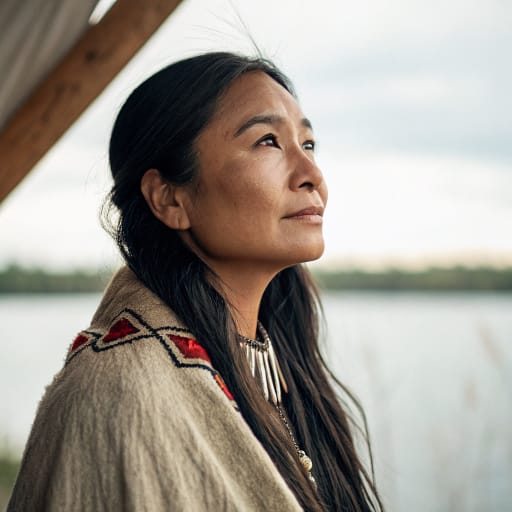
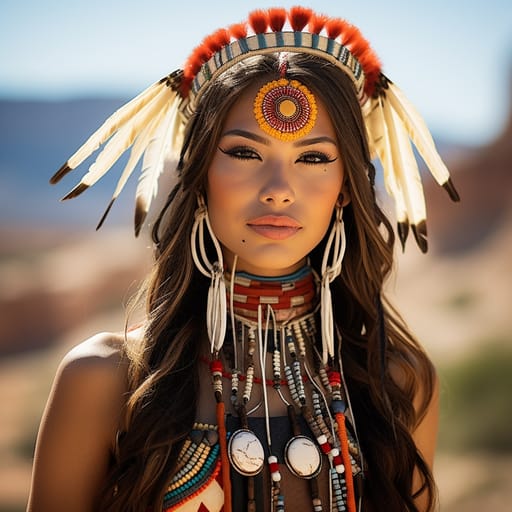
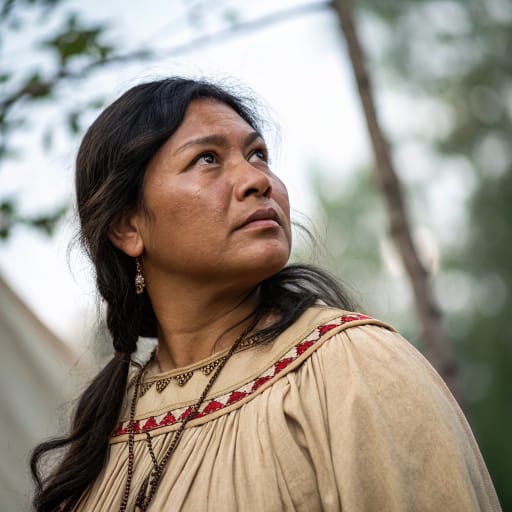
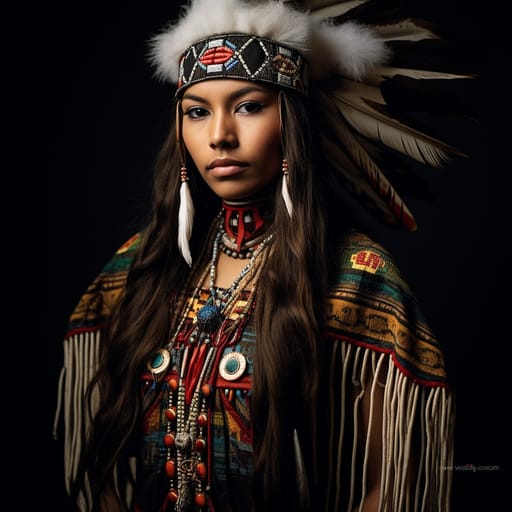
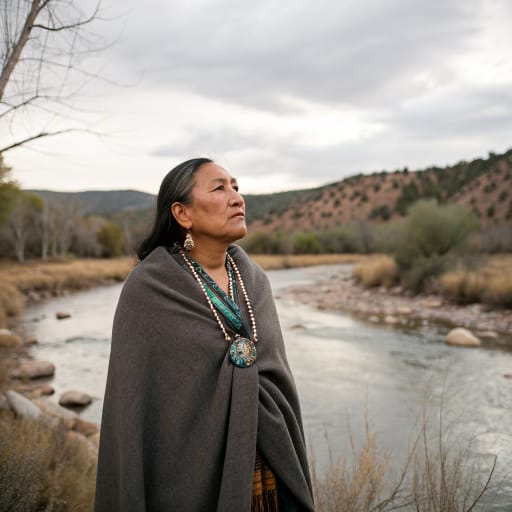
Typical Lekwungen Phenotypes
Reference for AI generation: hair, eyes, skin, facial structure, build
Lekwungen Body & Anatomy Reference
Anatomy by feature, Indigenous Northern American / Algonquian-Iroquoian phenotype
Lekwungen Boobs & Breasts
Lekwungen tits and boobs run medium cup, moderate projection, the classic Indigenous Northern American / Algonquian-Iroquoian bust profile. Lekwungen nipples and areolas show medium-brown areolar pigmentation against the copper-to-medium-brown skin tone, with areolar diameter typically in the 30-44mm range and forward-set positioning rather than the smaller East Asian bust. Lekwungen breasts trend full and moderate projection, a function of the mesomorph, broader frame in northern Indigenous populations body habitus and the mean adult female BMI 25-28. For anatomically accurate AI-generated Lekwungen nudes the render preserves the medium cup, moderate projection shape, 30-44mm areolas with medium-brown pigmentation, and the torso proportions of the Indigenous Northern American / Algonquian-Iroquoian phenotype.
Lekwungen Ass & Hips
Lekwungen hips and butt usually read as medium, moderate-to-full projection. The skeletal base is medium iliac crests, the Indigenous Northern American / Algonquian-Iroquoian pattern. Set against the slim East Asian narrow-hip profile, the difference is easy to see, and the hip-to-waist ratio is often what identifies Lekwungen women in photos.
Lekwungen Vagina & Pussy
Expect medium-brown labial pigmentation on Lekwungen women, in keeping with Indigenous Northern American / Algonquian-Iroquoian ancestry. The pubic hair is straight medium-coarse texture. Coloring should run evenly from the copper to medium-brown skin of the thighs to the labia, and Lekwungen nude imagery should keep the hair's straight medium-coarse texture.
Lekwungen Dicks & Penis
Lekwungen dick and penile anatomy in adult AI generation should anchor on the regional reference data: regional mean ~13cm erect, moderate girth, and medium-brown shaft pigmentation. The Lekwungen cock profile reflects the Indigenous Northern American / Algonquian-Iroquoian population's anthropometric measurements. The shaft pigmentation should track the surrounding copper to medium-brown skin tone, and the pubic hair should keep its straight medium-coarse texture in the typical inverted-V escutcheon.
Lekwungen Body, Curves & Build
Lekwungen body type: mesomorph, broader frame in northern Indigenous populations, with mean adult female BMI 25-28. This is the typical Indigenous Northern American / Algonquian-Iroquoian build. Height range, shoulder-to-hip ratio and fat distribution all follow from it, which is what an accurate Lekwungen nude body should show.
Lekwungen Skin Tone & Hair Texture
Lekwungen skin tone falls in the copper to medium-brown (Fitzpatrick III-V) band, the surface signal most often miscalibrated by generic AI nude generators. Lekwungen hair texture is typically straight 1A, dark-brown to black, often thick and dense, characteristic of the Indigenous Northern American / Algonquian-Iroquoian phenotype. In Lekwungen nude renders the skin should hold that band consistently across the body.
Explore phenotype categories
Structured taxonomy with peer-reviewed scales · 22 anatomical categories
Erotic Poses & Sex Positions
From the pose catalog: 219 named positions with reference skeletons
Frequently asked questions about Lekwungen people
Where is the Lekwungen homeland?
The Lekwungen homeland is Southern Vancouver Island around present-day Victoria and Esquimalt, including nearby islands such as Discovery and Chatham, British Columbia, Canada in North America.
What language do Lekwungen people speak?
Lekwungen people primarily speak Lekwungen dialect of North Straits Salish (Salishan); English.
What religion do Lekwungen people practice?
The predominant religion among Lekwungen people is Christianity alongside Coast Salish ceremonial practice, including winter spirit dancing.






Make your own Lekwungen images
Five a day, free, no credits to buy. The studio starts from this group's phenotype data, so you can set body type, pose and style and keep the traits accurate.
Start with Lekwungen