Help us get this right
Does this portrait look right for Lakota?
One tap. It takes a second and it is recorded.
1 says it looks right, 0 say it looks off.
Lakota Erotic
Northern Great Plains, United States: reservations in South and North Dakota (Pine Ridge, Rosebud, Cheyenne River, Standing Rock, Lower Brule); Wood Mountain, Saskatchewan, Canada; historically also Nebraska, Wyoming and Montana
Lakota, or Lakȟótiyapi (Siouan), closely related to Dakota; English is now the first language for most
Traditional Lakota spirituality (sacred pipe, sweat lodge, vision quest, Sun Dance) alongside Catholic and Episcopal Christianity; some follow the Native American Church
Teton division of the Očhéthi Šakówiŋ (Seven Council Fires, or Sioux); seven bands: Oglala, Sicangu (Brulé), Hunkpapa, Miniconjou, Sihasapa (Blackfoot Sioux), Itazipco (Sans Arc), Oohenunpa (Two Kettles)
About Lakota People
Lakota is the people's own name, usually glossed as friends or allies. Sioux is the outsiders' label, passed from Ojibwe through French, and it still appears in the official names of tribal governments such as the Oglala Sioux Tribe. Within the alliance known as the Seven Council Fires, the Lakota are the Teton, the westernmost division, and they are themselves seven bands: Oglala, Sicangu, Hunkpapa, Miniconjou, Sihasapa, Itazipco and Oohenunpa. Below the band sits the tiyóšpaye, the extended family group that still anchors kinship obligations for many families. They were not always a people of the open grass. In the 1600s they lived farther east, around the upper Mississippi, and moved west through the 1700s as horses and bison made the Plains worth holding. By the end of that century they had reached the Black Hills, Paha Sapa, which became the center of their sacred geography. The nineteenth century turned on a handful of events. Red Cloud's War forced the United States to abandon its forts on the Bozeman Trail, and the 1868 Fort Laramie Treaty confirmed the Hills as Lakota land. Gold undid that within a decade. Lakota, Cheyenne and Arapaho fighters wiped out Custer's battalion at the Little Bighorn in 1876, Congress seized the Hills the next year, and in 1890 the Army killed hundreds of Lakota, many of them women and children, at Wounded Knee. In 1980 the Supreme Court ruled that the Hills had been taken without just compensation and ordered payment. The Lakota nations have refused the money, now past a billion dollars in a federal account, on the grounds that accepting it would mean selling the Hills.
The largest communities today are on or near Pine Ridge, Rosebud, Cheyenne River and Standing Rock, and spiritual life there follows more than one path. The sacred pipe brought by White Buffalo Calf Woman, the inípi sweat lodge, the vision quest and the Sun Dance, driven underground by federal bans in the 1880s, stand alongside Catholic and Episcopal churches. Black Elk, the Oglala holy man, spent decades as a Catholic catechist. Prayers close with mitákuye oyás'iŋ, all my relatives. Lakȟótiyapi is a Siouan language close enough to Dakota that many linguists treat the two as dialects of one tongue. Most fluent speakers are elders, and immersion classrooms are racing that clock. Two customs outsiders rarely notice: winter counts, pictographic calendars that name each year for one memorable event, and the star quilt, which replaced the buffalo robe as the gift that marks an honoring, a graduation or a death.
Related ethnic groups
Groups that share Lakota's homeland, region, language, or religious tradition. These are likely candidates for comparative phenotype reference.
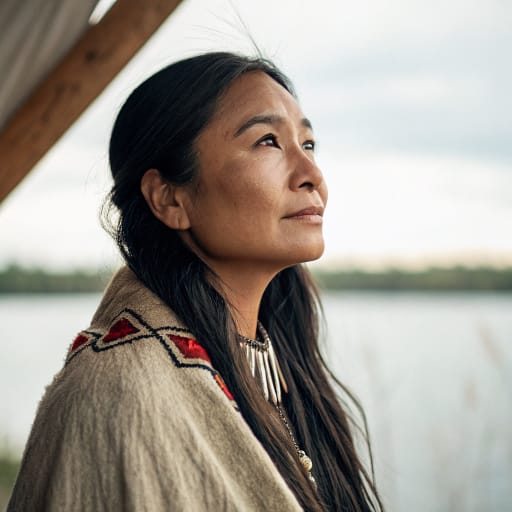
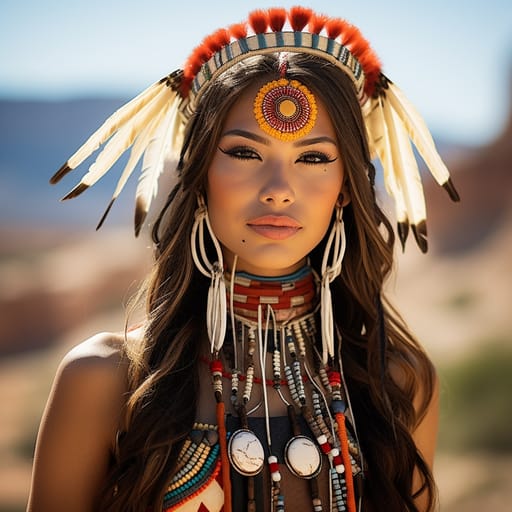
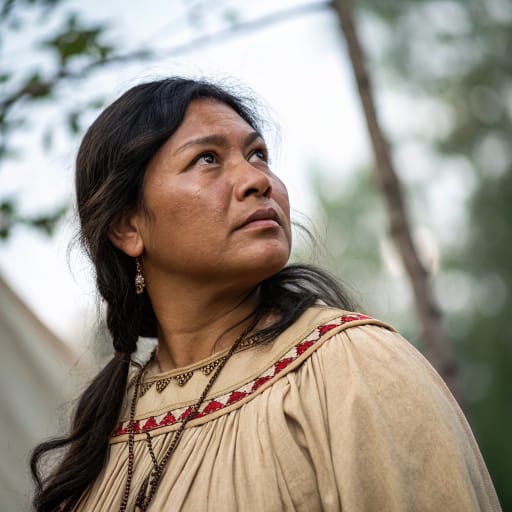
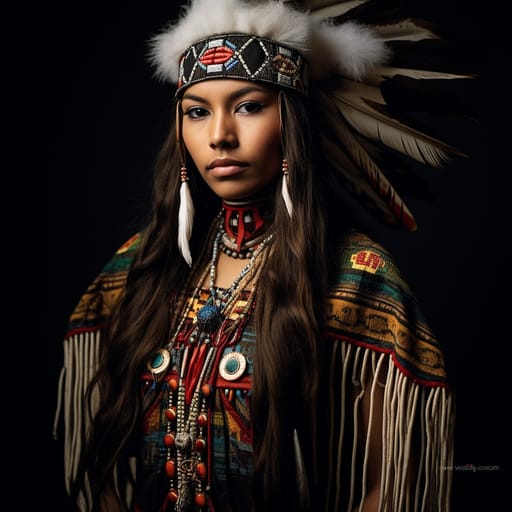
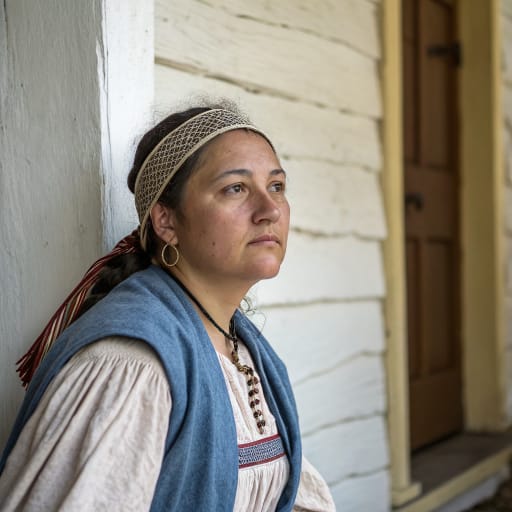
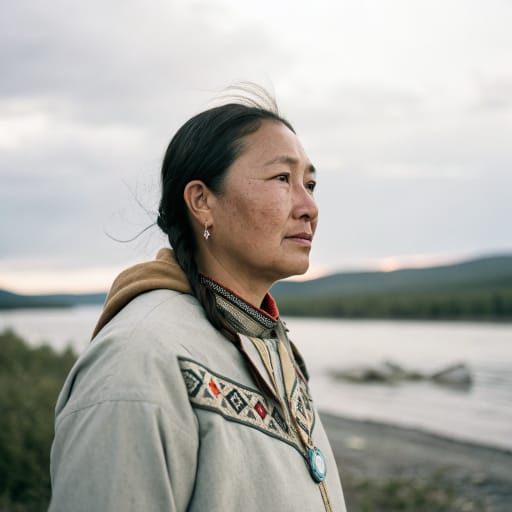
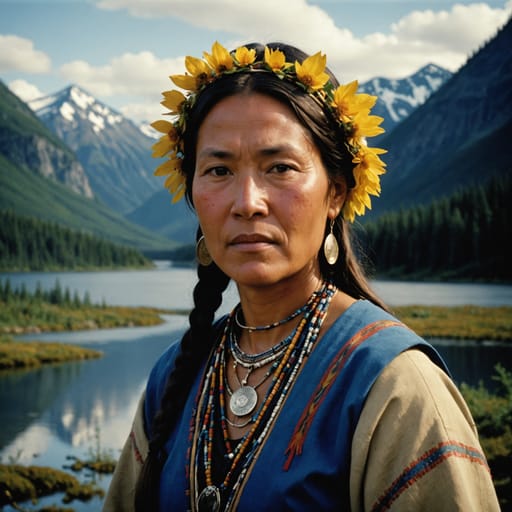
Typical Lakota Phenotypes
Reference for AI generation: hair, eyes, skin, facial structure, build
Lakota Body & Anatomy Reference
Indigenous Northern American / Algonquian-Iroquoian phenotype: anatomy reference for AI nude generation
Lakota Boobs & Breasts
Lakota tits and boobs run medium cup, moderate projection, the classic Indigenous Northern American / Algonquian-Iroquoian bust profile. Lakota nipples and areolas show medium-brown areolar pigmentation against the copper-to-medium-brown skin tone, with areolar diameter typically in the 30-44mm range and forward-set positioning rather than the smaller East Asian bust. Lakota breasts trend full and moderate projection, a function of the mesomorph, broader frame in northern Indigenous populations body habitus and the mean adult female BMI 25-28. For anatomically accurate AI-generated Lakota nudes the render preserves the medium cup, moderate projection shape, 30-44mm areolas with medium-brown pigmentation, and the torso proportions of the Indigenous Northern American / Algonquian-Iroquoian phenotype.
Lakota Ass & Hips
Lakota hips and butt usually read as medium, moderate-to-full projection. The skeletal base is medium iliac crests, the Indigenous Northern American / Algonquian-Iroquoian pattern. Set against the slim East Asian narrow-hip profile, the difference is easy to see, and the hip-to-waist ratio is often what identifies Lakota women in photos.
Lakota Vagina & Pussy
Expect medium-brown labial pigmentation on Lakota women, in keeping with Indigenous Northern American / Algonquian-Iroquoian ancestry. The pubic hair is straight medium-coarse texture. Coloring should run evenly from the copper to medium-brown skin of the thighs to the labia, and Lakota nude imagery should keep the hair's straight medium-coarse texture.
Lakota Dicks & Penis
Lakota dick and penile anatomy in adult AI generation should anchor on the regional reference data: regional mean ~13cm erect, moderate girth, and medium-brown shaft pigmentation. The Lakota cock profile reflects the Indigenous Northern American / Algonquian-Iroquoian population's anthropometric measurements. The shaft pigmentation should track the surrounding copper to medium-brown skin tone, and the pubic hair should keep its straight medium-coarse texture in the typical inverted-V escutcheon.
Lakota Body, Curves & Build
Lakota body type: mesomorph, broader frame in northern Indigenous populations, with mean adult female BMI 25-28. This is the typical Indigenous Northern American / Algonquian-Iroquoian build. Height range, shoulder-to-hip ratio and fat distribution all follow from it, which is what an accurate Lakota nude body should show.
Lakota Skin Tone & Hair Texture
Lakota skin tone falls in the copper to medium-brown (Fitzpatrick III-V) band, the surface signal most often miscalibrated by generic AI nude generators. Lakota hair texture is typically straight 1A, dark-brown to black, often thick and dense, characteristic of the Indigenous Northern American / Algonquian-Iroquoian phenotype. In Lakota nude renders the skin should hold that band consistently across the body.
Explore phenotype categories
Structured taxonomy with peer-reviewed scales · 22 anatomical categories
Erotic Poses & Sex Positions
From the pose catalog: 219 named positions with reference skeletons
Frequently asked questions about Lakota people
Where is the Lakota homeland?
The Lakota homeland is Northern Great Plains, United States: reservations in South and North Dakota (Pine Ridge, Rosebud, Cheyenne River, Standing Rock, Lower Brule); Wood Mountain, Saskatchewan, Canada; historically also Nebraska, Wyoming and Montana in North America.
What language do Lakota people speak?
Lakota people primarily speak Lakota, or Lakȟótiyapi (Siouan), closely related to Dakota; English is now the first language for most.
What religion do Lakota people practice?
The predominant religion among Lakota people is Traditional Lakota spirituality (sacred pipe, sweat lodge, vision quest, Sun Dance) alongside Catholic and Episcopal Christianity; some follow the Native American Church.






Make your own Lakota images
Five a day, free, no credits to buy. The studio starts from this group's phenotype data, so you can set body type, pose and style and keep the traits accurate.
Start with Lakota