Help us get this right
Does this portrait look right for Kwakwaka'wakw?
One tap. It takes a second and it is recorded.
1 says it looks right, 0 say it looks off.
Kwakwaka'wakw Erotic
Northern Vancouver Island and adjacent mainland, British Columbia, Canada
Kwak'wala (Wakashan)
Traditional beliefs and ceremonial complex; Christianity
Formerly called Kwakiutl; many constituent nations
About Kwakwaka'wakw People
Kwakwaka'wakw, meaning "those who speak Kwak'wala," are an Indigenous people of the Pacific Northwest Coast whose homeland spans northern Vancouver Island and the adjacent mainland inlets and islands of British Columbia, Canada. Once widely called the Kwakiutl, they comprise many constituent nations and speak Kwak'wala, a Wakashan language now undergoing revitalization. They number several thousand.
Society and subsistence
Life centered on the sea and the cedar forest: salmon, halibut, herring and its roe, shellfish, sea mammals, and abundant berries and roots supported dense villages of large cedar-plank houses. Society was organized into ranked descent groups called na'mima, whose chiefs held named seats, crests, songs, and prerogatives. The potlatch was the central institution of Kwakwaka'wakw society, a feast at which a host validated inherited rights by naming, dancing, and giving away great quantities of goods. When Canada banned the potlatch, the Kwakwaka'wakw were prominent in resisting the law and preserving the ceremony until its repeal, and their potlatch tradition remains vigorous.
Appearance and adornment
Kwakwaka'wakw ceremonial art is among the most dramatic on the coast. The winter Tseka, including the Hamatsa or Cannibal Dance, features towering carved and painted cedar masks, among them articulated transformation masks that open to reveal a second face, and giant hooked-beak bird masks such as Hokhokw and Crooked Beak of Heaven. Dancers wear thick red-dyed cedar-bark neck and head rings, button blankets, and Chilkat robes, and may blacken their faces with charcoal. Down feathers drift from headdresses during dances. Totem poles, house posts, and painted screens carry bold formline crests. Everyday dress is modern, with regalia reserved for the bighouse and the potlatch. Masks and coppers confiscated by the government during the potlatch ban were later returned and are now cared for at community-run institutions such as the U'mista Cultural Centre in Alert Bay, a focus of pride and cultural renewal.
Related ethnic groups
Groups that share Kwakwaka'wakw's homeland, region, language, or religious tradition. These are likely candidates for comparative phenotype reference.
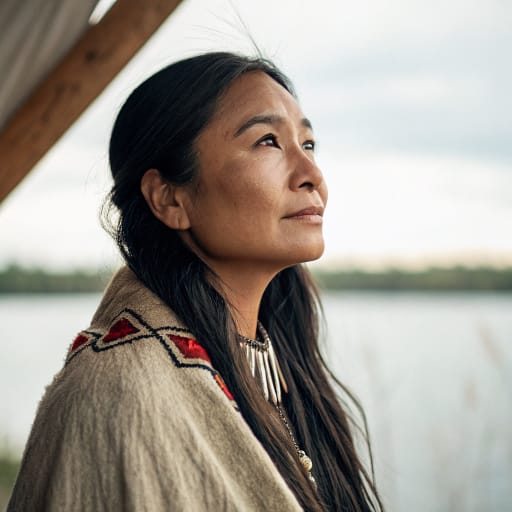
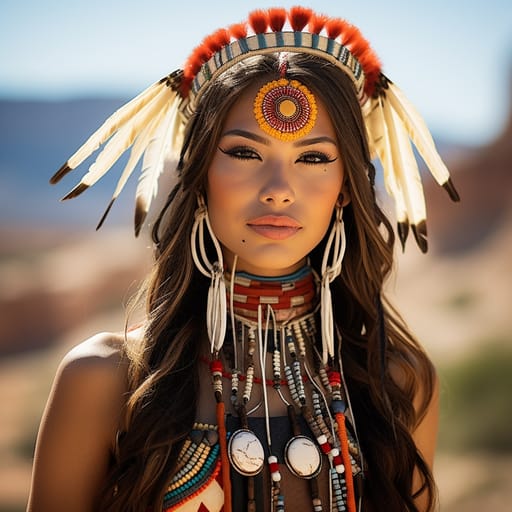
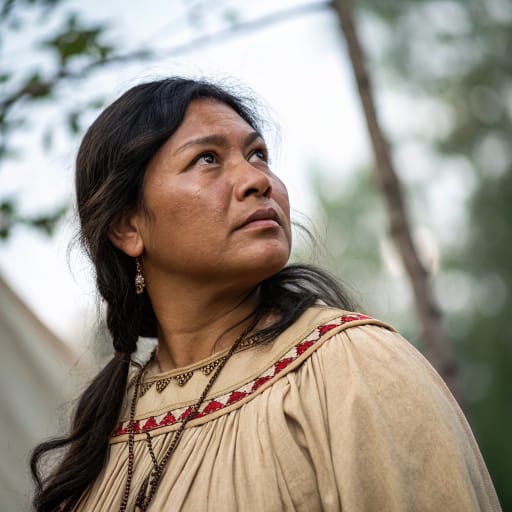
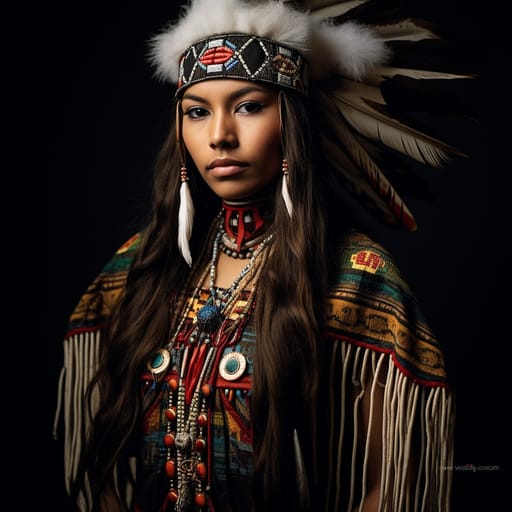
Typical Kwakwaka'wakw Phenotypes
Reference for AI generation: hair, eyes, skin, facial structure, build
Kwakwaka'wakw Body & Anatomy Reference
Per-feature anatomical profile for AI nude generation: Indigenous Northern American / Algonquian-Iroquoian phenotype
Kwakwaka'wakw Boobs & Breasts
The typical Kwakwaka'wakw bust is medium cup, moderate projection, in line with the wider Indigenous Northern American / Algonquian-Iroquoian pattern. Areolas usually fall in the 30-44mm range, with medium-brown areolar pigmentation against the copper-to-medium-brown skin tone. Compared with the smaller East Asian bust, Kwakwaka'wakw breasts sit forward and are generally full and moderate projection. A faithful AI render of Kwakwaka'wakw tits keeps that shape and areola size.
Kwakwaka'wakw Ass & Hips
Butt shape among Kwakwaka'wakw women: medium, moderate-to-full projection, over medium iliac crests. This follows Indigenous Northern American / Algonquian-Iroquoian ancestry and looks quite unlike the slim East Asian narrow-hip profile. An accurate Kwakwaka'wakw ass in adult AI imagery keeps both the silhouette and the overall build (mesomorph, broader frame in northern Indigenous populations) instead of a generic average.
Kwakwaka'wakw Vagina & Pussy
Vulvar anatomy among Kwakwaka'wakw women: medium-brown labial pigmentation. Pubic hair tends to be straight medium-coarse texture, in the usual inverted-triangle pattern. Both follow Indigenous Northern American / Algonquian-Iroquoian pigmentation, which is why Kwakwaka'wakw pussy renders should not fall back on a pale, sparse Western template.
Kwakwaka'wakw Dicks & Penis
The Kwakwaka'wakw cock profile, from Indigenous Northern American / Algonquian-Iroquoian anthropometric data: regional mean ~13cm erect; moderate girth; medium-brown shaft pigmentation. Pubic hair has a straight medium-coarse texture and forms the usual inverted-V pattern. Whether Kwakwaka'wakw men are circumcised follows religious and cultural practice rather than phenotype.
Kwakwaka'wakw Body, Curves & Build
Build and curves among Kwakwaka'wakw women follow the Indigenous Northern American / Algonquian-Iroquoian pattern: mesomorph, broader frame in northern Indigenous populations, mean adult female BMI 25-28. Proportions matter as much as skin tone, so Kwakwaka'wakw figures should keep their regional height and limb ratios.
Kwakwaka'wakw Skin Tone & Hair Texture
The Kwakwaka'wakw skin range is copper to medium-brown (Fitzpatrick III-V), and hair tends to be straight 1A, dark-brown to black, often thick and dense. That combination marks the Indigenous Northern American / Algonquian-Iroquoian phenotype, and skin tone is the trait AI generators most often get wrong for Kwakwaka'wakw women.
Explore phenotype categories
Structured taxonomy with peer-reviewed scales · 22 anatomical categories
Notable Kwakwaka'wakw People
18 reference figures, sourced from Wikipedia
- Alfred Scow, 1927-2013), first Aboriginal person to graduate from a BC law school, the fir…
- Sonny Assu, b. 1975), interdisciplinary artist
- Joe Peters Jr., artist, woodcarver
- Beau Dick, artist, woodcarver
- Gord Hill, artist, author and Indigenous rights activist
- Calvin Hunt, b. 1956), artist
- Henry Hunt, 1923-1985), artist
- Richard Hunt, b. 1951), artist
- Tony Hunt Sr., 1942-2017), artist
- Charles Joseph, carver from Maʼamtaglia-Tlowitsis tribe
- Mungo Martin, woodcarver
- David Neel, artist, writer
- Ellen Neel, woodcarver
- Marianne Nicolson, b. 1969), artist, academic
- Spencer O'Brien, b. 1988), snowboarder
- Quesalid, medicine man, writer
- Willie Seaweed, woodcarver
- Jody Wilson-Raybould, politician
Erotic Poses & Sex Positions
From the pose catalog: 219 named positions with reference skeletons
Frequently asked questions about Kwakwaka'wakw people
Where is the Kwakwaka'wakw homeland?
The Kwakwaka'wakw homeland is Northern Vancouver Island and adjacent mainland, British Columbia, Canada in North America.
What language do Kwakwaka'wakw people speak?
Kwakwaka'wakw people primarily speak Kwak'wala (Wakashan).
What religion do Kwakwaka'wakw people practice?
The predominant religion among Kwakwaka'wakw people is Traditional beliefs and ceremonial complex; Christianity.






Make your own Kwakwaka'wakw images
Five a day, free, no credits to buy. The studio starts from this group's phenotype data, so you can set body type, pose and style and keep the traits accurate.
Start with Kwakwaka'wakw