Help us get this right
Does this portrait look right for Kutenai?
Nobody has judged this one yet. You would be the first.
Kutenai Erotic
The Kootenay and upper Columbia river valleys of southeastern British Columbia, northern Idaho, and northwestern Montana.
Ktunaxa, also spelled Kutenai (a language isolate, with no demonstrated relatives); English is dominant today and Ktunaxa is severely endangered.
Roman Catholicism, layered over continuing Ktunaxa ceremonial practice and place-based belief.
Upper and Lower Ktunaxa. Modern communities include the Ktunaxa Nation bands in British Columbia (ʔaq'am, ʔakisq'nuk, Yaqan Nuʔkiy, Tobacco Plains), the Kootenai Tribe of Idaho at Bonners Ferry, and the Ksanka band of the Confederated Salish and Kootenai
About Kutenai People
Nearly every people in the inland Northwest can point to linguistic cousins somewhere. The Ktunaxa cannot. Their language is an isolate: unrelated to Salishan, to Algonquian, to anything anyone has managed to demonstrate, and after a century of attempts to attach it to a family the attempts have quietly stopped. Neighbors on every side, relatives nowhere.
The homeland follows the Kootenay River, which does something odd. It rises in the Rocky Mountain Trench in British Columbia, runs south into Montana and Idaho, then hooks back north into Canada and empties into Kootenay Lake. At Canal Flats it passes within about a mile of the Columbia and declines to join it. Ktunaxa territory covers that whole loop, some 70,000 square kilometers of mountain valley, cut in half by an international border drawn across it in 1846.
There are two broad divisions. The Upper Ktunaxa, upriver in the Trench and on the Tobacco Plains, took horses early and crossed the Rockies each year for bison, which kept them in long-running conflict with the Blackfoot. The Lower Ktunaxa, around Kootenay Lake and the Creston flats, worked water: waterfowl, fish, and the sturgeon-nosed canoe, a bark boat whose ends taper to a point below the waterline instead of rising into a prow. That hull appears in one other place on earth, along the Amur in Siberia, and nobody has explained it.
The nineteenth century arrived as Jesuit missions and then as surveyors. Most Ktunaxa are Catholic now, layered over older practice rather than replacing it. Qat'muk, in the Purcell Mountains, is the home of the Grizzly Bear Spirit; the fight to keep a ski resort out of it reached the Supreme Court of Canada in 2017 and was lost there, before the area was protected anyway. The residential school at St. Eugene, near Cranbrook, is today a resort and casino the Ktunaxa own and operate, on the stated reasoning that since the culture was taken from them inside that building, it should be given back in the same place. In Idaho, the Kootenai Tribe, left with no reservation at all, declared war on the United States in 1974 under chairwoman Amy Trice and collected a dime toll from cars on Highway 95 until Congress paid attention. They got land.
Related ethnic groups
Groups that share Kutenai's homeland, region, language, or religious tradition. These are likely candidates for comparative phenotype reference.
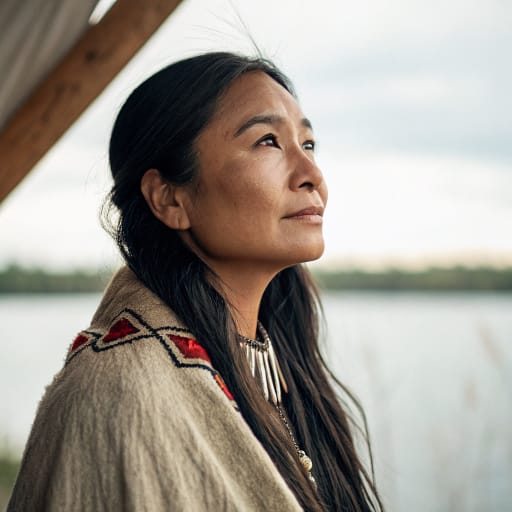
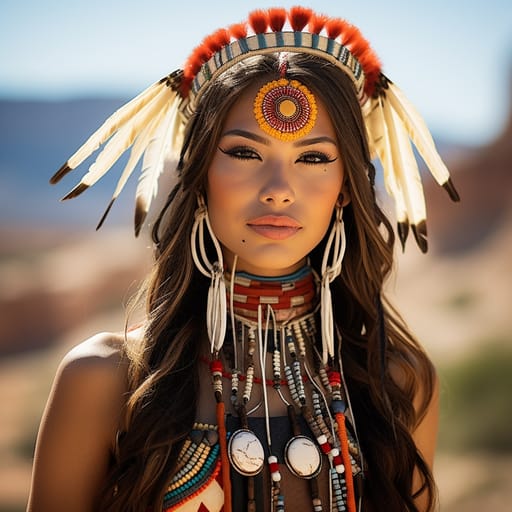
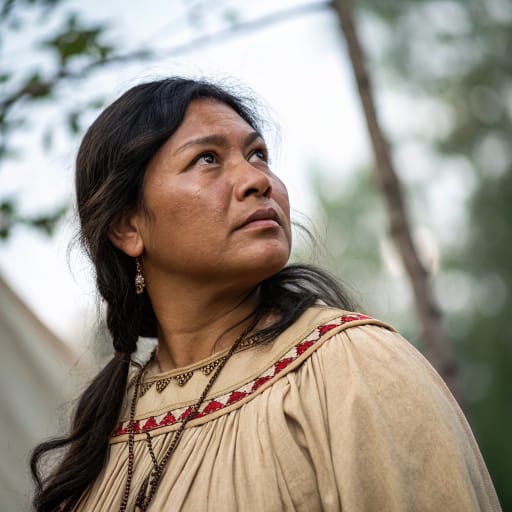
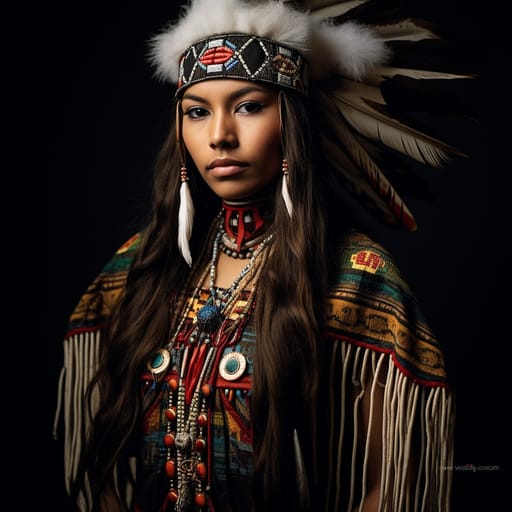
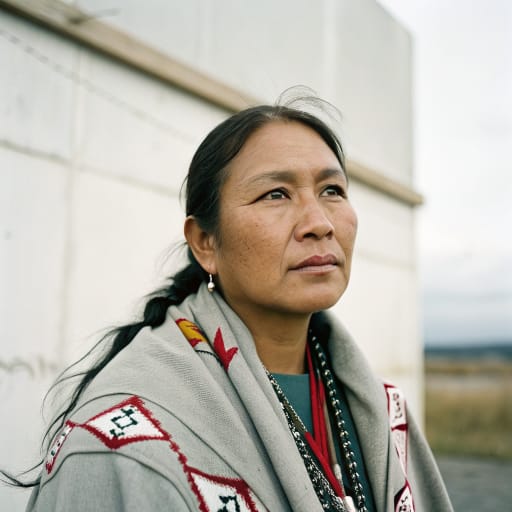
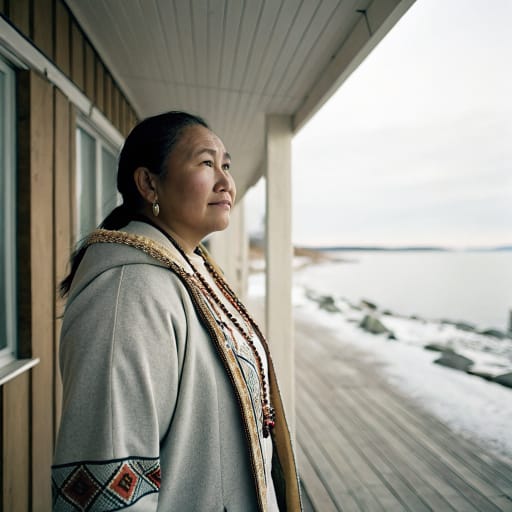
Typical Kutenai Phenotypes
Reference for AI generation: hair, eyes, skin, facial structure, build
Kutenai Body & Anatomy Reference
Anatomy by feature, Indigenous Northern American / Algonquian-Iroquoian phenotype
Kutenai Boobs & Breasts
The typical Kutenai bust is medium cup, moderate projection, in line with the wider Indigenous Northern American / Algonquian-Iroquoian pattern. Areolas usually fall in the 30-44mm range, with medium-brown areolar pigmentation against the copper-to-medium-brown skin tone. Compared with the smaller East Asian bust, Kutenai breasts sit forward and are generally full and moderate projection. A faithful AI render of Kutenai tits keeps that shape and areola size.
Kutenai Ass & Hips
Butt shape among Kutenai women: medium, moderate-to-full projection, over medium iliac crests. This follows Indigenous Northern American / Algonquian-Iroquoian ancestry and looks quite unlike the slim East Asian narrow-hip profile. An accurate Kutenai ass in adult AI imagery keeps both the silhouette and the overall build (mesomorph, broader frame in northern Indigenous populations) instead of a generic average.
Kutenai Vagina & Pussy
Vulvar anatomy among Kutenai women: medium-brown labial pigmentation. Pubic hair tends to be straight medium-coarse texture, in the usual inverted-triangle pattern. Both follow Indigenous Northern American / Algonquian-Iroquoian pigmentation, which is why Kutenai pussy renders should not fall back on a pale, sparse Western template.
Kutenai Dicks & Penis
The Kutenai cock profile, from Indigenous Northern American / Algonquian-Iroquoian anthropometric data: regional mean ~13cm erect; moderate girth; medium-brown shaft pigmentation. Pubic hair has a straight medium-coarse texture and forms the usual inverted-V pattern. Whether Kutenai men are circumcised follows religious and cultural practice rather than phenotype.
Kutenai Body, Curves & Build
Build and curves among Kutenai women follow the Indigenous Northern American / Algonquian-Iroquoian pattern: mesomorph, broader frame in northern Indigenous populations, mean adult female BMI 25-28. Proportions matter as much as skin tone, so Kutenai figures should keep their regional height and limb ratios.
Kutenai Skin Tone & Hair Texture
The Kutenai skin range is copper to medium-brown (Fitzpatrick III-V), and hair tends to be straight 1A, dark-brown to black, often thick and dense. That combination marks the Indigenous Northern American / Algonquian-Iroquoian phenotype, and skin tone is the trait AI generators most often get wrong for Kutenai women.
Explore phenotype categories
Structured taxonomy with peer-reviewed scales · 22 anatomical categories
Erotic Poses & Sex Positions
From the pose catalog: 219 named positions with reference skeletons
Frequently asked questions about Kutenai people
Where is the Kutenai homeland?
The Kutenai homeland is The Kootenay and upper Columbia river valleys of southeastern British Columbia, northern Idaho, and northwestern Montana. in North America.
What language do Kutenai people speak?
Kutenai people primarily speak Ktunaxa, also spelled Kutenai (a language isolate, with no demonstrated relatives); English is dominant today and Ktunaxa is severely endangered..
What religion do Kutenai people practice?
The predominant religion among Kutenai people is Roman Catholicism, layered over continuing Ktunaxa ceremonial practice and place-based belief..






Make your own Kutenai images
Five a day, free, no credits to buy. The studio starts from this group's phenotype data, so you can set body type, pose and style and keep the traits accurate.
Start with Kutenai