Help us get this right
Does this portrait look right for Krahn?
Nobody has judged this one yet. You would be the first.
Krahn Erotic
Grand Gedeh County and neighboring southeastern Liberia, and the Cavally and Guémon regions of western Ivory Coast.
Krahn, in Western and Eastern varieties, also called Wè (Kru branch of Niger-Congo)
Mostly Christian, with indigenous Wè practice and masking societies still active alongside it.
One of the Kru peoples. Krahn in Liberia plus the Guéré and Wobé of Ivory Coast are together called Wè; local Liberian groupings include Konobo, Tchien and Gbarzon.
About Krahn People
The Krahn live in the forest country straddling the Liberia and Ivory Coast border, with their heart in Liberia's Grand Gedeh County and communities running out into River Gee, Sinoe and Nimba, then across the Cavalla River into the Ivorian west. Krahn is an outsider's name. On the Ivorian side the same people are usually called Guéré or Wè, and Wè is the word they use for themselves, often glossed as men who forgive easily. Their speech belongs to the Kru branch of Niger-Congo, split into Western and Eastern Krahn, close kin to Sapo, Grebo and Bassa, and audibly not the Mande spoken by their Dan neighbors to the north. Politically they were never a kingdom. Authority sat with town elders and lineage heads, and the Liberian state only reached them in earnest in the twentieth century.
Farming is upland rice, cassava, plantain and oil palm, cut out of high forest and moved every few years. The best known Krahn and Guéré export, though, is not a crop but a mask. Wè masks are the ones with tubular protruding eyes and a crust of applied material: fur, cloth, cowries, animal teeth, bells, spent cartridge cases. Collectors call them fierce. In use they were officeholders. A mask arrived to settle a dispute, to call or halt a fight, to police a funeral, to entertain, and what was bolted to its face recorded what it had done. Christianity is now the majority affiliation on both sides of the border, layered over older practice rather than replacing it.
Modern Krahn identity is inseparable from 1980. Samuel Doe, a master sergeant from Grand Gedeh, led the coup that killed William Tolbert and ended 133 years of Americo-Liberian rule, then filled the army and security services with his own. That protection became a target. When Charles Taylor's fighters crossed from Ivory Coast in December 1989, the war turned into a war on categories of person, and Krahn civilians were on the list. Doe was captured and killed in 1990. Towns emptied into camps in Ivory Coast, Guinea and Ghana, and from there into Staten Island, Philadelphia and Minnesota, where Krahn churches and burial societies still function. In the Ivorian west, the Wè carried the cocoa land quarrels and the worst of the 2011 killings at Duékoué. People are farming those hills again, and still arguing about who owns them.
Related ethnic groups
Groups that share Krahn's homeland, region, language, or religious tradition. These are likely candidates for comparative phenotype reference.
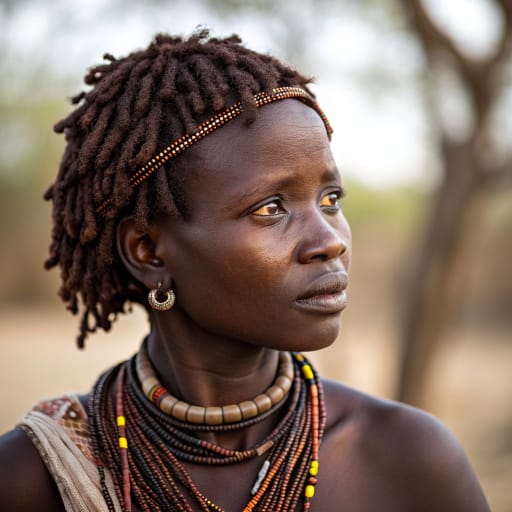
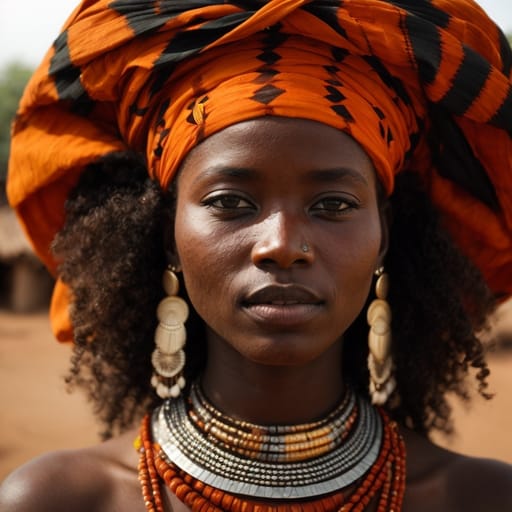
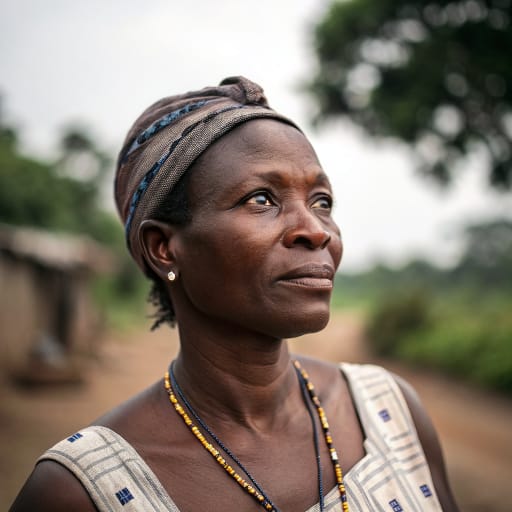
Typical Krahn Phenotypes
Reference for AI generation: hair, eyes, skin, facial structure, build
Krahn Body & Anatomy Reference
Anatomy by feature, West African Niger-Congo phenotype
Krahn Boobs & Breasts
Krahn boobs follow the West African Niger-Congo profile: medium-to-large cup, full, projecting. Areolar diameter is usually 35-50mm, and the coloring is deep-brown to near-black areolar pigmentation against the medium-to-deep-brown skin tone. Breast shape tracks body composition (mesomorph with strong gluteal-femoral fat distribution, mean adult female BMI 24-27), so Krahn breasts tend to be fuller and more projecting than the East African norm. Expect a forward-set shape, not the smaller conical Cushitic East African profile.
Krahn Ass & Hips
Krahn ass and hip morphology presents as wide-set, full, heavily projected glutes, distinctly different from the slim narrow-hip Cushitic East African profile. The Krahn pelvic profile shows wide iliac crests, broad gynoid pelvic pattern, high glute-to-waist ratio, anchored in the West African Niger-Congo skeletal pattern. Krahn butt shots in adult AI imagery should render the wide-set, full, heavily projected glutes silhouette with the overall build (mesomorph with strong gluteal-femoral fat distribution) and the fat distribution typical of the West African Niger-Congo phenotype.
Krahn Vagina & Pussy
Krahn pussy anatomy typically shows deep-brown to near-black labial pigmentation, fuller labia minora. Pubic hair is usually tightly-coiled coarse texture, densely distributed. In AI-generated Krahn nudes, labial color should blend into the medium-brown to deep-brown skin with a gradual transition, and the hair should keep its tightly-coiled coarse texture.
Krahn Dicks & Penis
Penis reference for Krahn men: regional mean ~14-15cm erect, above-average girth, ~13cm circumference. Coloring: deep-brown-to-near-black shaft pigmentation. An accurate Krahn cock in AI imagery matches the surrounding medium-brown to deep-brown skin rather than a generic porn default. Circumcision depends on religion and custom, not ancestry.
Krahn Body, Curves & Build
The Krahn figure is generally mesomorph with strong gluteal-femoral fat distribution, with mean adult female BMI 24-27, characteristic of West African Niger-Congo ancestry. AI image tools tend to flatten regional body types into a few stock shapes; here the Krahn build is kept as its own reference.
Krahn Skin Tone & Hair Texture
Skin: medium-brown to deep-brown (Fitzpatrick V-VI). Hair: tight 4A-4C coil, often worn natural, braided, or relaxed. Both are typical of West African Niger-Congo ancestry. The most common mistake in AI nudes of Krahn women is a body rendered lighter than the face.
Explore phenotype categories
Structured taxonomy with peer-reviewed scales · 22 anatomical categories
Erotic Poses & Sex Positions
From the pose catalog: 219 named positions with reference skeletons
Frequently asked questions about Krahn people
Where is the Krahn homeland?
The Krahn homeland is Grand Gedeh County and neighboring southeastern Liberia, and the Cavally and Guémon regions of western Ivory Coast. in Western Africa.
What language do Krahn people speak?
Krahn people primarily speak Krahn, in Western and Eastern varieties, also called Wè (Kru branch of Niger-Congo).
What religion do Krahn people practice?
The predominant religion among Krahn people is Mostly Christian, with indigenous Wè practice and masking societies still active alongside it..






Make your own Krahn images
Five a day, free, no credits to buy. The studio starts from this group's phenotype data, so you can set body type, pose and style and keep the traits accurate.
Start with Krahn