Help us get this right
Does this portrait look right for Khorasani Turks?
Nobody has judged this one yet. You would be the first.
Khorasani Turks Erotic
Khorasan (Iran)
Islam / Shia Islam
About Khorasani Turks People
The Khorasani Turks are an Oghuz-speaking population settled across the rolling steppe and mountain valleys of northeastern Iran — chiefly in North Khorasan, Razavi Khorasan, and the borderlands brushing up against Turkmenistan. They are the quieter cousins of the better-known Turkic peoples to the north and west: Turkmen across the frontier, Azerbaijanis on the opposite side of the country. Most outsiders never hear the name. Inside Iran, they are simply Tork — and yet their speech, when you listen for it, is its own thing.
Khorasani Turkic sits inside the Oghuz branch of the Turkic family, the same branch that produced Turkish, Azerbaijani, and Turkmen. It shares the bones of all three but belongs cleanly to none. Linguists generally treat it as transitional, with a southern cluster leaning toward Azerbaijani and a northern cluster leaning toward Turkmen, and dialect lines that don't always agree with administrative ones. Centuries of contact with Persian have left their mark on vocabulary and on the rhythm of everyday speech, but the verbal grammar — the agglutinative spine of the language — has held.
Religion is overwhelmingly Twelver Shia Islam, which is what distinguishes Khorasani Turks most sharply from the Sunni Turkmen on the other side of the border. This Shia identity is not incidental: it is the thread that ties them into the wider religious fabric of Iran and that has, for centuries, made Khorasan their home rather than a frontier. Many of the communities trace their settlement to the Safavid period, when Turkic tribal confederations were moved into the region as a buffer against Uzbek raiding from the northeast — a piece of imperial demography whose results are still on the map.
Daily life in the rural districts still carries the older shape: extended households, sheep and goats on the slopes above the village, women weaving carpets and kilims with motifs that anyone familiar with Turkmen weaving will recognize at a glance, though the palette and composition tilt their own way. Music is one of the clearer cultural signatures — the dotar, a long-necked two-stringed lute, and the bardic tradition of the bakhshi, who memorizes hours of sung narrative poetry and performs it at weddings and gatherings. Migration to Mashhad and Tehran has thinned some villages, and Persian increasingly dominates schooling and media, but the language is still being passed down at home, and the bakhshis are still being trained.
Related ethnic groups
Groups that share Khorasani Turks's homeland, region, language, or religious tradition. These are likely candidates for comparative phenotype reference.
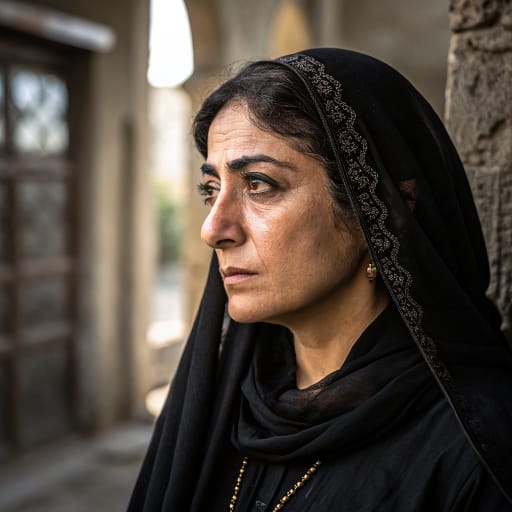
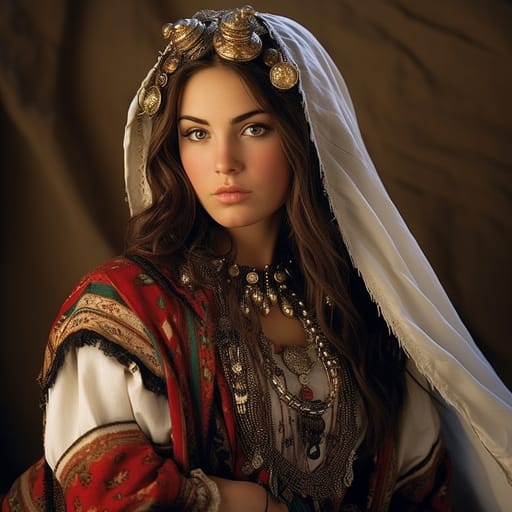
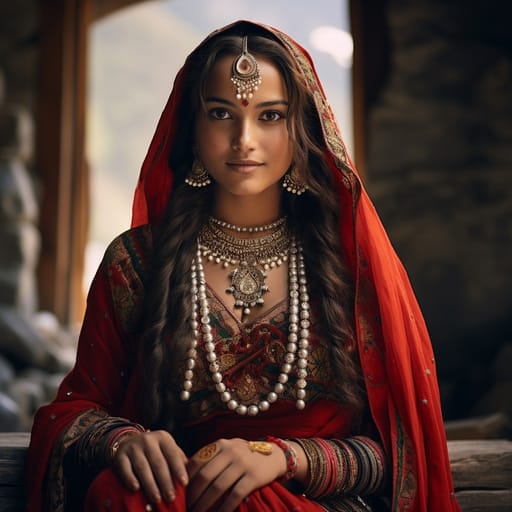
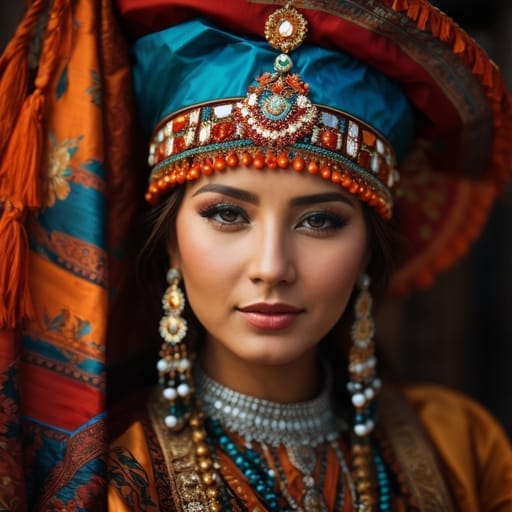
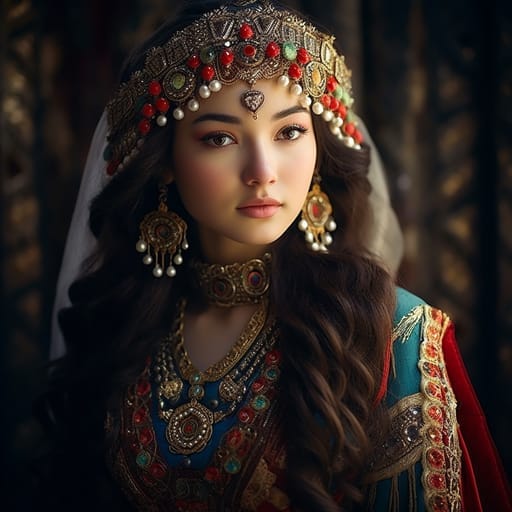
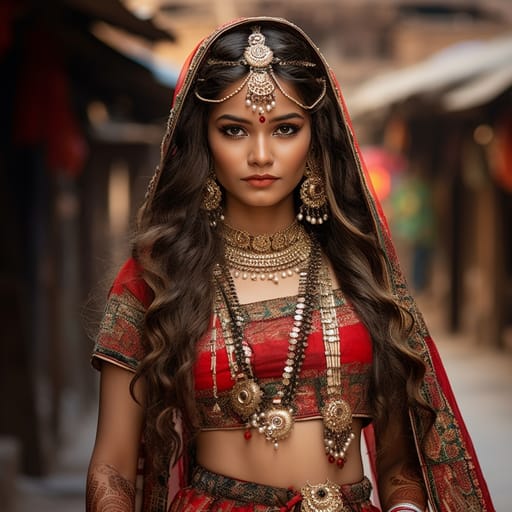
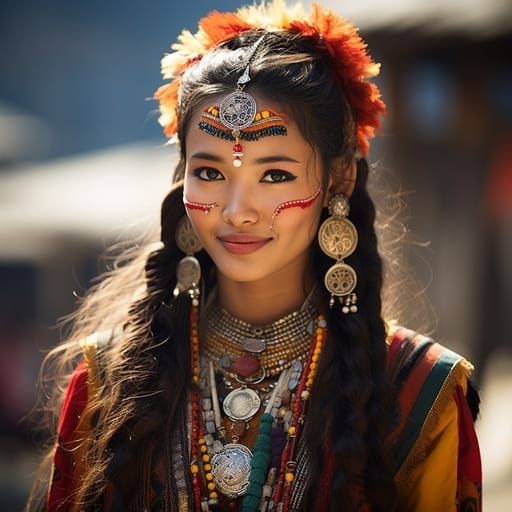
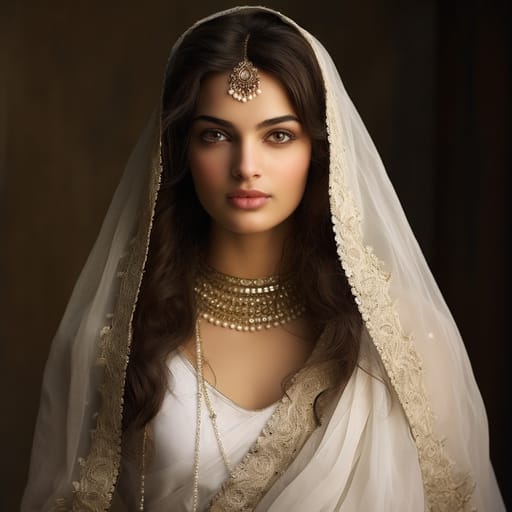
Typical Khorasani Turks Phenotypes
Reference for AI generation: hair, eyes, skin, facial structure, build
Khorasani Turks occupy the seam where Central Asian Turkic populations met the Iranian plateau, and their phenotype reads as exactly that: a Turkic substrate noticeably absorbed into a West Asian frame. Most look unmistakably West Asian to a stranger, with subtle Inner Asian traces — a slightly flatter midface, a softer brow, a mild epicanthic suggestion at the inner corner — surfacing in maybe a quarter of faces rather than dominating the group.
Hair is overwhelmingly dark brown to black, straight to gently wavy, with thick shafts and strong density. True curl is uncommon; the looser S-wave typical of Iranian Khorasan appears more in southern villages near Birjand and Qaen. Facial and body hair on men trends heavy, consistent with the broader Iranian-plateau pattern. Premature greying is widely observed.
Eyes run dark brown to near-black, with hazel turning up in a minority — perhaps one in ten — and pale eyes rare but not absent in the northern Quchan and Bojnurd belt where Turkic admixture is densest. Eye shape is the giveaway: a faint almond cast, occasional single-fold or slight epicanthic carryover, set under fuller-than-average upper lids. Brows are dark, thick, and often near-confluent on men.
Skin sits in Fitzpatrick III–IV, olive with a warm yellow-tan undertone rather than the cooler beige of Anatolian Turks. Sun-exposed villagers along the Kopet Dag foothills weather toward IV; urban Mashhadis read closer to III.
Facial structure carries a straight or gently convex nose with a moderately high bridge and narrow-to-medium alar width — generally less aquiline than Persians proper, less broad than Turkmens. Cheekbones are moderately high and forward-set, more prominent than in Fars Persians. Lips are medium, jawlines square in men and oval in women.
Build is medium — men commonly 170–176 cm, women 158–163 cm — stocky rather than slim, with broad shoulders and shorter limbs relative to torso. The northern subgroups bordering Turkmenistan trend taller and slightly more East-Asian-cast in feature; the southern Khorasani belt reads more uniformly Iranian.
Data depth
3/100Coverage of image-grounded phenotype observations · drives AI generation diversity
- Sample size
- 3/40· 1 image
- Image quality
- 0/30· 0% high
- Confidence
- 0/20· mean 0.30
- Source diversity
- 0/10· wikipedia
- ·No image observations yet
- ·Low overall confidence
- ·Wikipedia-only source, not population-representative
Explore phenotype categories
Structured taxonomy with peer-reviewed scales · 22 anatomical categories
Notable Khorasani Turks People
1 reference figure, sourced from Wikipedia
- Haji Bektash Veli, disputed)
Erotic Poses & Sex Positions
From the pose catalog: 219 named positions with reference skeletons
Frequently asked questions about Khorasani Turks people
Where is the Khorasani Turks homeland?
The Khorasani Turks homeland is Khorasan (Iran) in Southern Asia.
What language do Khorasani Turks people speak?
Khorasani Turks people primarily speak Turkic / Oghuz / Khorasani Turkic.
What religion do Khorasani Turks people practice?
The predominant religion among Khorasani Turks people is Islam / Shia Islam.






Make your own Khorasani Turks images
Five a day, free, no credits to buy. The studio starts from this group's phenotype data, so you can set body type, pose and style and keep the traits accurate.
Start with Khorasani Turks